
电子植入系统

Search documents
影响市场重大事件:重复使用火箭朱雀三号计划今年二季度再次挑战回收
Mei Ri Jing Ji Xin Wen· 2026-02-25 23:12
Group 1: Reusable Rocket Developments - China’s commercial aerospace company, Blue Arrow Aerospace, announced that the reusable rocket Zhuque-3 will conduct recovery tests in Q2 2026, optimizing the landing process for potential reuse [1] - The Zhuque-3 rocket's first stage, if successfully recovered, will be used for subsequent launches, aiming for a reusable flight by Q4 2026 [1] Group 2: Launch Plans and Achievements - China Aerospace Science and Technology Corporation (CASC) revealed that the recoverable liquid rocket, Lijian-2, is set for its maiden flight in late March 2026, carrying the light cargo spacecraft [2] - CASC plans to conduct four launches within the year, with the solid rocket Lijian-1 expected to have at least eight launches, including two at sea [2] Group 3: Hong Kong's Aerospace Initiatives - Hong Kong's Financial Secretary, Paul Chan, stated that the government is reviewing listing regulations to attract more aerospace companies to the region [3] - The government aims to facilitate the integration of mainland aerospace industries with global markets, providing various professional services [3] Group 4: Autonomous Driving Projects - The "Aerospace Corridor" autonomous driving transport system is expected to be operational within the year, marking the first commercial operation of its kind in Hong Kong [4] Group 5: Technological Innovations in Fuel Cells - A research team from Northwestern Polytechnical University and Peking University has developed a novel strategy to address carbon deposition in solid oxide fuel cells, enhancing the conversion of natural gas to electricity [5] Group 6: Advancements in Medical Technology - Researchers from the University of Pennsylvania and Harvard have created an electronic implant system that monitors and influences the development of human pancreatic cells, providing a platform for future diabetes therapies [6] Group 7: Gene Editing in Medical Treatments - A team from the Air Force Medical University successfully performed the first gene-edited pig liver perfusion treatment for a patient with liver failure, demonstrating safety and efficacy [7] Group 8: Semiconductor Manufacturing Improvements - Samsung Electronics has achieved an 80% yield rate for its 1C DRAM, significantly up from 60-70% in Q4 2025, with expectations to reach 90% by May [8] - The yield for Samsung's HBM4 based on 1C DRAM has also improved, nearing 60% compared to 50% in Q4 2025 [8] Group 9: Policy Initiatives in Sichuan - The Sichuan provincial government has expanded its "computing power voucher" program and is exploring new policies to support digital innovation, including funding for digital application laboratories [9] Group 10: AI Model Developments by Alibaba - Alibaba has released three new medium-sized models in the Qwen 3.5 series, outperforming previous flagship models, with costs as low as 0.2 yuan per million tokens [10]
电子植入系统可监测胰岛细胞发育过程为构建功能成熟的人源胰岛提供关键技术平台
Xin Lang Cai Jing· 2026-02-24 23:26
Core Viewpoint - Researchers have developed an electronic implant system that can monitor and influence the maturation process of human islet cells, providing a key technological platform for constructing functionally mature human islets and offering new insights for cell-based diabetes therapies [3][4]. Group 1: Technology Development - The electronic implant system integrates a thin conductive mesh structure into growing pancreatic tissue, allowing for the recording of electrical signals produced by islet cells and the application of precise electrical stimulation to influence their development [3][5]. - This system is described as "bionic" or "cyber-organ," combining electronic systems with living tissues to create a controllable biological system [3]. Group 2: Application in Diabetes Treatment - In Type 1 diabetes, the immune system attacks islet cells, leading to a loss of insulin secretion capability. Laboratory-cultured functional pancreatic tissue is seen as a potential alternative to donor pancreas or islet transplants, which are limited by donor availability and require long-term immunosuppressive therapy [4]. - The research team implanted a stretchable electronic mesh within developing three-dimensional pancreatic organoids, enabling the recording of electrical activity from individual islet cells for up to two months and observing their maturation process [5]. Group 3: Findings and Future Applications - The introduction of a 24-hour electrical activity cycle similar to the human biological clock resulted in islet cells maintaining this rhythmic activity and hormone secretion at appropriate times after several days of rhythmic stimulation [5]. - This technology may have two potential applications: training laboratory-cultured islet cells through electrical stimulation before transplantation, or retaining the electronic mesh post-transplantation for continuous monitoring and stimulation to prevent functional decline under stress or disease [5].

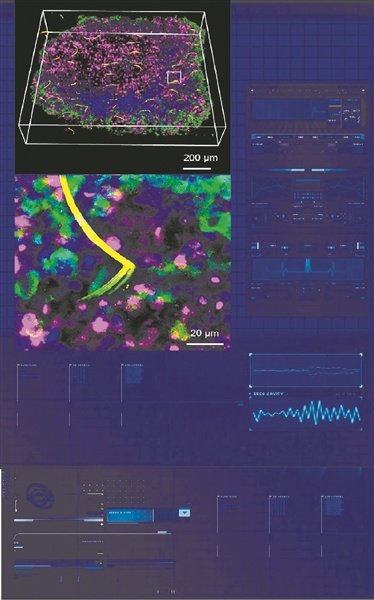
电子植入系统可监测胰岛细胞发育过程
Ke Ji Ri Bao· 2026-02-24 22:56
Core Insights - Researchers from the University of Pennsylvania and Harvard have developed an electronic implant system that can monitor and influence the maturation of human islet cells, providing a key technological platform for creating functional human pancreas and new approaches for cell-based diabetes therapies [1][2]. Group 1: Technology Development - The team embedded a thin conductive mesh structure within lab-grown pancreatic tissue, allowing the electronic device to closely interact with biological tissue. This system can record electrical signals produced by islet cells and apply precise electrical stimulation to influence their development [1][2]. - The implantable device is described as "bionic" or "cyber-organ," combining electronic systems with living tissue to create a controllable biological system [1]. Group 2: Research Findings - The researchers implanted a stretchable electronic mesh within developing three-dimensional pancreatic organoids, which is thinner than a human hair. This structure was placed between cell layers, allowing cells to aggregate and form islets. The device enabled the recording of electrical activity from individual islet cells for up to two months, observing their maturation process [2]. - By introducing a 24-hour electrical activity cycle similar to the human circadian rhythm, the cells were able to maintain this rhythmic activity autonomously after several days of stimulation, leading to improved hormone secretion at appropriate times [2]. Group 3: Future Applications - The technology may have two potential applications: first, to "train" lab-cultured islet cells through electrical stimulation before transplanting them into patients; second, to retain the electronic mesh structure post-transplant for continuous monitoring and moderate stimulation of cells to prevent functional decline under stress or disease [2].