
电子设计自动化(EDA)软件

Search documents
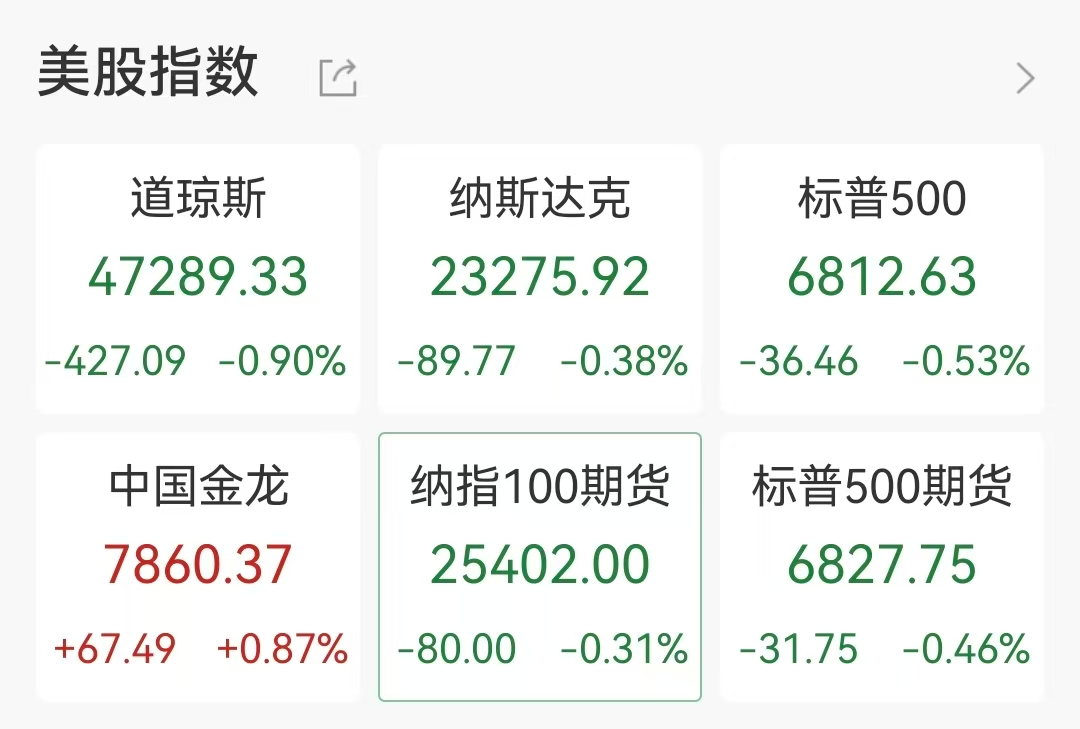
美股三大指数集体收跌,道指跌420点,蔚来跌超5%,阿里网易涨超4%
2 1 Shi Ji Jing Ji Bao Dao· 2025-12-01 23:31
Market Overview - On December 1, U.S. stock indices collectively declined, with the Dow Jones falling by 0.9%, losing over 420 points, the Nasdaq down by 0.38%, and the S&P 500 decreasing by 0.53% [1][2]. Technology Sector - Major tech stocks mostly fell, with Broadcom dropping over 4%, Google and Microsoft down more than 1%, while Nvidia rose by 1.65% and Apple increased by 1.52%, reaching a historical high of $283.42 during the session [2][3]. - The MAG index, which includes major tech giants, showed a slight increase of 0.15% [3]. Cryptocurrency Market - The cryptocurrency sector experienced significant declines, with Bitcoin dropping over 5% to $86,415.3 and Ethereum falling more than 7% to $2,797.79. The total cryptocurrency market cap has evaporated by over $1 trillion since reaching a peak of approximately $4.3 trillion [6][7]. Commodities - In commodities, spot gold rose by 0.28% to $4,232.12, while silver prices reached a new high of $58.8 per ounce, marking a year-to-date increase of over 100% [5]. - Crude oil prices also saw gains, with West Texas Intermediate (WTI) rising by 1.64% to $59.51 per barrel and Brent crude increasing by 1.49% to $63.31 per barrel, driven by geopolitical risks and supply concerns [5][6]. Retail Sector - Walmart's stock increased by nearly 1%, reaching a historical high, as the "Cyber Monday" shopping event commenced, with online sales expected to reach $14.2 billion according to Adobe Analytics [4]. - Shopify faced a decline of 5.9% due to system outages affecting merchants trying to access its platform [4]. Chinese Stocks - Chinese stocks showed strength, with the Nasdaq Golden Dragon China Index rising by 0.87% and the Wind Technology Leaders Index increasing by 1.61%. Notable individual stock movements included a rise of over 5% for Atour and NetEase, while NIO fell by over 5% [4].


大行评级丨里昂:稀土管制为海外半导体公司带来限制 中资企业或受惠
Ge Long Hui· 2025-10-14 02:34
Core Viewpoint - The report from Citi highlights that China's Ministry of Commerce has announced further export controls on a total of 12 rare earth elements and related upstream and downstream products, which is expected to negatively impact overseas semiconductor companies while benefiting domestic Chinese semiconductor firms [1] Group 1: Impact of Export Controls - The export controls on rare earth elements are critical as they are key materials in the semiconductor manufacturing supply chain [1] - The measures are likely to hinder foreign semiconductor companies while promoting localization efforts within China [1] Group 2: Beneficiaries of the Situation - Companies that may benefit from the ongoing US-China competition include SMIC, Hua Hong Semiconductor, JCET, Northern Huachuang, Zhongwei Company, and Zhaoyi Innovation, along with various analog chip manufacturers and EDA companies [1] - The necessity for domestic alternatives is expected to increase, particularly benefiting Chinese EDA firms [1]
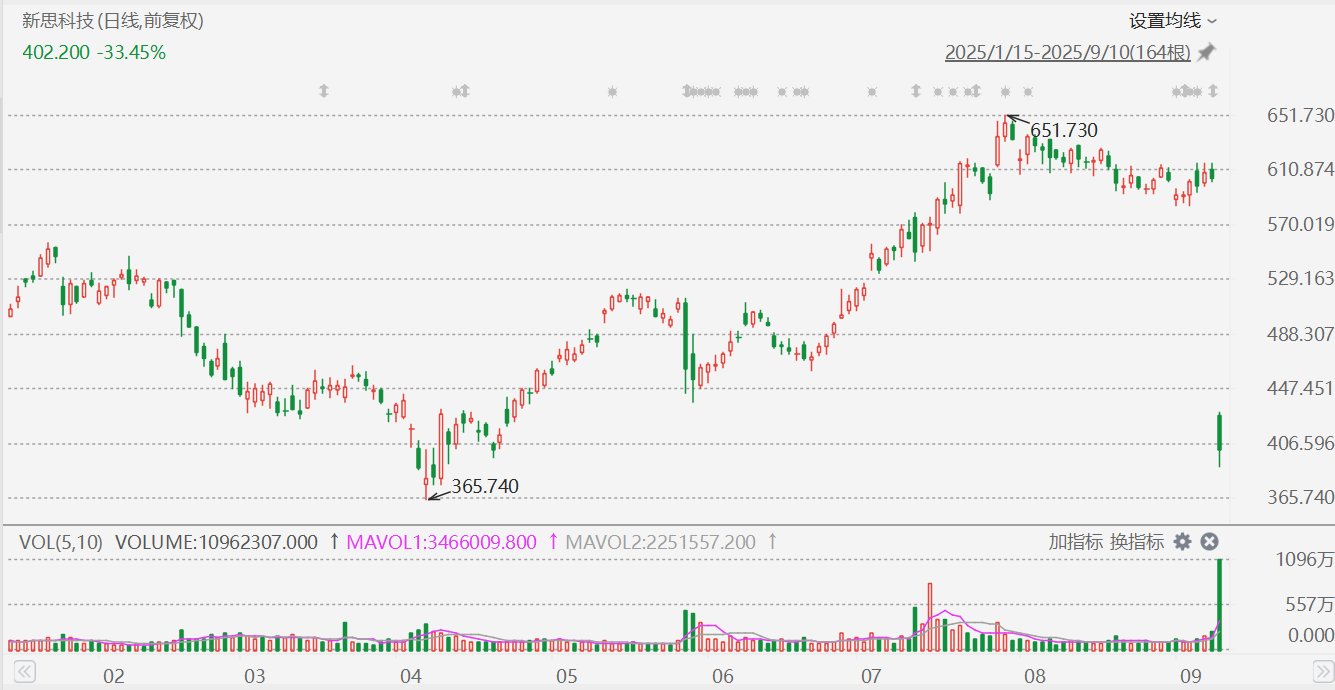
美股异动丨新思科技放量暴跌35%,创5个月新低
Ge Long Hui· 2025-09-10 16:32
Core Viewpoint - Synopsys (SNPS.US) experienced a significant intraday drop of 35%, reaching a five-month low of $390.15 following the release of its Q3 earnings report, which fell short of market expectations [1] Financial Performance - For the third fiscal quarter ending July 31, Synopsys reported a revenue increase of 14% year-over-year to $1.74 billion, but this was below the expected $1.77 billion [1] - The adjusted earnings per share (EPS) for the quarter were $3.39, which also missed market expectations of $3.80 [1] Future Guidance - For the fourth fiscal quarter, Synopsys expects an adjusted EPS in the range of $2.76 to $2.80, significantly lower than the market expectation of $4.50 [1] - The company projects revenue for the fourth quarter to be between $2.23 billion and $2.26 billion, compared to the market expectation of $2.1 billion [1]

美股异动丨新思科技盘前大跌近20%,Q3业绩及Q4指引不及预期
Ge Long Hui· 2025-09-10 08:36
Core Viewpoint - Synopsys (SNPS.US) experienced a significant pre-market drop of nearly 20% to $485.75 following the release of its Q3 earnings report, which showed revenue growth but fell short of market expectations [1] Financial Performance - For the third fiscal quarter ending July 31, Synopsys reported a revenue increase of 14% year-over-year, reaching $1.74 billion, but this was below the expected $1.77 billion [1] - The adjusted earnings per share (EPS) for the quarter were $3.39, which also fell short of market expectations of $3.80 [1] Future Guidance - For the fourth fiscal quarter, Synopsys projected an adjusted EPS of $2.76 to $2.80, significantly lower than the market expectation of $4.50 [1] - The company anticipates revenue for the fourth quarter to be between $2.23 billion and $2.26 billion, compared to the market expectation of $2.1 billion [1]
高盛评AI芯片产业链:英伟达(NVDA.US)等四企获买入 “杠铃式”策略布局半导体
智通财经网· 2025-07-11 02:41
Core Insights - Goldman Sachs recently initiated coverage on several US digital semiconductor and EDA software companies, highlighting significant investment opportunities in commercial and custom chips as well as EDA suppliers within AI-related capital expenditures [1][2] Group 1: Investment Ratings - The analyst team, led by James Schneider, assigned buy ratings to four companies: Nvidia (NVDA.US) with a target price of $185, Broadcom (AVGO.US) at $315, Cadence Design Systems (CDNS.US) at $380, and Synopsys with a target price of $620 [1] - For AMD (AMD.US), Arm (ARM.US), and Marvell Technology (MRVL.US), the target prices are set at $140, $160, and $75 respectively, maintaining a neutral rating [1] Group 2: Market Trends and Dynamics - Current AI infrastructure capital expenditures have surpassed $350 billion, indicating early signs of revenue growth and cost optimization that support ongoing investments [1] - The semiconductor market and technology leadership landscape are undergoing rapid restructuring, driven by the balance demand for advanced model training and low-cost inference [1] Group 3: EDA Software and Chip Design - The shift from traditional client/server architecture to cloud computing and generative AI is increasing system complexity and multi-chip integration needs, thereby enhancing the value of EDA software [2] - Although the custom chip sector is in its early development stage with limited market share, scale effects will benefit leading companies [2] Group 4: Geopolitical Factors - Geopolitical influences are identified as core variables affecting the semiconductor industry, with emerging sovereign infrastructure demands from China and other regions creating new opportunities to mitigate geopolitical uncertainties [2] - Goldman Sachs maintains an optimistic outlook on the long-term development prospects of AI, suggesting that current technological iterations and capital investments will create sustained growth opportunities for companies with technological barriers and ecosystem advantages [2]


美国取消对中国芯片设计软件的出口限制?德国西门子回应
news flash· 2025-07-03 04:09
Core Viewpoint - Siemens AG has received notification from the U.S. government that export restrictions on chip design software to China have been lifted, allowing the company to fully restore access to its software and technology for Chinese customers [1] Group 1: Company Actions - Siemens has resumed full access to its electronic design automation (EDA) software and technology for Chinese customers following the U.S. Department of Commerce's notification [1] - The company has restored sales and technical support services to its Chinese clients in compliance with applicable export control laws and regulations [1] Group 2: Regulatory Changes - The U.S. Bureau of Industry and Security (BIS) informed Siemens that the export control restrictions previously applicable to the company's EDA software and technology are no longer in effect as of May 23 [1] - The specific export control classification numbers (ECCNs) for the software and technology that have been restored are 3D991 and 3E991 [1]

新思科技(SNPS.US)Q2业绩“稳健”获分析师“点赞” 但出口限制仍现隐忧
智通财经网· 2025-05-30 08:04
Core Viewpoint - Synopsys (SNPS.US) reported better-than-expected Q2 results for fiscal year 2025, but its stock experienced volatility due to ongoing concerns over U.S. export restrictions [1][3] Financial Performance - Q2 Non-GAAP diluted earnings per share were $3.67, a year-over-year increase of approximately 22.33%, exceeding market expectations [1] - Revenue for Q2 reached $1.604 billion, up 10.28% year-over-year, surpassing the anticipated $1.599 billion [1] - Revenue breakdown: Automation Design segment generated $1.122 billion, while the IP Design segment brought in $482 million [1] Analyst Ratings and Outlook - Wells Fargo maintains a "Hold" rating on Synopsys with a target price of $520, noting a "clean" earnings report ahead of the planned acquisition of ANSYS (ANSS.US) [1] - Morgan Stanley holds an "Overweight" rating with a target price of $590, highlighting that Q2 sales met expectations and earnings outperformed, although Q3 guidance was weaker than anticipated [3] - Analysts express confidence in Synopsys's ability to complete the acquisition of ANSYS in H1 2025 despite geopolitical tensions [3] Market Conditions and Challenges - The U.S. Federal Trade Commission (FTC) is requiring Synopsys and ANSYS to divest certain assets to facilitate their $35 billion merger [2] - Reports indicate that the U.S. Department of Commerce has requested EDA companies to halt sales to China, creating market uncertainty [3][4] - Despite a soft demand in the non-AI market, there are signs of stabilization in the industrial and automotive sectors [3]
