硼中子俘获治疗(BNCT)

Search documents
代表通道直击 陈延伟:用微观世界的真相,照亮产业发展道路
Nan Fang Du Shi Bao· 2026-01-26 02:35
Group 1 - The Guangdong Province's major scientific facility, the China Spallation Neutron Source, supports industrial progress and development, particularly in the field of new energy batteries by addressing battery capacity decay issues [2] - During the 14th Five-Year Plan period, the China Spallation Neutron Source completed over 2,500 experimental projects, with 10% of these experiments originating from enterprises, a number that is expected to grow [2] - The facility is recognized as a "super microscope" that extends beyond research, contributing to advancements in cancer treatment through Boron Neutron Capture Therapy (BNCT), which is noted for its high precision, short treatment cycles, and relatively low costs [3] Group 2 - The facility has entered clinical trials, successfully treating 12 patients, which not only signifies individual patient recovery but also stimulates the entire industry chain from drug development to equipment manufacturing [4] - The strategic focus on core technology autonomy in Guangdong is facilitating the transition from being the "world's factory" to becoming a "scientific highland" [4]


这场大赛为创新活力之城“赋能”
Hang Zhou Ri Bao· 2025-12-12 02:27
Group 1 - The 14th China Innovation and Entrepreneurship Competition focuses on disruptive technology innovation, featuring 163 projects competing in six cutting-edge tracks, including future manufacturing, information, and materials [1][2] - The competition aims to create a full-chain platform for technology display, capital connection, and industrial landing, promoting efficient collaboration of national innovation resources [2] - The event highlights innovative medical technologies, such as boron neutron capture therapy (BNCT), which targets cancer cells with precision, minimizing damage to healthy tissues and improving patient quality of life [2] Group 2 - Since the competition's debut in Hangzhou, 50 projects have established a presence in the city, demonstrating the effectiveness of the "competition promotes innovation" strategy [3] - Hangzhou is committed to leading industrial innovation through technological advancements, aiming to become a hub for disruptive technology transfer and a major market for tech achievements [2][3] - The local government has developed a support system for disruptive technology innovation, including policies, space, capital, and application scenarios, to facilitate project development and success [3][4]
精准“爆破”癌细胞,有了新型“特种兵”(探一线)
Ren Min Ri Bao· 2025-08-15 22:11
Core Viewpoint - Boron Neutron Capture Therapy (BNCT) is a promising new radiation therapy that aims to effectively kill cancer cells while minimizing damage to healthy cells, representing a significant advancement over traditional radiation methods [1][2]. Group 1: Technology Overview - BNCT is a binary targeted therapy that involves two main steps: injecting a non-toxic boron-10 compound that accumulates in cancer cells, followed by neutron irradiation that triggers a nuclear reaction to release high-energy particles, effectively damaging cancer cell DNA [1][2]. - The "blast radius" of BNCT is less than 10 micrometers, which is smaller than the diameter of a cancer cell, resulting in minimal harm to normal tissues [2]. Group 2: Historical Context and Development - The concept of BNCT was introduced in the 1930s, with subsequent research focused on its feasibility for cancer treatment [2]. - Historically, strong neutron beams for BNCT were produced using nuclear reactors, which posed challenges for hospital applications. However, advancements in accelerator neutron source technology in the 21st century have made it safer and more cost-effective for clinical use [2]. Group 3: Technological Breakthroughs - The research team has achieved three major technological breakthroughs: 1. Development of a high-power, stable accelerator neutron source system that meets the requirements for proton beam flow [3]. 2. Creation of a second-generation boron compound with improved synthesis efficiency, reduced production costs, and enhanced quality and efficacy [3]. 3. Development of a domestic BNCT treatment planning system (TPS) that accurately analyzes and predicts treatment outcomes [3]. - These advancements position the country among the global leaders in BNCT research and development, with plans to initiate clinical trials by the end of the year [3].
西安交通大学—湖州中子科学实验室团队探索肿瘤治疗新路径 精准“爆破”癌细胞,有了新型“特种兵”(探一线)
Ren Min Ri Bao· 2025-08-15 21:46
Core Viewpoint - Boron Neutron Capture Therapy (BNCT) is a promising new radiation therapy that aims to effectively kill cancer cells while minimizing damage to healthy cells, representing a significant advancement over traditional radiation methods [1][2]. Group 1: Technology Overview - BNCT is a binary targeted therapy that involves two main steps: injecting a non-toxic boron-10 compound that accumulates in cancer cells, followed by precise neutron irradiation to induce a nuclear reaction that destroys cancer cell DNA [1][2]. - The effective range of BNCT is less than 10 micrometers, which is smaller than the diameter of a cancer cell, resulting in minimal damage to normal tissues and reduced side effects compared to conventional treatments [2]. Group 2: Historical Context and Development - The concept of BNCT was introduced in the 1930s, but practical application faced challenges due to the need for suitable boron compounds and stable neutron sources [2]. - In the 21st century, Japan advanced BNCT technology by developing accelerator neutron sources that are safer and more cost-effective than traditional nuclear reactors, enabling successful treatments for various tumors [2]. Group 3: Technological Breakthroughs - The research team has achieved three major technological breakthroughs: 1. Development of a high-power, stable accelerator neutron source system that meets the requirements for proton beam flow [3]. 2. Creation of a second-generation boron compound with improved synthesis efficiency, reduced production costs, and enhanced quality and efficacy [3]. 3. Development of a domestic BNCT treatment planning system (TPS) that accurately analyzes and predicts treatment outcomes using a proprietary Monte Carlo particle transport program [3]. - The successful integration of these components positions the country among the global leaders in BNCT technology, with plans to initiate clinical trials by the end of the year [3].
手动即可击破“肿瘤”,东莞“BNCT科普基地”即将启用
Nan Fang Du Shi Bao· 2025-07-14 08:49
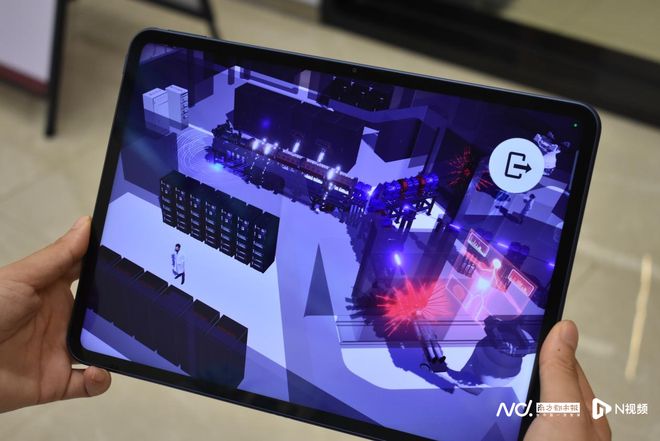
Core Insights - The introduction of the 2.0 version of the BNCT (Boron Neutron Capture Therapy) educational device at Dongguan Southern Medical University’s Tenth Affiliated Hospital aims to make advanced cancer treatment technology accessible and engaging for the public, especially youth [1][5] - The device utilizes holographic displays and AR interactive games to provide an immersive experience that illustrates the BNCT treatment process and its benefits [2][4] Summary by Sections Technology and Innovation - The BNCT educational device features a holographic cabinet that visually demonstrates the complete treatment process, including the generation of thermal neutrons and the targeted delivery of boron drugs to tumor tissues [2][4] - The technology emphasizes the protective effect of BNCT on surrounding healthy tissues while effectively destroying cancer cells [4] Interactive Experience - Participants can engage with the holographic cabinet by simulating the targeting of tumors with a neutron beam, receiving immediate feedback on their actions [4] - The AR sandbox allows users to take on different roles in the cancer treatment process, enhancing understanding through interactive gameplay [4] Educational Outreach - The hospital has been conducting a series of educational activities focused on cancer prevention and BNCT since October of the previous year, aiming to shift public perception from passive healthcare to proactive health management [5][7] - The new educational device is part of a broader initiative to integrate science into everyday life, making advanced medical knowledge more accessible [7]