神经调控

Search documents
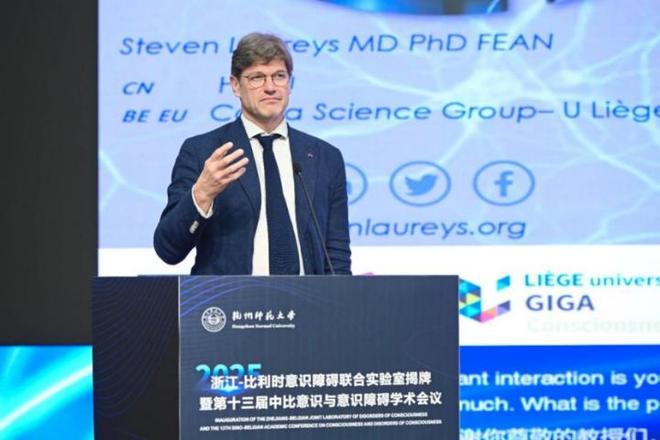
关于中国学术界,我有几点观察和建议
Guan Cha Zhe Wang· 2026-01-14 00:32
Core Insights - The article discusses the intersection of science and ethics in the study of consciousness, highlighting the work of Professor Steven Laureys, a leading figure in consciousness research [1][2]. Group 1: Research Contributions - Laureys emphasizes the importance of understanding consciousness as a multidimensional spectrum rather than a binary state, correcting historical misconceptions in clinical practice [6][9]. - The development of advanced neuroimaging techniques, such as PET and fMRI, has allowed researchers to challenge previous beliefs about unconscious patients, revealing their potential for awareness and recovery [4][7]. - Collaborative research with Chinese teams has led to significant breakthroughs in understanding the recovery mechanisms of patients previously labeled as being in a "vegetative state," now referred to as "unresponsive wakefulness syndrome" [7][9]. Group 2: Clinical Applications - The application of brain-computer interface technology is advancing, with potential to assist patients with severe cognitive impairments and paralysis, although challenges remain in fully understanding neural coding of consciousness [10][11]. - The integration of artificial intelligence in research has enhanced the ability to analyze complex data from neuroimaging, improving diagnostic accuracy and patient care [13]. - The establishment of clinical guidelines in China aims to ensure equitable access to advanced treatments for consciousness disorders, moving beyond a focus on affluent patients [16][18]. Group 3: Ethical Considerations - The ethical implications of medical decisions in cases of consciousness disorders are highlighted, stressing the need for comprehensive assessments to guide treatment options [14][15]. - The article calls for public discourse on end-of-life decisions, advocating for advance directives to communicate patient values and wishes [15][16]. - Laureys points out the necessity of balancing scientific exploration with ethical considerations in animal research, emphasizing transparency and humane practices [19][20]. Group 4: Academic Environment - Laureys observes that the competitive nature of the academic environment in China can hinder collaboration, suggesting a need for a more cooperative approach among researchers [21]. - Language barriers and the need for improved English proficiency among Chinese scientists are identified as challenges for broader scientific communication [21]. - The article suggests that fostering a spirit of inquiry and questioning established truths is essential for scientific progress, encouraging a culture of creativity and innovation [21][22].

北陆药业:持有医未医疗14.9881%股份,系其第二大股东
Sou Hu Cai Jing· 2026-01-12 09:10
Group 1 - The core viewpoint of the article is that Beilu Pharmaceutical holds a significant stake in Yiwei Medical, which is a leading AI company in China focused on brain diseases, covering the entire process from screening to diagnosis and rehabilitation [1] - Beilu Pharmaceutical currently owns 14.9881% of Yiwei Medical, making it the second-largest shareholder [1] - Yiwei Medical specializes in non-invasive brain-machine interfaces, neuroregulation, and medical AI, targeting essential scenarios such as stroke, Alzheimer's disease, and cognitive disorders [1]

最新!全球医疗制造巨头换帅
思宇MedTech· 2025-10-27 03:16
Core Insights - Integer Holdings has appointed Payman Khales as the new CEO, succeeding Joseph Dziedzic who retired after eight years [2] - The company reported Q3 2025 sales revenue of $468 million, an 8% year-over-year increase, with adjusted earnings per share growing by 25% [3] - Integer's strategic focus is shifting from a manufacturing-centric model to a customer-centric innovation platform [11][12] Leadership Transition - Payman Khales joined Integer in 2018 and previously served as the president of the Cardio & Vascular Business, where he successfully doubled sales over seven years [6] - Khales has a strong background in industrial manufacturing and operations management, having held senior positions at CECO Environmental Corp. and Ingersoll Rand Co. [7] - His vision for Integer emphasizes innovation and collaboration with customers to enhance clinical value in medical technology [7] Business Structure and Global Positioning - Integer operates as a leading Contract Development and Manufacturing Organization (CDMO), providing end-to-end services from product design to supply chain integration [9] - The company has two main business segments: Cardio & Vascular, which is the largest revenue contributor, and Advanced Surgical & Power Solutions, focusing on neuromodulation and implantable battery systems [9][10] - Integer has over 30 manufacturing and R&D centers globally, enhancing its supply chain stability and compliance management [10] Strategic Intent and Industry Impact - The leadership change signifies a strategic restructuring in response to the competitive landscape of the global CDMO market [11] - Integer aims to extend its capabilities from manufacturing to early product development and engineering validation, leveraging a "customer co-innovation" model [12] - The global medical device industry is experiencing a shift towards outsourcing non-core manufacturing to CDMO partners, with the market expected to grow from approximately $15 billion in 2023 to $27 billion by 2030 [13] Future Directions - Under Khales, Integer is likely to enhance investments in digital manufacturing, supply chain transparency, and sustainable operations, aligning with industry trends [13] - The transition positions Integer to evolve from a traditional contract manufacturer to a high-end medical manufacturing platform with innovation incubation capabilities [14] - The leadership change reflects broader structural changes in the medical device manufacturing sector, where OEMs and CDMOs are increasingly collaborating in design and innovation processes [14][15]

青年企业家如何把握AI时代新机遇
Mei Ri Shang Bao· 2025-05-27 22:16
Group 1 - The event "2025 New Generation Talks" held in Hangzhou focused on the theme "Intelligent Creation of the Future: New Opportunities for Young Entrepreneurs in the AI Era," attracting over 300 young entrepreneurs to discuss development paths under the AI wave [2] - Wu Haiyu, Vice Chairman of the Zhejiang Provincial Federation of Industry and Commerce, emphasized that AI is a young industry and young entrepreneurs should seize development opportunities while taking on responsibilities [2] - Zhejiang is positioning itself as a leader in the digital economy, actively building an AI industry ecosystem to provide a broad innovation platform for young entrepreneurs [2] Group 2 - Chen Bin, Chairman of Zhejiang Saizhi Bole Equity Investment Management Co., shared his investment philosophy of "investing early, investing small, investing in technology, and investing in quality," highlighting a significant increase in the valuation of one invested AI company from under 200 million to over 4 billion since 2021 [3] - The AI industry is categorized into three types: chip layer enterprises, middle layer enterprises focusing on computing power scheduling and data collection, and application layer enterprises related to vertical industries and AI tools [3] - Bian Wenyin, Director of Strategic Relations at Zhejiang Qiangnao Technology Co., introduced brain-computer interface technology and the company's focus on rehabilitation health, with plans to expand applications in various fields such as human-computer interaction and education [3] Group 3 - The "New Generation Talks" initiative aims to create a multi-dimensional interactive platform to promote collaboration among young entrepreneurs in thought exchange and industry cooperation [3]