
禾花田

Search documents
零售商新老势力混战“自有品牌” 谁能更胜一筹?
Mei Ri Jing Ji Xin Wen· 2025-12-09 14:53
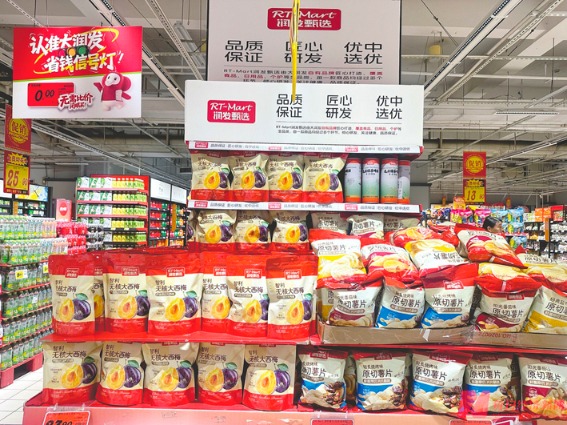
Core Viewpoint - Walmart is intensifying its focus on private label brands, particularly "Wojixian," as a strategic response to competition from e-commerce and emerging retailers, while also addressing the declining image of its Sam's Club brand [1][2][4]. Group 1: Walmart's Strategy - Walmart's private label "Wojixian" has been upgraded to cover essential categories like fresh produce, food, and beverages, emphasizing low prices and health attributes [2][4]. - The company is facing challenges as traditional retail formats struggle against e-commerce platforms, prompting a shift towards private labels to enhance competitiveness [1][4]. - The strategy of launching private labels is seen as a "last resort" to revitalize the hypermarket format amid increasing competition [1][4]. Group 2: Market Competition - Other traditional retailers, such as RT-Mart, are also focusing on private labels, with a similar emphasis on low prices and health trends [2][4]. - New players like Hema and Dingdong Maicai have established private labels as core competitive advantages, highlighting the shift in market dynamics [6][9]. - The competition for quality suppliers is intensifying as both established and emerging retailers seek to enhance their private label offerings [7][8]. Group 3: Financial Performance - RT-Mart's parent company, Gao Xin Retail, reported a revenue decline of 12.1% year-on-year, indicating the financial pressures faced by traditional retailers [5]. - Walmart's performance in China is primarily driven by Sam's Club, while its hypermarket segment has been experiencing store closures [5]. Group 4: Private Label Development - The private label penetration varies significantly among retailers, with Aldi achieving a 90% share in China, while Hema's community stores have nearly 60% [7]. - Successful private label strategies require strong brand value and supply chain management to maintain competitive pricing and quality [7][8]. - Walmart's approach involves stringent supplier selection, with only a small percentage of potential suppliers making it through the rigorous evaluation process [8].


零售商新老势力混战“自有品牌”,谁能更胜一筹?
Mei Ri Jing Ji Xin Wen· 2025-12-09 14:43
Core Insights - Walmart is developing its private label "Wojixian" as a response to the declining image of its high-end membership store Sam's Club, indicating a strategic shift in its retail approach [1][2] - The competition in the retail market is intensifying, with traditional retailers like Walmart and RT-Mart facing pressure from e-commerce and emerging players [1][4] Group 1: Walmart's Strategy - Walmart's "Wojixian" brand focuses on affordability and health, with products prominently displayed at low price points [2][3] - The company is adopting a strategy similar to RT-Mart, which is also enhancing its private label offerings, emphasizing low prices and health attributes [2][3] - The shift towards private labels is seen as a necessary response to market competition and performance pressures, as evidenced by declining revenues and profits reported by RT-Mart's parent company [3][4] Group 2: Market Competition - New retail players like Hema and Dingdong Maicai have established their private labels as core competitive advantages, launching various products since 2017 [4][5] - The self-owned brand strategy is crucial for retailers to attract customers and improve profit margins by defining product standards and reducing intermediary costs [4][5] - The competition for quality suppliers is intensifying as traditional retailers ramp up their private label initiatives, with companies like Dingdong Maicai investing in direct sourcing and partnerships [5][6] Group 3: Supply Chain and Brand Development - The success of private labels relies heavily on effective supply chain management and the ability to create strong brand value [5][6] - Walmart is currently focusing on supplier selection and has a rigorous evaluation process for potential suppliers, which limits the number of partnerships [6] - The retail landscape is evolving, with established players like Walmart actively learning from newer competitors to enhance their product offerings and market positioning [6]
山姆“人设”滑坡、沃尔玛“沃集鲜”成新宠 新老势力混战“自有品牌”谁能更胜一筹?
Mei Ri Jing Ji Xin Wen· 2025-12-05 13:37
Core Insights - Walmart is developing its private label "Wojixian" as a response to the competitive pressures from e-commerce and emerging retailers, positioning it as a "budget version" of Sam's Club [1][2] - The shift towards private labels by traditional retailers like Walmart and RT-Mart is driven by the need to compete with e-commerce platforms and new entrants in the retail market [1][3] Group 1: Private Label Strategy - Walmart's "Wojixian" focuses on affordability and health, with visible pricing strategies such as "everyday low prices" [2][3] - RT-Mart is also enhancing its private label offerings, emphasizing low prices and health trends, but adopts a dual-brand strategy for its private labels [2][3] - The competition in the retail sector is prompting established players to adopt private labels as a core strategy to attract customers and improve profit margins [4][6] Group 2: Market Performance and Challenges - RT-Mart's parent company, Gao Xin Retail, reported a revenue decline of 12.1% year-on-year, highlighting the financial pressures faced by traditional retailers [3] - Walmart's performance in China is primarily driven by the success of Sam's Club, while its traditional hypermarket format is facing challenges, including store closures [3][4] - The competition for quality suppliers and production sources is intensifying as retailers like Hema and Dingdong Maicai have already established strong private label brands [4][6] Group 3: Supply Chain and Brand Development - Successful private label development requires strong supply chain management and the ability to create distinct brand value [6][7] - Retailers are increasingly focusing on sourcing high-quality suppliers, with Walmart currently evaluating a limited number of potential suppliers for its private label products [6][7] - The competition for premium suppliers and production capabilities is expected to escalate as traditional retailers enhance their private label strategies [6][7]