
黑钻世家

Search documents
美团收购落地一月,叮咚买菜创始人梁昌霖卸任CEO
Guan Cha Zhe Wang· 2026-03-10 10:20
Core Viewpoint - The acquisition of Dingdong Maicai by Meituan has led to significant management changes, marking the transition into a "post-founder era" for the company, with a focus on integrating operations and management under new leadership [3][8]. Company Changes - Founder Liang Changlin has resigned as CEO, with former CFO Wang Song taking over the role while Liang remains as Chairman of the Board, focusing on strategic governance and retaining control over overseas operations [1][3]. - Wang Song, who joined Dingdong Maicai in September 2023, has a strong background in the consumer retail industry and has demonstrated exceptional business capabilities in a short time [6][7]. Business Strategy - Dingdong Maicai has emphasized product selection and procurement capabilities, establishing direct connections with hundreds of production bases to control costs and quality [5]. - The company has developed multiple private label brands since 2020, including "Liangxin Craftsman" and "Black Diamond Family," showcasing its commitment to brand expansion [5]. Financial Performance - For Q4 2025, Dingdong Maicai reported revenue of 6.2426 billion yuan, a year-on-year increase of 5.7%, and a GMV of 6.7032 billion yuan, up 2.4% [7]. - Despite achieving profitability over several quarters, the net profit margin remains low, with GAAP net profit declining by 63.3% year-on-year [7]. Industry Context - The shift in leadership reflects a broader trend in the fresh e-commerce sector, where independent startups face challenges against larger companies, indicating a closing window for independent entrepreneurship [8].




零售商新老势力混战“自有品牌” 谁能更胜一筹?
Mei Ri Jing Ji Xin Wen· 2025-12-09 14:53
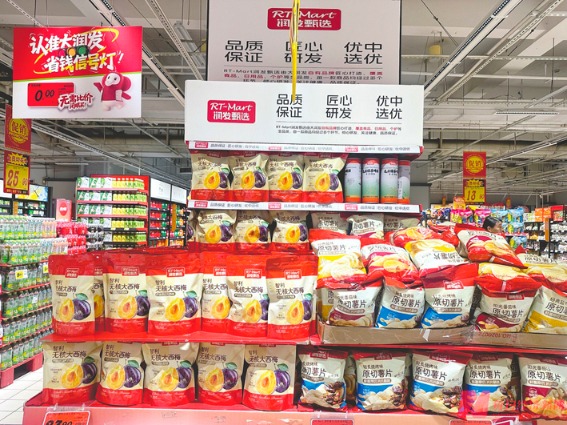
Core Viewpoint - Walmart is intensifying its focus on private label brands, particularly "Wojixian," as a strategic response to competition from e-commerce and emerging retailers, while also addressing the declining image of its Sam's Club brand [1][2][4]. Group 1: Walmart's Strategy - Walmart's private label "Wojixian" has been upgraded to cover essential categories like fresh produce, food, and beverages, emphasizing low prices and health attributes [2][4]. - The company is facing challenges as traditional retail formats struggle against e-commerce platforms, prompting a shift towards private labels to enhance competitiveness [1][4]. - The strategy of launching private labels is seen as a "last resort" to revitalize the hypermarket format amid increasing competition [1][4]. Group 2: Market Competition - Other traditional retailers, such as RT-Mart, are also focusing on private labels, with a similar emphasis on low prices and health trends [2][4]. - New players like Hema and Dingdong Maicai have established private labels as core competitive advantages, highlighting the shift in market dynamics [6][9]. - The competition for quality suppliers is intensifying as both established and emerging retailers seek to enhance their private label offerings [7][8]. Group 3: Financial Performance - RT-Mart's parent company, Gao Xin Retail, reported a revenue decline of 12.1% year-on-year, indicating the financial pressures faced by traditional retailers [5]. - Walmart's performance in China is primarily driven by Sam's Club, while its hypermarket segment has been experiencing store closures [5]. Group 4: Private Label Development - The private label penetration varies significantly among retailers, with Aldi achieving a 90% share in China, while Hema's community stores have nearly 60% [7]. - Successful private label strategies require strong brand value and supply chain management to maintain competitive pricing and quality [7][8]. - Walmart's approach involves stringent supplier selection, with only a small percentage of potential suppliers making it through the rigorous evaluation process [8].

零售商新老势力混战“自有品牌”,谁能更胜一筹?
Mei Ri Jing Ji Xin Wen· 2025-12-09 14:43
Core Insights - Walmart is developing its private label "Wojixian" as a response to the declining image of its high-end membership store Sam's Club, indicating a strategic shift in its retail approach [1][2] - The competition in the retail market is intensifying, with traditional retailers like Walmart and RT-Mart facing pressure from e-commerce and emerging players [1][4] Group 1: Walmart's Strategy - Walmart's "Wojixian" brand focuses on affordability and health, with products prominently displayed at low price points [2][3] - The company is adopting a strategy similar to RT-Mart, which is also enhancing its private label offerings, emphasizing low prices and health attributes [2][3] - The shift towards private labels is seen as a necessary response to market competition and performance pressures, as evidenced by declining revenues and profits reported by RT-Mart's parent company [3][4] Group 2: Market Competition - New retail players like Hema and Dingdong Maicai have established their private labels as core competitive advantages, launching various products since 2017 [4][5] - The self-owned brand strategy is crucial for retailers to attract customers and improve profit margins by defining product standards and reducing intermediary costs [4][5] - The competition for quality suppliers is intensifying as traditional retailers ramp up their private label initiatives, with companies like Dingdong Maicai investing in direct sourcing and partnerships [5][6] Group 3: Supply Chain and Brand Development - The success of private labels relies heavily on effective supply chain management and the ability to create strong brand value [5][6] - Walmart is currently focusing on supplier selection and has a rigorous evaluation process for potential suppliers, which limits the number of partnerships [6] - The retail landscape is evolving, with established players like Walmart actively learning from newer competitors to enhance their product offerings and market positioning [6]
山姆“人设”滑坡、沃尔玛“沃集鲜”成新宠 新老势力混战“自有品牌”谁能更胜一筹?
Mei Ri Jing Ji Xin Wen· 2025-12-05 13:37
Core Insights - Walmart is developing its private label "Wojixian" as a response to the competitive pressures from e-commerce and emerging retailers, positioning it as a "budget version" of Sam's Club [1][2] - The shift towards private labels by traditional retailers like Walmart and RT-Mart is driven by the need to compete with e-commerce platforms and new entrants in the retail market [1][3] Group 1: Private Label Strategy - Walmart's "Wojixian" focuses on affordability and health, with visible pricing strategies such as "everyday low prices" [2][3] - RT-Mart is also enhancing its private label offerings, emphasizing low prices and health trends, but adopts a dual-brand strategy for its private labels [2][3] - The competition in the retail sector is prompting established players to adopt private labels as a core strategy to attract customers and improve profit margins [4][6] Group 2: Market Performance and Challenges - RT-Mart's parent company, Gao Xin Retail, reported a revenue decline of 12.1% year-on-year, highlighting the financial pressures faced by traditional retailers [3] - Walmart's performance in China is primarily driven by the success of Sam's Club, while its traditional hypermarket format is facing challenges, including store closures [3][4] - The competition for quality suppliers and production sources is intensifying as retailers like Hema and Dingdong Maicai have already established strong private label brands [4][6] Group 3: Supply Chain and Brand Development - Successful private label development requires strong supply chain management and the ability to create distinct brand value [6][7] - Retailers are increasingly focusing on sourcing high-quality suppliers, with Walmart currently evaluating a limited number of potential suppliers for its private label products [6][7] - The competition for premium suppliers and production capabilities is expected to escalate as traditional retailers enhance their private label strategies [6][7]
黑猪“逆袭”?产值持续走高,海南、广东消费缺口扩至30%
Nan Fang Nong Cun Bao· 2025-08-01 03:06
Core Insights - The black pig market in China is experiencing steady growth, with the market share increasing from less than 2% in 2014 to 5% currently, and projections suggest it could reach 10% in the next decade [4][5][8] - The overall value of the black pig industry is rising, with a compound annual growth rate exceeding 4%, indicating increased consumer demand and higher sales prices [8][9] - There is a significant consumption gap in regions like Hainan and Guangdong, where the demand for black pig products exceeds supply by over 30% [10][22] Industry Trends - The black pig output is projected to reach 21.8 million heads in 2024, an increase of 2.55 million heads from 2023 [3][4] - The Northeast, North, and East China regions account for 70% of the national black pig production capacity, with notable developments in local breeds and production [11][13] - The black pig market is characterized by a dynamic balance of supply and demand, but regional structural contradictions are becoming more pronounced [17][18] Market Dynamics - The black pig industry is seeing a shift towards large-scale farming, with 65% of production now coming from this model, which offers significant profit advantages compared to traditional farming [56] - The average market penetration rate for black pig products has reached 15%, driven by rising consumer recognition and demand for high-quality pork [31][35] - Innovations in breeding and farming practices, such as antibiotic-free farming and the development of new black pig breeds, are enhancing the industry's competitiveness [49][46][39] Consumer Preferences - Black pig meat is favored in high-end markets due to its higher intramuscular fat content and superior taste, with premium cuts commanding prices significantly above regular pork [54][55] - The industry is expanding its product offerings, including deep-processed foods, to cater to diverse consumer needs and preferences [60][68] - Companies are increasingly focusing on brand development and market diversification to enhance their competitive edge [52][72]

叮咚买菜设10个独立事业部,强化供应链和自有品牌
Jing Ji Guan Cha Wang· 2025-07-23 03:14
Core Insights - The company is shifting from a traffic and platform-centric approach to a product and ecosystem mindset, focusing on fresh produce and food supply chain [1] - An organizational restructuring has been initiated to enhance product quality and differentiation, creating 10 independent divisions based on major product categories [1] - The company has developed several proprietary brands and is exploring further expansion into self-owned brands [1][2] Company Strategy - The restructuring involves 10 independent divisions that encompass product development, operations, and quality control, each led by a core executive [1] - The company aims to enhance its self-owned brand strategy, having already launched various brands across different categories [1] - The company is also expanding its sales channels beyond its own platform to include major online platforms and offline retail channels [2] Financial Performance - In Q1 of this year, the company's GMV reached 5.96 billion yuan, a year-on-year increase of 7.9%, while revenue was 5.48 billion yuan, up 9.1% [3] - The net profit under GAAP standards was 8.017 million yuan, with a net profit margin of 0.1% [3] - The improvement in business metrics is attributed to strategic adjustments and organizational changes [3]