
私募股权投资基金管理服务

Search documents
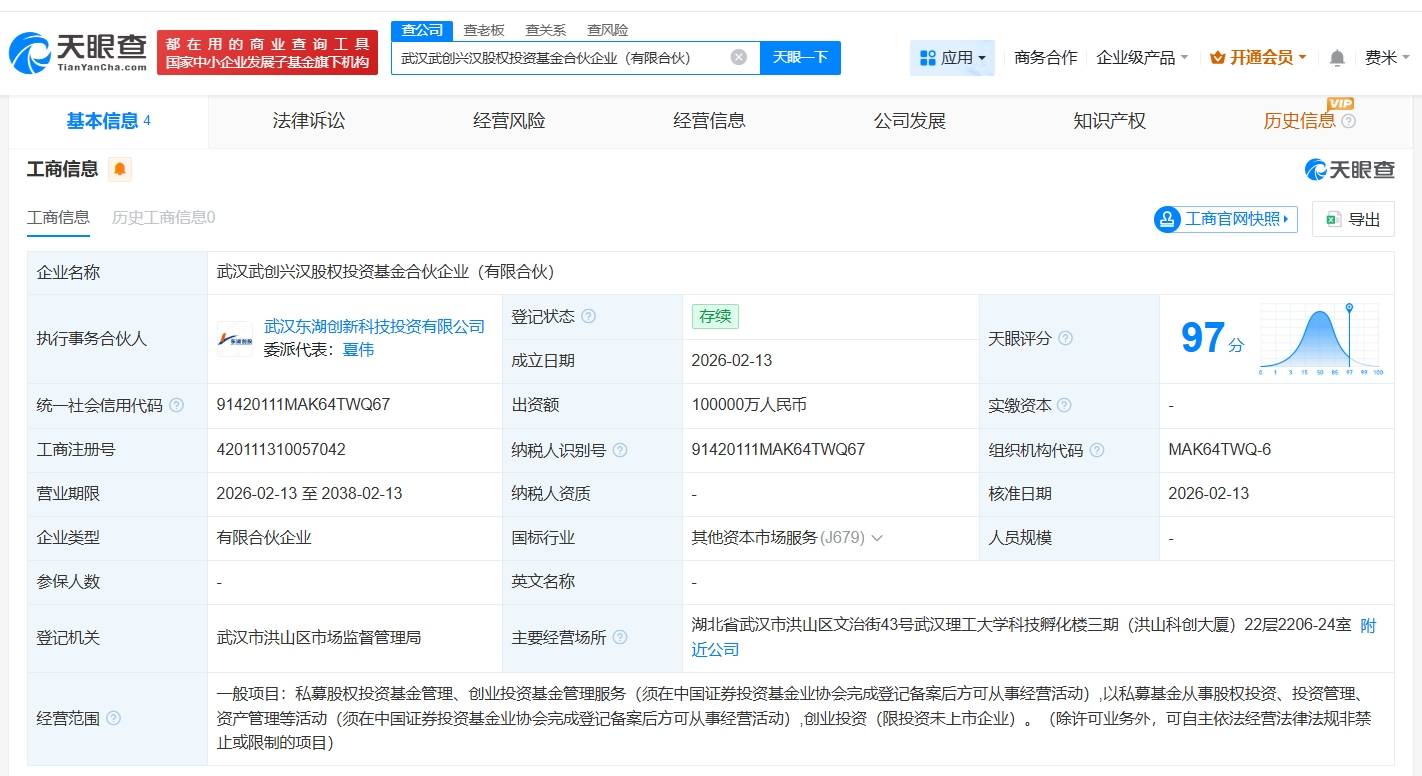
武汉武创兴汉股权投资基金登记成立
Sou Hu Cai Jing· 2026-02-25 09:44
Core Viewpoint - Wuhan Wuchuang Xinghan Equity Investment Fund Partnership (Limited Partnership) has been established with a capital contribution of 1 billion RMB, focusing on private equity investment fund management and venture capital services [1][2]. Group 1: Company Information - The executing partner of the fund is Wuhan East Lake Innovation Technology Investment Co., Ltd. [1][2] - The fund is co-funded by Wuhan Industrial Development Fund Co., Ltd., Wuhan Innovation Investment Group Co., Ltd., and Wuhan East Lake Innovation Technology Investment Co., Ltd. [1][2] - The fund's business scope includes private equity investment fund management, venture capital fund management services, and venture capital [1][2]. Group 2: Operational Details - The fund was registered with a capital of 1 billion RMB and is classified as a limited partnership [2]. - The business operation period is from February 13, 2026, to February 13, 2038 [2]. - The fund must complete registration with the Asset Management Association of China before engaging in business activities [2].

四川双马1月23日获融资买入1390.96万元,融资余额11.28亿元
Xin Lang Cai Jing· 2026-01-26 01:25
Group 1 - The core viewpoint of the news highlights the financial performance and trading activities of Sichuan Shuangma, indicating a decline in stock price and significant financing activities on January 23 [1] - On January 23, Sichuan Shuangma's stock price fell by 0.72%, with a trading volume of 176 million yuan. The financing buy amount was 13.91 million yuan, while the financing repayment was 25.89 million yuan, resulting in a net financing outflow of 11.98 million yuan [1] - As of January 23, the total financing and securities lending balance for Sichuan Shuangma was 1.129 billion yuan, with the financing balance exceeding 90% of the level over the past year, indicating a high position [1] Group 2 - As of September 30, the number of shareholders for Sichuan Shuangma was 29,200, a decrease of 5.50% from the previous period, while the average circulating shares per person increased by 5.83% to 26,145 shares [2] - For the period from January to September 2025, Sichuan Shuangma achieved an operating income of 917 million yuan, representing a year-on-year growth of 23.21%, and a net profit attributable to shareholders of 294 million yuan, up 20.03% year-on-year [2] Group 3 - Sichuan Shuangma has distributed a total of 931 million yuan in dividends since its A-share listing, with 259 million yuan distributed over the past three years [3] - As of September 30, 2025, Hong Kong Central Clearing Limited was the eighth largest circulating shareholder of Sichuan Shuangma, holding 6.7258 million shares, an increase of 3.0976 million shares compared to the previous period [3]

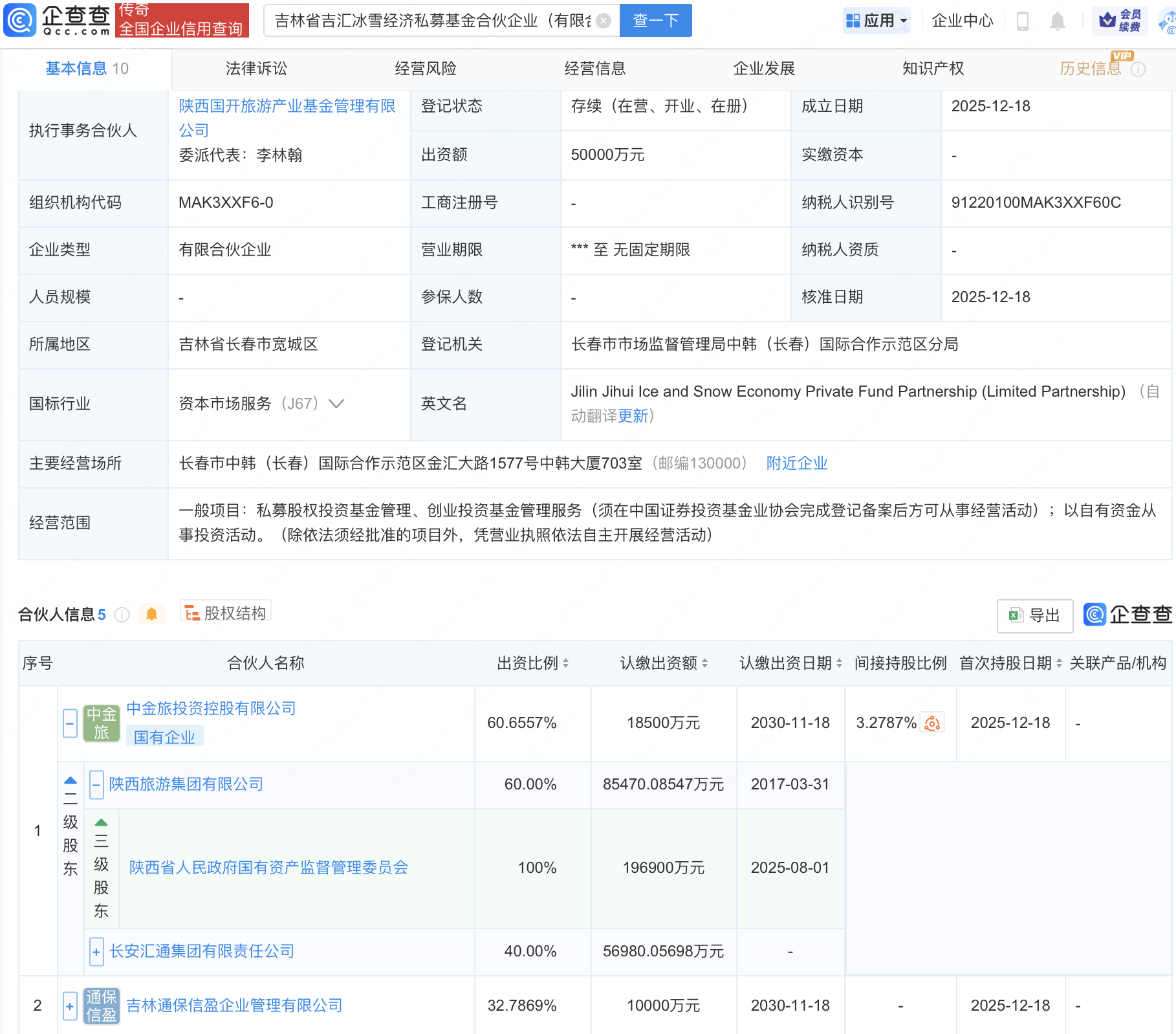
陕西国资等在吉林长春新设冰雪经济私募基金
Sou Hu Cai Jing· 2025-12-25 06:46
Group 1 - The Jilin Jihui Ice and Snow Economy Private Equity Fund Partnership has been established with a total investment of 500 million yuan [1][2] - The fund's business scope includes private equity investment fund management and venture capital fund management services, as well as investment activities using its own funds [1][2] - The fund is co-funded by Zhongjin Travel Investment Holding Co., Ltd., a subsidiary of Shaanxi Tourism Group Co., Ltd., and Jilin Tongbao Xinying Enterprise Management Co., Ltd. [1][2] Group 2 - The fund is registered in Changchun City, Jilin Province, and is classified under capital market services [2] - The fund's executive partner is Shaanxi Guokai Tourism Industry Fund Management Co., Ltd. [2] - The fund operates without a fixed term and is currently in a state of existence [2]
四川和谐双马股份有限公司第九届董事会第十八次会议决议公告
Shang Hai Zheng Quan Bao· 2025-12-17 19:04
Group 1 - The company held its 18th meeting of the 9th Board of Directors on December 16, 2025, with all 7 directors present, complying with legal and regulatory requirements [2][3] - The board approved a related party transaction involving the provision of management services by a wholly-owned subsidiary to a related entity [3][4][5] - The voting results for the proposal were 5 votes in favor, 0 against, and 0 abstentions [6] Group 2 - The company announced a share transfer agreement between its controlling shareholder, Beijing Harmony Hengyuan Technology Co., Ltd., and its concerted actor, LAFARGE CHINA OFFSHORE HOLDING COMPANY (LCOHC), for the transfer of 48,786,912 shares, representing 6.39% of the total share capital [11][12] - Following the transfer, Harmony Hengyuan will hold 251,232,944 shares, accounting for 32.91% of the total share capital, while LCOHC will hold 77,593,727 shares, accounting for 10.16% [12] - The share transfer is an internal transfer between controlling shareholders and does not affect the control of the company or its financial status [14][32] Group 3 - The management service agreement with the related entity, Yiwu Harmony Jinhong Equity Investment Partnership, is part of a series of transactions aimed at extending the partnership's duration and ensuring orderly project exits [39][40] - The management fee for the extended period will be 1% per year of the total investment cost of ongoing projects, with the agreement approved by the board [41][42] - The company has a history of stable operations and aims to enhance profitability through these management services [48][49]
私募基金管理|北京私募基金管理公司转让项目 51%股权转让51BJ-1102
Sou Hu Cai Jing· 2025-11-11 08:02
Core Insights - The project company, established in 2018 in Beijing, focuses on capital market services and is undergoing a 51% equity transfer with a base price of 6.260046 million yuan [1][3]. Company Overview - The project company is a state-controlled enterprise with a registered capital of 50 million yuan and paid-in capital of 12.5 million yuan [3]. - The company specializes in private equity fund management and venture capital fund management, requiring registration with the China Securities Investment Fund Industry Association to operate [3]. Financial Performance - **2024 Audited Report:** - Revenue: 4.28422319 million yuan - Operating Profit: -0.07914879 million yuan - Net Profit: -1.22841066 million yuan - Total Assets: 23.76883114 million yuan - Total Liabilities: 11.95629778 million yuan - Owner's Equity: 11.81253336 million yuan [3]. - **2025 Financial Report (as of September 30):** - Revenue: 2.39150943 million yuan - Operating Profit: -0.09069818 million yuan - Net Profit: -0.08306237 million yuan - Total Assets: 23.43761596 million yuan - Total Liabilities: 11.70814497 million yuan - Owner's Equity: 11.72947099 million yuan [3]. Investment Advantages - **Extensive Resources and Collaboration:** - The company benefits from a wide network of connections across government, financial institutions, and the business sector, enhancing its operational support [4][5]. - **Compliance and Risk Management:** - The company emphasizes compliance in its operations, effectively reducing legal and operational risks, which helps in asset preservation and value appreciation for investors [6].

“LP打电话问我:你们还收管理费吗?”
3 6 Ke· 2025-06-16 04:11
Core Viewpoint - The recent announcement by the Guangdong Provincial Finance Department regarding the management fee structure for government investment funds has sparked significant discussion in the investment community, particularly concerning the implications for venture capital (VC) firms and their management fee practices [10][11][12]. Group 1: Management Fee Structure - The management fee for government investment funds will now be determined based on performance evaluations, and fees should primarily be paid from fund earnings or interest, not from the principal [10][11]. - A notable shift in the management fee model is the move from a traditional "commitment-based" fee structure to a "performance-based" one, where fees are only collected if the fund generates returns [11][12]. - The common fee structure of "2+20" (2% management fee and 20% performance fee) is under scrutiny, with some firms now promising to defer management fees until after the fund has generated returns [2][10]. Group 2: Industry Reactions and Trends - The investment community is experiencing a "management fee earthquake," with LPs (limited partners) questioning the viability of traditional fee structures and some VCs offering to waive fees during the fundraising phase [10][15]. - The average fundraising time has significantly increased, from around 10 months in 2015-2020 to approximately 27 months currently, leading to increased pressure on VCs to adapt their fee structures [9][10]. - The new regulations may lead to a broader reevaluation of the management fee practices across the industry, with potential implications for the survival of many GP (general partner) firms [15][16]. Group 3: Financial Implications - The financial sustainability of VC firms is at risk, as management fees are crucial for covering operational costs such as salaries and office rent [12][15]. - The average DPI (Distributions to Paid-In) for government-guided funds is only 0.7, indicating that many funds have not yet returned their initial investments, which raises concerns about the long-term viability of the current investment model [13][14]. - The shift in management fee practices reflects a broader trend of decreasing fees in the industry, with some major firms reducing their management fees in response to market conditions [15][16].