
科创人工智能ETF华宝等

Search documents
【盘前三分钟】10月27日ETF早知道
Xin Lang Ji Jin· 2025-10-27 01:16
Core Insights - The article highlights the current positive momentum in the artificial intelligence (AI) sector, driven by a confluence of policy support, technological advancements, and increasing demand, indicating a potential for further growth in the industry [4]. Market Overview - As of October 24, 2025, the Shanghai Composite Index, Shenzhen Component Index, and ChiNext Index have shown significant valuation metrics, with their respective ten-year price-to-earnings (P/E) percentile ranks at 99.42%, 80.49%, and 46.13% [1]. - The market temperature gauge indicates a 25% increase in overall market sentiment, reflecting a bullish outlook [1]. Sector Performance - The electronic sector led the inflow of funds with a net inflow of 11.429 billion, while the pharmaceutical sector experienced the highest outflow at 1.673 billion [2]. - Notable sector performance includes: - Electronics: +2.20% - Defense and military: +1.55% - Real estate: -1.18% - Computer: -1.29% [2]. ETF Performance - The article lists several ETFs with notable performance over the past six months, including: - AI ETF: +103.34% - Innovation Leader ETF: +78.07% - Technology ETF: +64.48% [3]. - The AI sector's index surged over 5% on October 24, 2025, indicating strong market interest and investment in AI technologies [4]. Investment Outlook - The article suggests that the A-share market's effective breakthrough relies on technology leadership, with a positive outlook for the technology sector over the next year [4]. - The "15th Five-Year Plan" emphasizes the importance of new productive forces, positioning technology self-reliance as a core strategic goal [4].


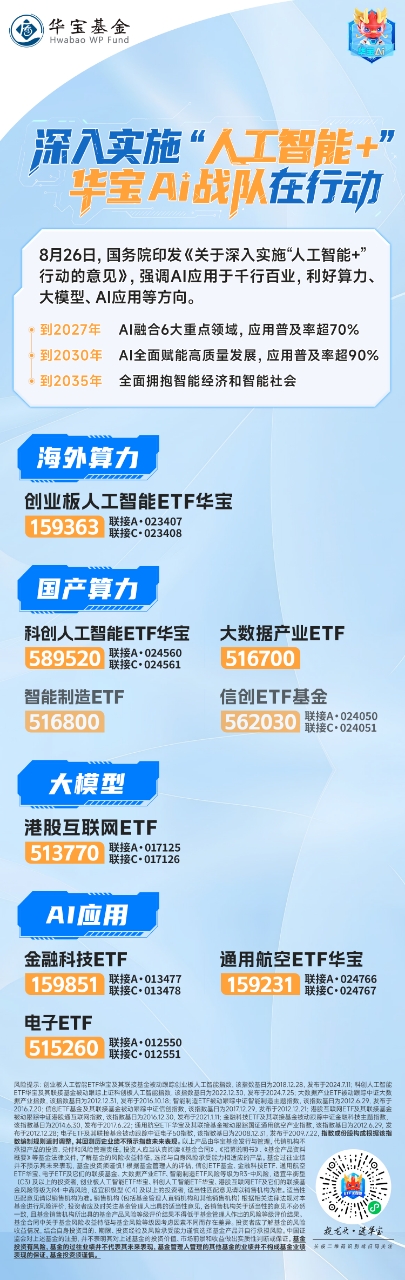
深入实施“人工智能+”,华宝“AI+”战队在行动
Xin Lang Ji Jin· 2025-08-27 00:16
Group 1 - The State Council issued an opinion on August 26 to promote the implementation of "Artificial Intelligence +" across various industries, benefiting sectors such as computing power, large models, and AI applications [1] - By 2027, AI integration is expected to cover six key areas with an application penetration rate exceeding 70% [1] - By 2030, the application penetration rate of AI is projected to exceed 90%, leading to a comprehensive embrace of the intelligent economy and society by 2035 [1] Group 2 - Various ETFs related to AI and technology sectors are highlighted, including the Huabao AI ETF and the Sci-Tech Innovation AI ETF, indicating investment opportunities in these areas [1] - The document lists several ETFs focused on big data, smart manufacturing, and financial technology, suggesting a growing interest in these sectors [1]
【盘前三分钟】8月5日ETF早知道
Xin Lang Ji Jin· 2025-08-05 01:21
Market Overview - The market temperature gauge indicates a long-term signal with a 75% positive outlook, reflecting a favorable investment environment [1] - The Shanghai Composite Index, Shenzhen Component Index, and ChiNext Index show slight fluctuations with changes of 0.66%, 0.46%, and 0.50% respectively [1] Sector Performance - The defense and military sector leads with a short-term gain of 3.06%, followed by machinery equipment at 1.93% and non-ferrous metals at 1.87% [2] - The media, comprehensive, textile and apparel, social services, and retail sectors experienced declines, with the worst performer being the petroleum and petrochemical sector [2] Capital Flow - The top three sectors for capital inflow are defense and military (¥2.507 billion), machinery equipment (¥2.151 billion), and household appliances (¥0.591 billion) [2] - The sectors with the highest capital outflow include computers (¥-3.168 billion), electronics (¥-1.973 billion), and communications (¥-0.868 billion) [2] ETF Performance - The General Aviation ETF has shown a 3.29% increase, while the Defense Vehicle ETF and Non-ferrous Metals ETF have also performed well with increases of 2.61% and 1.74% respectively [5] - The banking sector ETF is attracting long-term capital due to its high and stable dividends, with a notable increase in interest from insurance funds [6] Strategic Insights - The low-altitude economy and military aviation sectors are expected to drive significant industrial value, supported by government investment and strategic initiatives [6] - Recent developments in low-altitude aviation, such as the successful transport flight by a domestically developed eVTOL aircraft, highlight the potential for growth in this sector [6]
