稀土化合物

Search documents
特朗普下令:180天打破中国垄断,不然加税
Xin Lang Cai Jing· 2026-01-15 14:44
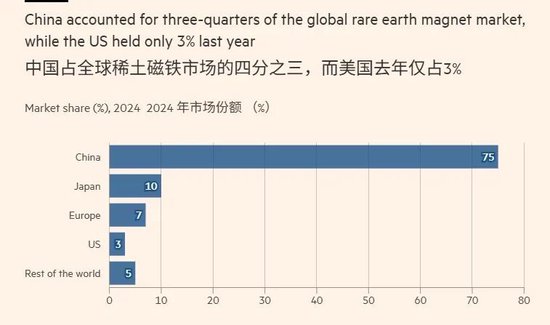
Core Viewpoint - The United States aims to reduce its dependence on Chinese rare earths by forming alliances, but continues to employ unilateral tactics such as tariff threats and deadlines [1][12]. Group 1: U.S. Policy and Actions - On January 14, President Trump signed a presidential announcement titled "Adjusting the Import of Processed Critical Minerals and Their Derivatives," threatening global suppliers with new trade barriers if they do not negotiate agreements with the U.S. [3][13]. - Trump declared that the U.S. reliance on foreign processed critical minerals poses a "national security threat" [2][14]. - The announcement states that by 2024, the U.S. will fully depend on imports for 12 critical minerals, with 29 others having a net import reliance of 50% or more [4][15]. - The U.S. Department of Commerce concluded that this reliance exposes critical sectors like defense and telecommunications to supply disruptions and price volatility [4][15]. - Trump instructed U.S. Trade Representative Jamison Greer and Commerce Secretary Howard Lutnick to negotiate agreements within 180 days, with a deadline of July 13 [4][15]. Group 2: International Relations and Supply Chain - The announcement did not specify demands to allies but emphasized the need for supply chain diversification away from "dominant and potentially coercive" sources [5][16]. - Measures suggested include enhancing processing capabilities among allies, securing purchasing agreements, and investing in non-Chinese facilities [5][16]. - The G7 finance ministers discussed rare earths, with China controlling over 60% of global rare earth production and 92% of processing [9][19]. - The U.S. and EU are developing emergency plans to enhance local production and diversify supplier networks [9][19]. - The U.S. is increasing cooperation with allies like Australia, Malaysia, Indonesia, and Vietnam to establish alternative supply chains [9][19]. Group 3: Pricing Strategies and Market Impact - The U.S. is considering setting a "price floor" for rare earths, which has raised concerns among G7 and EU members about potential cost increases for manufacturers [10][20]. - The 180-day deadline imposed by the U.S. is seen as direct pressure on the EU and India, both of which are hesitant about the price floor mechanism [10][20]. - China's Ministry of Foreign Affairs reiterated its commitment to maintaining stability and security in the global critical minerals supply chain [10][20].

精心布局13年,惨遭印度杀猪盘:日本的稀土独立梦为何失败
Sou Hu Cai Jing· 2025-11-20 07:43
Core Insights - Japan's ambition for rare earth independence has proven to be a strategic miscalculation, underestimating China's dominance in the global rare earth market and overestimating its own technological capabilities [1][14] Group 1: Historical Context - In 2010, China imposed rare earth export restrictions on Japan, reducing exports from 50,000 tons in 2009 to approximately 30,000 tons in 2011, resulting in a 40% supply shortfall [3] - This led to significant disruptions in Japan's manufacturing sector, particularly affecting the automotive industry, which faced production halts due to insufficient rare earth supplies [3] Group 2: Japan's Response and Actions - Following the 2010 crisis, Japan initiated a rare earth breakthrough plan, investing heavily to reduce reliance on Chinese supplies, but this effort was ultimately disrupted by India's export halt in June 2025 [4][5] - Japan engaged in various partnerships, including with Mongolia and Australia, and invested in rare earth recycling in France, spending over 100 billion yen on these initiatives [4] Group 3: Challenges Faced - Japan's agreement with India to source rare earths turned out to be ineffective, as India lacked the technological capacity to provide sufficient raw materials, leading to Japan purchasing rare earths that were originally sourced from China [4][5] - Attempts to develop alternative technologies, such as Sony's effort to recycle rare earths from old PS4 consoles, yielded minimal results, recovering only 200 kg from 100,000 units [7] Group 4: Resource Exploration and Limitations - Japan identified significant rare earth deposits near Minami-Torishima in 2013, but the high costs and technical challenges of deep-sea mining have hindered extraction efforts [9] - The projected cost for initial deep-sea mining trials in 2025 is estimated at 12 billion yen (approximately 83 million USD), with extraction rates being economically unfeasible [9] Group 5: China's Dominance - China's rare earth advantage is not solely based on resource control but on a comprehensive industrial ecosystem that includes mining, refining, and production of downstream materials, maintaining over 60% of the global market share in 2023 [11] - The systemic advantages China has developed over the years ensure its continued leadership in the rare earth sector, making it a challenging competitor for other nations seeking to disrupt this order [13][14]
安泰科:2025前三季度我国稀土产品进出口量总体呈同比下降趋势
智通财经网· 2025-10-23 13:01
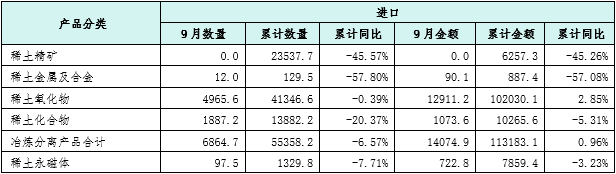
Core Viewpoint - In the first three quarters of 2025, China's rare earth import and export volumes showed a year-on-year decline, influenced by international trade dynamics and domestic export controls, yet China remains the primary supplier of rare earth products, contributing significantly to the stability of the global supply chain [1][21]. Import Situation Analysis - From January to September 2025, China imported a total of 23,537.7 tons of rare earth concentrates, a decrease of 45.6% year-on-year, with 99.3% of these imports coming from the United States [2][3]. - The import of rare earth metals and alloys was approximately 129.5 tons, down 57.8% year-on-year, while rare earth oxides totaled 41,346.6 tons, showing a slight decrease of 0.4% [3][4]. - The main sources of rare earth imports included Vietnam for metals and alloys (81%), Myanmar for oxides (61.8%), and Malaysia for compounds (64.3%) [7]. Export Situation Analysis - In the same period, China exported 48,000 tons of rare earth separation products, marking a 10.9% increase year-on-year, while exports of rare earth permanent magnets decreased by 7.5% [8][9]. - The export of rare earth metals and alloys reached 7,520.2 tons, up 4.0%, and rare earth oxides increased by 38.0% to 24,151.3 tons [9][11]. - Japan was the largest export destination for rare earth metals and alloys, accounting for 59.3% of the total, while the United States received 40% of the rare earth oxides [14]. Trade Influencing Factors - The trade of rare earth products has been affected by ongoing adjustments in Sino-U.S. economic policies, leading to fluctuations in export volumes [15][21]. - Despite a slight recovery in the third quarter, the overall export of rare earth permanent magnets to the U.S. saw a significant decline of 24.0% year-on-year [18][21]. - The export of rare earth separation products to the U.S. increased by 14.0%, primarily driven by light rare earth products such as lanthanum and cerium [18].