
稻米造血1类创新药

Search documents
科创板累计IPO募资规模达9346亿
2 1 Shi Ji Jing Ji Bao Dao· 2025-11-06 08:15
Core Insights - The establishment of the Sci-Tech Innovation Board (STAR Market) has significantly enhanced China's capital market's ability to support technological innovation, with 592 listed companies and total fundraising exceeding 1.1 trillion yuan by October 2025 [1][3] - The STAR Market has demonstrated strong growth, with a compound annual growth rate (CAGR) of 18% in revenue and 9% in net profit for listed companies over the past five years [3][4] - The board has successfully fostered a vibrant ecosystem for hard technology, with over 80% of companies in emerging industries such as new-generation information technology and biomedicine [4][5] Company Performance - As of 2025, 22 out of 57 unprofitable companies listed on the STAR Market have achieved profitability, indicating a positive trend in financial performance [3] - The integrated circuit sector has over 120 listed companies, with revenue and net profit growth of 27% and 83% respectively in the first three quarters of 2025 [4] - In the biopharmaceutical sector, 21 out of 22 companies have received approval for 48 drugs/vaccines, contributing significantly to the innovation landscape [4] R&D Investment - The total R&D investment by STAR Market companies reached 1,680 billion yuan in 2024, more than three times their net profit [5] - In the first three quarters of 2025, R&D investment amounted to 1,133.45 billion yuan, a year-on-year increase of 9.01% [5] - The average number of invention patents per company on the STAR Market is 230, with 30% of companies having products or projects that are industry-first [5][6] Ecosystem Development - The STAR Market has created a virtuous cycle of "technology-industry-capital," enhancing the efficient allocation of innovative resources [7] - Over 60% of the founding teams of STAR Market companies consist of scientists or industry experts, fostering a strong innovation culture [7] - The market has seen a significant increase in cash dividend proposals, with a total of 38.8 billion yuan in dividends planned for 2024 [8] Institutional Innovation - The STAR Market has pioneered various institutional innovations, including diverse listing standards and mechanisms for rapid financing, which serve as a model for other markets [9] - Recent reforms have expanded the scope of the STAR Market to include more cutting-edge fields, enhancing its inclusivity [9] - The growth of the STAR Market's "growth layer" has accelerated, with companies showing revenue growth of 35.09% and a median R&D intensity of 44.34% [9] Future Outlook - The Shanghai Stock Exchange aims to further leverage the STAR Market as a testing ground for identifying high-quality tech companies, particularly in emerging fields like artificial intelligence and aerospace [10]

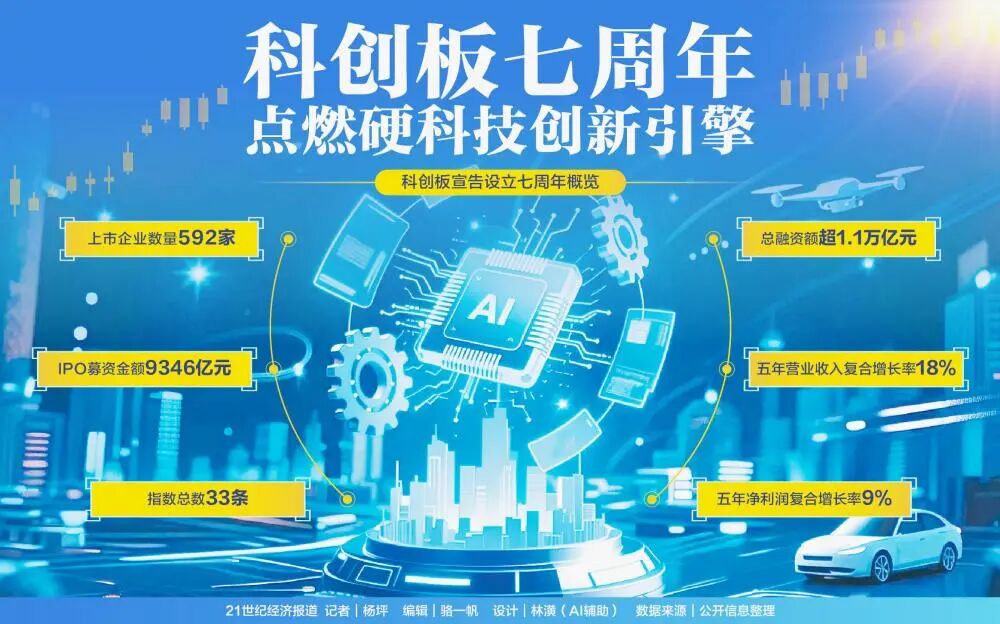
科创板累计IPO募资规模达9346亿
21世纪经济报道· 2025-11-06 08:05
Core Viewpoint - The establishment of the Sci-Tech Innovation Board (STAR Market) has significantly contributed to the development of China's capital market, particularly in supporting technological innovation and the growth of "hard technology" companies over the past seven years [1][3]. Group 1: Market Development and Performance - As of October 2025, the STAR Market has gathered 592 listed companies, with a cumulative IPO fundraising scale of 934.6 billion yuan and total financing exceeding 1.1 trillion yuan, playing a crucial role in nurturing new productive forces and upgrading the modern industrial system [1]. - The compound annual growth rates for operating income and net profit attributable to shareholders of STAR Market companies over the past five years are 18% and 9%, respectively, indicating strong growth potential [3]. - Among the 57 unprofitable companies at the time of listing, 22 have achieved profitability, showcasing a trend of successful transitions from research and development to market success [3]. Group 2: Industry Focus and Innovation - The STAR Market has maintained a focus on "hard technology," with over 80% of listed companies in emerging industries such as new-generation information technology, biomedicine, and high-end equipment manufacturing [5]. - Key industries like integrated circuits and biomedicine have seen significant clustering effects, with over 120 listed companies in the integrated circuit sector, contributing to a complete and collaborative innovation ecosystem [6]. - In the integrated circuit sector, revenue and net profit for 119 companies that disclosed Q3 reports in 2025 grew by 27% and 83% year-on-year, respectively, with net profit for chip design companies soaring by 141% [6]. Group 3: Research and Development Investment - In 2024, total R&D investment by STAR Market companies reached 168 billion yuan, more than three times their net profit; in the first three quarters of 2025, R&D investment reached 113.3 billion yuan, a year-on-year increase of 9.01% [7]. - The STAR Market has generated over 130,000 invention patents, with an average of 230 patents per company, and 30% of companies have products or projects that are industry-first [7]. Group 4: Ecosystem and Capital Integration - The STAR Market has successfully established a virtuous cycle of "technology-industry-capital," enhancing the efficient allocation of innovative resources [10]. - Approximately 90% of STAR Market companies received venture capital investment before going public, indicating a strong trend towards early-stage investment in hard technology [11]. - The STAR Market has developed a comprehensive index system, with over 100 ETFs listed, and the total scale of index tracking products exceeding 330 billion yuan, making it a flagship index for hard technology investments [11]. Group 5: Institutional Innovation and Reforms - As a pioneer in the registration system reform, the STAR Market has implemented various innovative practices in issuance, listing, and trading, providing valuable experience for other market segments [14]. - Recent reforms, including the "1+6" measures, have further enhanced the inclusivity of the system, supporting the growth of companies in cutting-edge fields like artificial intelligence [14][15]. - The STAR Market has also accelerated the development of the "growth layer" for innovative companies, with significant increases in revenue and R&D investment among these firms [14].

592颗星,1.1万亿活水:科创板激活中国创新伟力
Zhong Guo Ji Jin Bao· 2025-11-05 05:02
Core Insights - The Sci-Tech Innovation Board (STAR Market) has significantly contributed to China's innovation-driven economic development, with 592 listed companies and over 1.1 trillion yuan raised since its inception [1][2] - The board has established a unique ecosystem that supports various stages of technology companies, allowing unprofitable firms to go public and facilitating substantial R&D investments [2][4] Group 1: Institutional Framework - The STAR Market's inclusive listing system has enabled 57 unprofitable companies to go public, with 22 of them turning profitable [2] - The introduction of the fifth set of listing standards has particularly benefited the biopharmaceutical sector, with 21 out of 22 companies successfully launching self-developed drugs [3] Group 2: R&D Investment - In 2024, total R&D investment by STAR Market companies reached 168 billion yuan, more than three times the net profit of the sector [4] - By the third quarter of 2025, R&D investment further increased to 113.35 billion yuan, marking a 9.01% year-on-year growth [4] Group 3: Industry Clusters - The STAR Market has fostered significant industry clusters, particularly in integrated circuits, with 121 listed companies covering the entire supply chain [5][6] - The semiconductor sector has seen record IPO fundraising, which has stimulated growth in related upstream and downstream companies [6] Group 4: Capital Ecosystem - Approximately 90% of STAR Market companies received venture capital before going public, promoting a culture of early and small investments in hard technology [7] - The market has developed a comprehensive index system with 33 indices and over 100 ETFs, with total assets exceeding 330 billion yuan [7] Group 5: Policy Developments - The introduction of the "1+6" policy measures aims to enhance support for technology companies with significant breakthroughs and ongoing R&D investments [8] - These reforms signify a transition from a testing ground to a demonstration platform, further aligning with national innovation strategies [8]