
第二代睡眠产品

Search documents
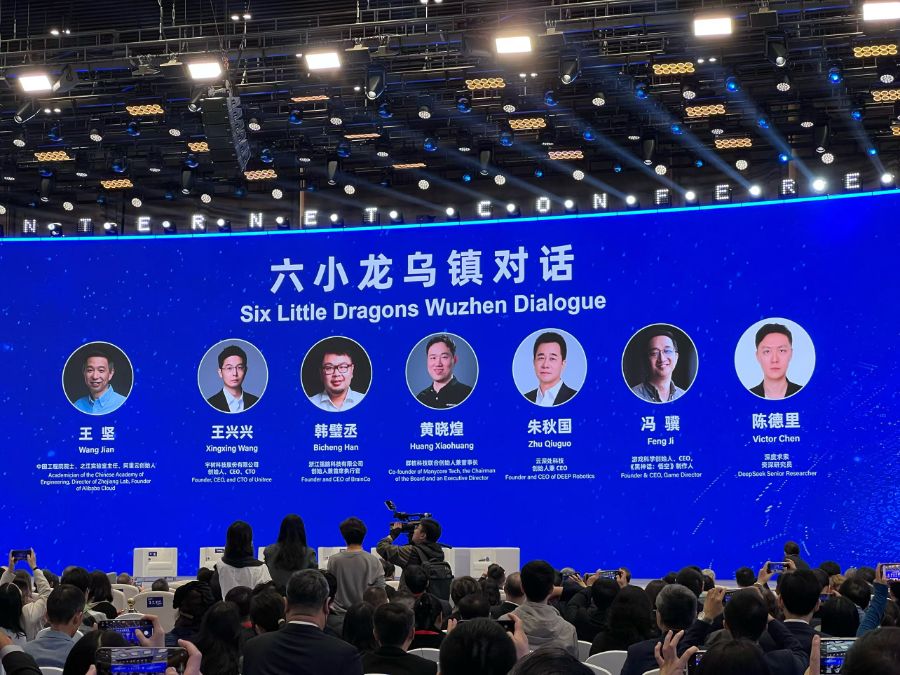
在乌镇 “杭州六小龙” 聊了三件事
Zhong Guo Xin Wen Wang· 2025-11-08 14:08
Core Insights - The 2025 World Internet Conference in Wuzhen highlighted the "Hangzhou Six Little Dragons," showcasing their innovative breakthroughs and ongoing relevance in the AI industry [1][2] - The event featured a dialogue among the six companies, discussing their entrepreneurial challenges, successes, and future industry priorities, providing a unique perspective on the evolution of China's AI sector [1][2] Group 1: Company Experiences - Strong Brain Technology shared humorous anecdotes about their early struggles, including a story about scaring a local resident during late-night experiments [2] - Cloud Deep Technology recounted the challenges faced during the initial product demonstrations, where their robotic dog required steel wires for support due to technical limitations [2] - The experiences of these companies reflect the broader narrative of the nascent development of China's AI industry over the past decade [3] Group 2: Industry Growth and Opportunities - The success of the "Little Dragons" is attributed to the support of Chinese users and the rapid development of the internet and mobile internet over the past decade, which has created a wealth of data and user engagement [4][5] - The AI industry in China is projected to exceed 700 billion yuan by 2024, maintaining a growth rate of over 20% annually [6] Group 3: Future Prospects and Challenges - Companies expressed optimism about the future of AI, with expectations for significant advancements in robotics and other applications in the coming years [7] - Key challenges identified include the need for robots to move autonomously and the technical hurdles in creating bionic hands, as well as the ethical implications of AI development [8] - The dialogue emphasized the importance of ensuring AI serves to help rather than harm society, highlighting the need for responsible innovation [8]
杭州六小龙,乌镇大会首次同框
2 1 Shi Ji Jing Ji Bao Dao· 2025-11-08 04:28
Core Insights - The "Six Little Dragons" of Hangzhou showcased their advancements and challenges in various tech sectors during the Wuzhen Internet Conference, highlighting the rapid development of AI and its implications for their industries [1][3]. Group 1: Industry Developments - Yushutech's CEO Wang Xingxing noted that AI is accelerating the development of the robotics industry, particularly in humanoid robots, which are relatively easier to advance compared to other cutting-edge technologies [3]. - Qiangnao Technology's founder Han Bicheng emphasized that brain-computer interfaces have transitioned from laboratory concepts to impactful products, such as aiding the visually impaired, with their second-generation sleep product aimed at improving sleep for those with insomnia [3]. - Qunke Technology's founder Huang Xiaohuang identified spatial intelligence as a significant field following large language models, applicable in robotics and video generation [3]. - Yundongchu Technology's CEO Zhu Qiuguo stated that robots will ultimately assist humans in addressing dangerous tasks in the workplace [3]. - Game Science's Feng Ji highlighted that China's gaming industry has the largest user base and market size globally, having developed significantly over the past decade [3]. Group 2: Challenges and Risks - The "Six Little Dragons" expressed concerns about the challenges posed by AI development. Wang Xingxing pointed out that while large language models have made significant progress, the training data for robotics cannot be decoupled from the robots themselves, leading to a lack of standardization [4]. - Han Bicheng mentioned that serious brain diseases like Alzheimer's and autism currently lack effective treatments, but AI could aid in data collection and analysis [4]. - Huang Xiaohuang warned that the rise of AI could lead to the replacement of traditionally stable creative jobs [4]. - Zhu Qiuguo noted that robotics faces power supply bottlenecks, and dexterous hands struggle with complex tasks in uncertain environments [4]. - Feng Ji raised concerns about the potential monopolization of technological advantages by fewer individuals and companies due to AI advancements, posing a significant risk [5]. - Chen Deli from Deep Exploration emphasized the need for effective and stable algorithms for AI, advocating for continuous learning in real-world environments [6].

强脑科技创始人韩璧丞:把脑机接口技术变成真实产品
2 1 Shi Ji Jing Ji Bao Dao· 2025-11-07 12:05
Core Viewpoint - The company is focused on developing non-invasive brain-computer interface technology aimed at creating real-world products to assist individuals with disabilities, particularly those without limbs, enabling them to lead normal lives [1] Group 1: Technology Development - The company is pursuing a technology roadmap that emphasizes addressing urgent needs first, referred to as "from pain to large" [1] - The CEO highlighted the potential of non-invasive brain-computer interfaces to create products that allow individuals to control prosthetic limbs through thought [1] Group 2: Product Expansion - The company plans to expand its product offerings, with a second-generation sleep product expected to launch next year aimed at helping individuals with sleep issues [1] - A weight management product is also in development, scheduled for release in the following year, continuing the focus on solving everyday problems through brain-computer interface technology [1]