
索拉非尼

Search documents
海正药业:获得药品补充申请批准通知书
Ge Long Hui· 2025-12-23 09:19
Core Viewpoint - The company has received approval from the National Medical Products Administration for a supplemental application for Everolimus tablets, adding a new 2.5mg specification to the already approved 5mg version [1] Group 1: Product Approval - The new 2.5mg specification of Everolimus is intended for adult patients with advanced renal cell carcinoma who have failed previous treatments with Sunitinib or Sorafenib [1] - Everolimus is also indicated for various other conditions, including advanced pancreatic neuroendocrine tumors and tuberous sclerosis complex-related tumors [1] - The original manufacturer of Everolimus is Novartis, and the product has been approved under the new category 4, which is considered equivalent to passing the consistency evaluation [1] Group 2: Market Statistics - The global sales of Everolimus tablets are projected to be approximately $1.013 billion in 2024, with domestic sales around $11.7842 million [2] - For the first half of 2025, global sales are estimated at about $497 million, with domestic sales expected to be around $5.4255 million [2] - The company has invested approximately 7.4042 million RMB in the research and development of the 2.5mg specification of Everolimus [2]

沈阳药科大学最新Cell子刊论文:铁死亡+免疫治疗,双管齐下抗肿瘤
生物世界· 2025-11-10 00:30
Core Viewpoint - Ferroptosis is emerging as a promising anti-tumor therapy driven by the oxidation of polyunsaturated fatty acids in cell membranes, leading to lipid peroxidation and cell death, while also releasing damage-associated molecular patterns (DAMPs) that enhance T cell activation [1][4]. Summary by Sections Ferroptosis Mechanism and Challenges - Ferroptosis induces cell death through increased intracellular iron, reduced glutathione synthesis, and elevated reactive oxygen species (ROS) levels. However, the upregulation of PD-L1 in tumor cells can inhibit cytotoxic T cell recognition, leading to immune suppression [1][5]. Research Development - A team from Shenyang Pharmaceutical University and Shenzhen University developed a fluorinated prodrug-engineered nano-remodeler that combines a PD-L1 inhibitor (JQ1) and a ferroptosis inducer (sorafenib) to enhance oxygen supply in hypoxic tumors, significantly improving the efficacy of ferroptosis and anti-tumor immunogenicity [2][6]. Nano-remodeler Characteristics - The engineered nano-remodeler (FJSO NA) has high oxygen solubility and releases oxygen in low-pressure environments, alleviating hypoxia in solid tumors, downregulating PD-L1 expression, and enhancing ferroptosis induction and anti-tumor immune responses [6][8]. Efficacy and Safety - The study demonstrated that the nano-remodeler effectively inhibited tumor growth in various models without significant toxicity, indicating a promising direction for enhancing ferroptosis-based immunotherapy by addressing the hypoxic tumor microenvironment [8].


和誉-B(02256)中报观:靠“造血优势”拉高安全边际,靠硬核创新提升配置价值
智通财经网· 2025-08-05 00:04
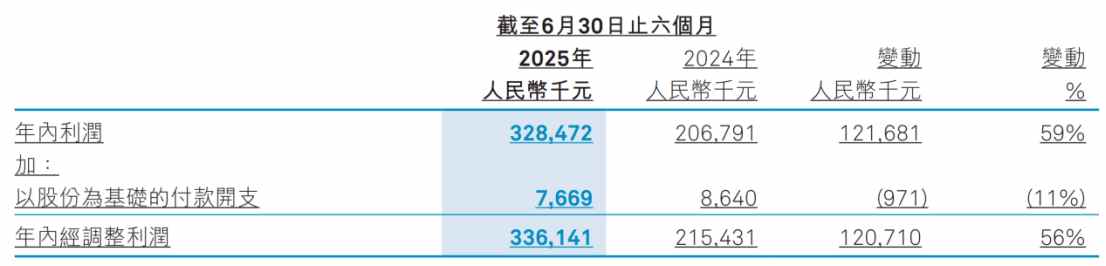
Core Viewpoint - The company has experienced significant stock price growth and is actively repurchasing shares to reward investors, reflecting strong market recognition of its value [1][2]. Group 1: Financial Performance - As of June 30, the company achieved total revenue of 657 million RMB, a 20% year-on-year increase, with a net profit of 328 million RMB, up 59% from the previous year [3][4]. - The adjusted net profit reached 336 million RMB, marking a 56% increase year-on-year [4]. - The company has received over 150 million USD in cash from its collaboration with Merck, with potential future payments totaling up to 606 million USD [4]. Group 2: Product Development and Commercialization - The core product, Pimicotinib, has been recognized as a breakthrough therapy by multiple regulatory agencies, indicating strong commercial potential [2][3]. - The company has established a robust pipeline with 22 differentiated innovative research projects, focusing on oncology precision treatment and immune therapy [6][11]. - The second major product, Epagolatinib, has also been designated as a breakthrough therapy, showcasing the company's innovative capabilities in drug design [10][11]. Group 3: Market Position and Valuation - The company is positioned to capitalize on the growing global market for liver cancer treatments, projected to reach approximately 5.3 billion USD by 2029 [10][12]. - Current price-to-sales (PS) ratio stands at 14.01, indicating significant growth potential compared to peers with higher valuations [12].
恒瑞医药4款药物临床获批 累计研发超20亿元
Zheng Quan Shi Bao Wang· 2025-07-17 10:15
Core Viewpoint - Heng Rui Medicine has received approval from the National Medical Products Administration for clinical trials of four drugs, indicating a significant advancement in its oncology pipeline [1][2][3][4] Group 1: Drug Approvals and Clinical Trials - The company and its subsidiaries have been granted clinical trial approval for SHR-8068 injection, Adebali monoclonal antibody injection, Bevacizumab injection, and Apatinib mesylate tablets [1][2][3][4] - SHR-8068 is a fully human anti-CTLA-4 monoclonal antibody aimed at enhancing anti-tumor immune effects, with a cumulative R&D investment of approximately 214 million yuan [1] - Adebali monoclonal antibody injection, a humanized anti-PD-L1 monoclonal antibody, was approved in March 2023 for first-line treatment of extensive-stage small cell lung cancer, with a cumulative R&D investment of about 887 million yuan [2] - Bevacizumab injection, a humanized anti-VEGF monoclonal antibody, was approved in June 2021, with a cumulative R&D investment of around 345 million yuan [3] - Apatinib mesylate tablets have been approved for three indications, with a cumulative R&D investment of approximately 587 million yuan [4] Group 2: Market Potential and Competitors - The global sales of similar products for SHR-8068, including Ipilimumab and Tremelimumab, are projected to be approximately 3.271 billion USD in 2024 [1] - The combined global sales for Adebali's competitors, Atezolizumab, Avelumab, and Durvalumab, are estimated to be around 9.648 billion USD in 2024 [2] - Bevacizumab's global sales are projected to be about 5.655 billion USD in 2024 [3] - The global sales for Apatinib's competitors, including Sorafenib, Sunitinib, and Pazopanib, are expected to total approximately 543 million USD in 2024 [4]

第二款“十亿美元分子”获BTD认证,和誉-B(02256)“真创新”配置价值凸显
智通财经网· 2025-05-28 01:55
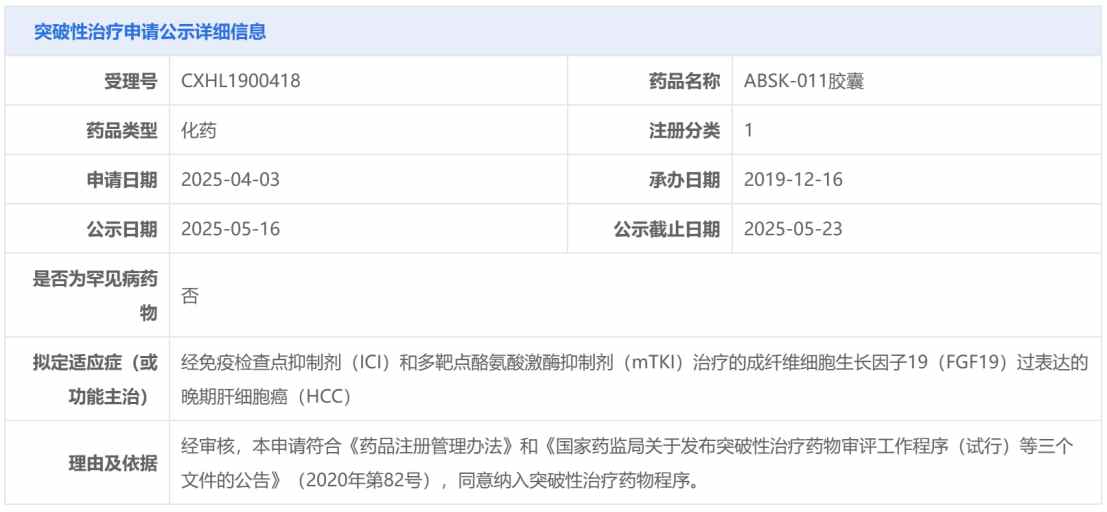
Core Viewpoint - The announcement of the inclusion of ABSK011 (Ipagotinib) as a breakthrough therapy for advanced hepatocellular carcinoma (HCC) patients who have failed previous treatments marks a significant milestone for the company, indicating its potential to become a "billion-dollar molecule" [1][2][3]. Group 1: Breakthrough Therapy Designation - ABSK011 has been officially designated as a breakthrough therapy for treating FGF19 overexpressing advanced HCC patients who have previously undergone immune checkpoint inhibitors (ICI) and multi-targeted tyrosine kinase inhibitors (mTKI) [1][2]. - This designation follows the earlier approval of Pimicotinib (ABSK021), making ABSK011 the second major product of the company to receive such recognition [1]. Group 2: Clinical Data and Efficacy - Recent clinical data presented at the ESMO conference showed that the 220mg BID dosage of ABSK011 achieved an overall response rate (ORR) of 44.8% in patients with FGF19 overexpressing HCC who had previously been treated with ICIs and mTKIs [3][4]. - The drug demonstrated a median duration of response (mDOR) of 7.4 months and a median progression-free survival (mPFS) of 5.5 months, significantly outperforming existing therapies [3][4]. Group 3: Market Potential and Competitive Advantage - The global liver cancer market is projected to reach approximately $5.3 billion by 2029, with immunotherapy accounting for about 72.2% of the market share [6]. - The company has developed ABSK011 as the first small molecule inhibitor targeting the aberrant activation of the FGF19/FGFR4 signaling pathway, which is expected to provide a differentiated treatment option for HCC patients [2][6]. Group 4: Financial Performance and Investment Value - The company has achieved its first full-year profitability in 2024, generating substantial cash flow and signaling a sustainable growth trajectory [8]. - The management has been actively repurchasing shares, reflecting confidence in the company's future and commitment to returning value to investors [8][9]. Group 5: Stock Market Performance - Following a period of volatility, the company's stock price rebounded significantly, reaching a peak of 8.95 HKD, with a maximum increase of 62.14% over a one-and-a-half-month period [11]. - This price recovery indicates strong market interest and confidence in the company's fundamentals and growth potential [11].
国内首个肝细胞癌一线双免疫联合疗法获批上市
Xin Jing Bao· 2025-04-01 02:26
Core Viewpoint - Bristol-Myers Squibb's immunotherapy drugs, Opdivo (nivolumab) and Yervoy (ipilimumab), have received approval from the National Medical Products Administration for a new indication as a first-line treatment for adult patients with unresectable or advanced hepatocellular carcinoma, making it the first and only approved dual immunotherapy regimen for this condition in China [1][2]. Group 1 - The approval is based on the Phase III CheckMate-9DW study, which is the first global trial to demonstrate the efficacy of an immunotherapy regimen for first-line treatment of hepatocellular carcinoma, showing significant superiority over previous standard treatments (lenvatinib or sorafenib) [1][2]. - The CheckMate-9DW study involved a global multi-center, randomized controlled design, comparing the Opdivo and Yervoy regimen against investigator's choice of lenvatinib or sorafenib, with 85% of the control group receiving lenvatinib [2]. - The primary endpoint results indicated that the median overall survival (mOS) for the Opdivo and Yervoy group was 23.7 months, compared to 20.6 months for the control group, representing a 21% reduction in the risk of death [2]. Group 2 - The secondary endpoint results showed that the objective response rate (ORR) for the Opdivo and Yervoy group was 36%, while the control group had an ORR of 13%; the median duration of response (mDOR) was 30.4 months for the treatment group versus 12.9 months for the control group [2]. - The overall safety profile of the Opdivo and Yervoy regimen was manageable, with no new safety signals identified; the incidence of grade 3/4 treatment-related adverse events was 41% for the treatment group and 42% for the control group [2]. - The principal investigator in China emphasized that the dual immunotherapy regimen not only has a high response rate but also significantly extends both the duration of response and overall survival, indicating its excellent short-term efficacy and long-term survival benefits [2]. Group 3 - Opdivo and Yervoy were approved in October 2015, becoming the first immuno-oncology drug combination approved by regulatory authorities globally, and have since been approved in over 50 countries for seven types of cancer, including melanoma, kidney cancer, colorectal cancer, liver cancer, lung cancer, mesothelioma, and esophageal cancer [3]. - The Opdivo and Yervoy regimen has been approved in China for multiple cancer types, including mesothelioma, colorectal cancer, and hepatocellular carcinoma [3].