经贸类展会

Search documents
去年我国经贸类展会数量和展览总面积创新高 会展业综合带动效应不断放大
Jing Ji Ri Bao· 2026-02-01 01:30
Core Insights - The report from the China Council for the Promotion of International Trade indicates that by 2025, China will host 4,095 trade exhibitions with a total exhibition area of 159 million square meters, representing year-on-year growth of 6.53% and 2.5% respectively, both setting historical records [1] - The exhibition industry is recognized as a crucial vehicle for guiding industrial development and promoting economic cooperation, with China's complete industrial system and innovation framework providing a broad market space for deepening cooperation in the exhibition sector [1] - Future development directions for the exhibition industry include integration, greening, internationalization, specialization, and digitization, with localities breaking down barriers to promote deep integration with consumption, trade, culture, and tourism [1] Group 1: Exhibition Industry Growth - In the "Exhibition + Consumption" aspect, regions like Guangdong, Jiangxi, Tianjin, and Chongqing are incorporating the exhibition industry into special actions to boost consumption, encouraging the hosting of consumer exhibitions and first-release events [2] - The "Exhibition + Trade" initiative in Beijing emphasizes the platform role of the exhibition industry in the high-quality development of service and digital trade, promoting specialized exhibitions in these areas [2] - The exhibition industry is evolving from a basic trade demand to nurturing industrial ecosystems, with a focus on becoming a "symbiotic partner" that fosters collaboration across the industrial chain [2] Group 2: Policy Support and Regional Development - By 2025, various regions are expected to implement policies supporting the exhibition industry's development, creating a multi-faceted support system that includes rewards, subsidies, and tax exemptions [2] - In Wuhan, major exhibitions like the International Auto Show are accelerating the transformation of the automotive industry, attracting significant investments and new production capacities [2] - Hubei province plans to host nearly 2,000 exhibitions in 2025, with over 100 exhibitions exceeding 10,000 square meters, attracting participants from over 120 countries and regions, and generating contracts worth over 300 billion yuan [3]
中国展览经济发展报告2025-中国国际贸易促进委员会
中国国际贸易促进委员会· 2026-01-26 06:35
Investment Rating - The report indicates a positive outlook for the exhibition industry in China for 2025, with expectations of growth and increased internationalization [6]. Core Insights - The overall industry is progressing steadily, with the number and area of trade exhibitions in China reaching historical highs in 2025, and the level of internationalization continuing to improve [6]. - The regional distribution of exhibitions is optimizing, with an increased share of exhibitions in the central and western regions, while the Yangtze River Delta, Pearl River Delta, and Beijing-Tianjin-Hebei remain major hubs [6]. - The structure of overseas exhibitions is improving, with significant growth in projects in Asia, Latin America, and Africa, while the share of traditional markets in Europe and America has slightly decreased [6]. - The acceleration of green and digital transformation in exhibition venues is notable, with a significant increase in the number of operational exhibition venues and the implementation of green venue standards, alongside widespread use of technologies like AI and VR [6]. - There is a clear policy drive, with local governments introducing special policies to support the integration of the exhibition industry with consumption, cultural tourism, and industry [6]. - Major exhibition platforms such as the Chain Expo, China International Import Expo, and Canton Fair are highlighted as important windows for opening up to the outside world [6]. - The outlook for 2026 is optimistic, with the exhibition industry expected to continue playing a significant role in the construction of a modern industrial system, leading new consumption, and empowering the digital economy [6]. Summary by Relevant Sections Market Performance - In 2025, the number of domestic trade exhibitions is projected to be 4,095, covering an area of 1.59 million square meters, marking a historical high [7]. - The central and western regions are expected to see an increase in exhibition share, indicating a trend towards regional balance [7]. - The number of UFI-certified members in China (excluding Hong Kong, Macau, and Taiwan) is 258, with overseas exhibitions covering 57 countries [7]. Technological and Policy Environment - The implementation of AI, VR, and green venue standards is expected to enhance the digitalization and sustainability of the exhibition industry [7]. - Various local governments are expected to continue introducing supportive policies for the exhibition industry [7].
中国办展面积创新高,展会经济将成城市竞争新赛道
Di Yi Cai Jing· 2026-01-23 05:19
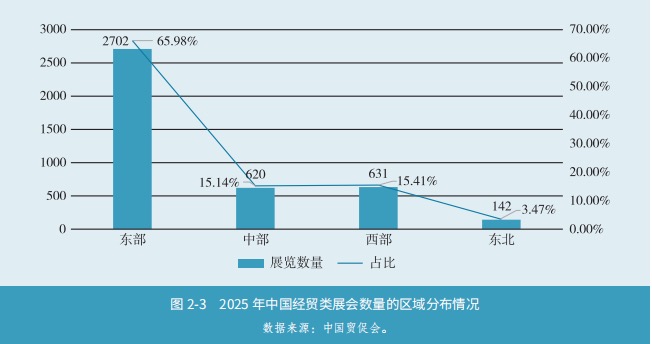
Core Insights - The exhibition economy in China is projected to reach historical highs in 2025, with 4,095 trade exhibitions and a total exhibition area of 159 million square meters [1][2]. Group 1: Industry Trends - Emerging hotspots for exhibitions include cutting-edge fields such as artificial intelligence and smart connected vehicles, with 28 Chinese exhibitions making it to the global top 100 list, ranking second worldwide [2]. - The number of exhibitions in the central and western regions is growing faster than the national average, indicating a shift in the regional exhibition landscape [3]. Group 2: Regional Dynamics - In 2025, the eastern region will host 2,702 trade exhibitions, accounting for 65.98% of the total, while the central and western regions will see slight increases in their shares, with 620 and 631 exhibitions respectively [3]. - The 20th China Western International Expo attracted over 3,000 enterprises from 62 countries and regions, with a total investment of 354.3 billion yuan, highlighting its significance as a gateway for western development [3]. Group 3: Exhibition Scale and Structure - The number of small to medium-sized exhibitions (10,000 to 30,000 square meters) increased by 24.26%, while large exhibitions (over 100,000 square meters) grew by 15.03% [5]. - Industrial and technology exhibitions lead the industry distribution, making up 21.87% of the total, followed by consumer goods and residential services at 11.5% [5]. Group 4: International Exhibition Projects - In 2025, overseas exhibition projects are primarily concentrated in Asia and Western Europe, with Asian projects increasing by 16.07% to 520, representing 41.3% of the total [6]. - The actual transaction amount from overseas exhibitions rose by 19.09%, with an average transaction value per event increasing by 14.16% [6]. Group 5: Government Support and Policy - Local governments are implementing diverse support systems for the exhibition industry, including financial incentives and policy measures to stimulate growth [7][8]. - Initiatives such as integrating exhibitions with consumption, trade, and cultural tourism are being promoted to enhance the overall economic impact of the exhibition sector [8]. Group 6: Future Development - The exhibition industry is expected to transition towards digitalization and sustainability, with a focus on creating a low-carbon exhibition environment [10]. - The competition among cities in the exhibition economy is intensifying, with international cities aiming for world-class exhibitions and regional cities focusing on national-level events [10].