综合PMI产出指数

Search documents
——2026年3月4日利率债观察:如何科学评价春节月的PMI?
EBSCN· 2026-03-04 14:07
1. Industry Investment Rating - There is no information about the industry investment rating provided in the report 2. Core Viewpoints - The manufacturing PMI in February 2026 was 49.0%, a 0.3 percentage point decline from the previous month, mainly due to the Spring Festival holiday. Averaging the January and February values can mitigate the impact of the holiday. The average of the manufacturing PMI in January and February 2026 was 49.15%, 0.15 percentage points higher than the February value [1][9]. - The traditional method of judging based on whether the PMI exceeds 50% has limited investment - guiding significance as the manufacturing PMI has been mostly below 50% in recent years. Comparing the current value with the previous one can sensitively perceive the latest data. Using the average of the past two or three months as a benchmark can avoid the "noise" caused by rapid fluctuations [2][11]. - Comparing with historical quantiles is also a valid evaluation method. The average of the manufacturing PMI in January and February 2026 was slightly lower than the 1/4 quantile and the median from September 2024 to December 2025. This method can also be extended to non - manufacturing and comprehensive PMI output indices [3][14]. 3. Summary by Relevant Catalogs How to scientifically evaluate the PMI during the "Spring Festival month"? - **Manufacturing PMI**: In February 2026, the manufacturing PMI was 49.0%, down 0.3 percentage points from the previous month. The average of January and February was 49.15%. The traditional method of judging by the 50% threshold has limited investment guidance. Comparing with the previous value can sense the latest data, and using the average of the past two or three months can avoid "noise". The 2026 January - February average was lower than the 2025 December value, and also lower than the averages of November - December 2025 and October - December 2025. It was also slightly lower than the 1/4 quantile and median from September 2024 to December 2025 [1][2][14]. - **Non - manufacturing PMI**: The non - manufacturing procurement manager survey index system includes 10 classification indices, and the business activity index is commonly used to reflect the overall non - manufacturing economic change. The average of the non - manufacturing business activity index in January and February 2026 was 49.45%, lower than the 1/4 quantile (50.08%) and median (50.25%) from September 2024 to December 2025. The average of the construction business activity index in the same period was 48.50%, lower than the corresponding 1/4 quantile (49.68%) and median (50.85%) [15]. - **Comprehensive PMI Output Index**: It reflects the overall output change of the whole industry. The average of the comprehensive PMI output index in 2026 was 49.65%, lower than the 1/4 quantile (50.35%) and median (50.60%) from September 2024 to December 2025 [21].
【数据发布】2026年1月中国采购经理指数运行情况
中汽协会数据· 2026-02-02 05:03
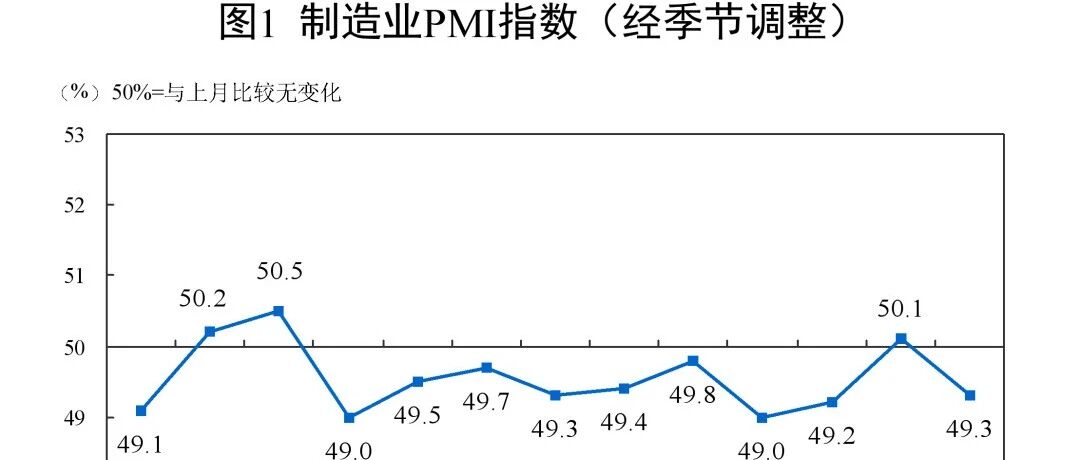
Group 1: Manufacturing PMI Overview - In January, the Manufacturing Purchasing Managers' Index (PMI) was 49.3%, a decrease of 0.8 percentage points from the previous month, indicating a decline in manufacturing activity [1] - Large enterprises had a PMI of 50.3%, down 0.5 percentage points, while medium and small enterprises had PMIs of 48.7% and 47.4%, down 1.1 and 1.2 percentage points respectively, both below the critical point [3] - The production index was 50.6%, down 1.1 percentage points, indicating continued expansion in manufacturing production [3] - The new orders index was 49.2%, down 1.6 percentage points, suggesting a slowdown in market demand [3] - The raw materials inventory index was 47.4%, down 0.4 percentage points, indicating a continued decrease in major raw material inventories [3] - The employment index was 48.1%, down 0.1 percentage points, reflecting a slight decline in employment conditions within manufacturing [3] - The supplier delivery time index was 50.1%, down 0.1 percentage points, indicating that supplier delivery times continued to accelerate [4] Group 2: Non-Manufacturing PMI Overview - In January, the Non-Manufacturing Business Activity Index was 49.4%, a decrease of 0.8 percentage points from the previous month [6] - The construction industry business activity index was 48.8%, down 4.0 percentage points, while the service industry business activity index was 49.5%, down 0.2 percentage points [8] - The new orders index for non-manufacturing was 46.1%, down 1.2 percentage points, indicating a decline in market demand [13] - The input prices index was 50.0%, down 0.2 percentage points, indicating stable input prices for non-manufacturing enterprises [13] - The sales prices index was 48.8%, up 0.8 percentage points, suggesting a narrowing decline in sales prices [13] - The employment index was 46.1%, stable from the previous month, indicating stable employment conditions in non-manufacturing [13] - The business activity expectation index was 56.0%, down 0.5 percentage points, remaining in a high optimism range [14] Group 3: Comprehensive PMI Overview - In January, the Comprehensive PMI Output Index was 49.8%, a decrease of 0.9 percentage points, indicating a general slowdown in production and business activities compared to the previous month [18]

2025年9月中国采购经理指数运行情况
Guo Jia Tong Ji Ju· 2025-09-30 01:30
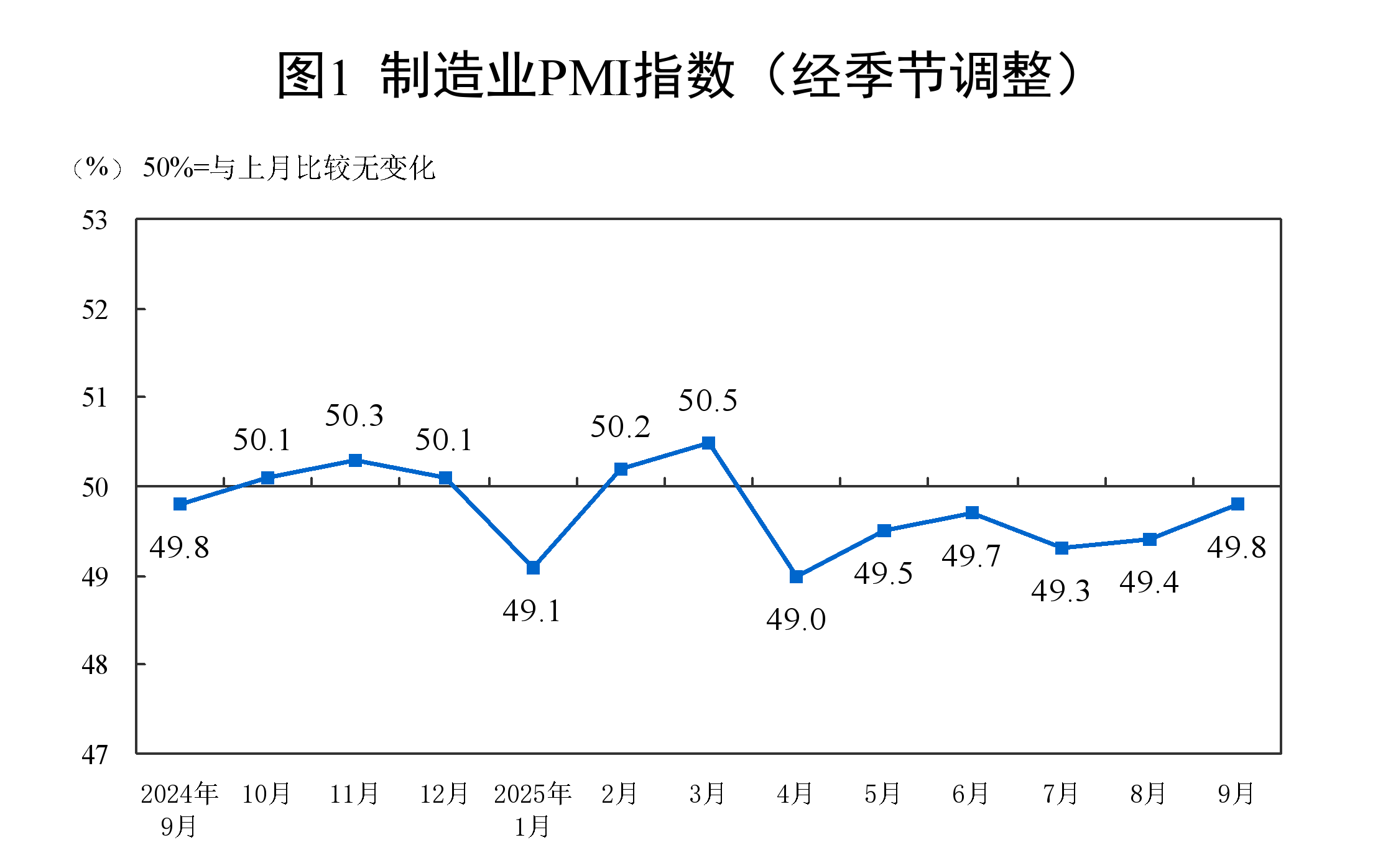
Group 1: Manufacturing PMI Overview - In September, the Manufacturing Purchasing Managers' Index (PMI) was 49.8%, an increase of 0.4 percentage points from the previous month, indicating continued improvement in manufacturing sentiment [1] - The PMI for large enterprises was 51.0%, up 0.2 percentage points, while medium-sized enterprises saw a PMI of 48.8%, down 0.1 percentage points, and small enterprises had a PMI of 48.2%, up 1.6 percentage points [4] - The production index was 51.9%, up 1.1 percentage points, indicating accelerated production expansion, while the new orders index was 49.7%, up 0.2 percentage points, suggesting improved market demand [4] Group 2: Manufacturing PMI Components - The raw material inventory index was 48.5%, up 0.5 percentage points, indicating a continued narrowing of the decline in raw material inventory levels [4] - The employment index was 48.5%, up 0.6 percentage points, reflecting improved employment sentiment in manufacturing [4] - The supplier delivery time index was 50.8%, up 0.3 percentage points, indicating faster delivery times from suppliers [4] Group 3: Non-Manufacturing PMI Overview - In September, the Non-Manufacturing Business Activity Index was 50.0%, a decrease of 0.3 percentage points from the previous month, indicating overall stability in non-manufacturing business volume [8] - The construction industry business activity index was 49.3%, up 0.2 percentage points, while the service industry index was 50.1%, down 0.4 percentage points [10] Group 4: Non-Manufacturing PMI Components - The new orders index for non-manufacturing was 46.0%, down 0.6 percentage points, indicating a decline in market demand [14] - The input prices index was 49.0%, down 1.3 percentage points, suggesting a decrease in the overall level of input prices for non-manufacturing enterprises [14] - The employment index for non-manufacturing was 45.0%, down 0.6 percentage points, indicating a decline in employment sentiment [16] Group 5: Composite PMI Overview - The Composite PMI Output Index was 50.6%, an increase of 0.1 percentage points from the previous month, indicating continued acceleration in overall production and business activities [19]