
网购

Search documents
新华深读 | 1.6亿“银发网民”加速“链接”数字世界
Xin Hua She· 2025-12-29 03:58
Core Insights - The number of elderly internet users in China aged 60 and above is projected to reach 161 million by June 2025, indicating a significant shift in their engagement with the digital world [1] - The digitalization of life services and social interactions is transforming the lifestyle of the elderly, with a notable increase in their online activities [2][3] Group 1: Digital Engagement of the Elderly - The elderly population's online presence has grown approximately 18 times from less than 10 million in 2010 to 161 million in 2025, reflecting a major lifestyle change [1] - Social networking is a primary reason for elderly individuals to go online, with about 97% of them using communication tools, primarily engaging in familiar social circles [1] - The online shopping rate among elderly users has reached 69.8%, with significant participation in health, entertainment, and travel sectors [2] Group 2: Content Creation and Personal Empowerment - Over 75% of elderly internet users aged 55 to 83 have experience in short video creation, with more than 27% regularly posting content, marking a shift from consumers to content creators [3] - The internet serves as a platform for elderly individuals to redefine their self-worth and engage in creative expression, positively impacting their mental health [3] Group 3: Social Connections and Family Dynamics - The internet is crucial for elderly individuals to combat loneliness and maintain social connections, especially as family structures become smaller [4] - Digital engagement has been shown to improve family relationships, with children often taking on teaching roles to help their parents navigate technology [4] Group 4: Challenges and Barriers - Despite the benefits, 82.9% of elderly internet users face various obstacles in using the internet, with this figure rising to 87.9% among those aged 70 and above [5] - Physical limitations, such as vision and hearing impairments, along with psychological barriers like fear of technology, hinder their online experience [6] Group 5: Policy and Community Support - Recent policies aim to create a more inclusive digital environment for the elderly, focusing on improving digital literacy and preventing online fraud [9][10] - Community initiatives, such as "time banks," are emerging to provide elderly individuals with support in learning digital skills, fostering intergenerational connections [11]
习近平新时代中国特色社会主义思想获国际社会高度认同 2025年中国国际形象全球调查报告发布
Huan Qiu Shi Bao· 2025-12-29 01:29
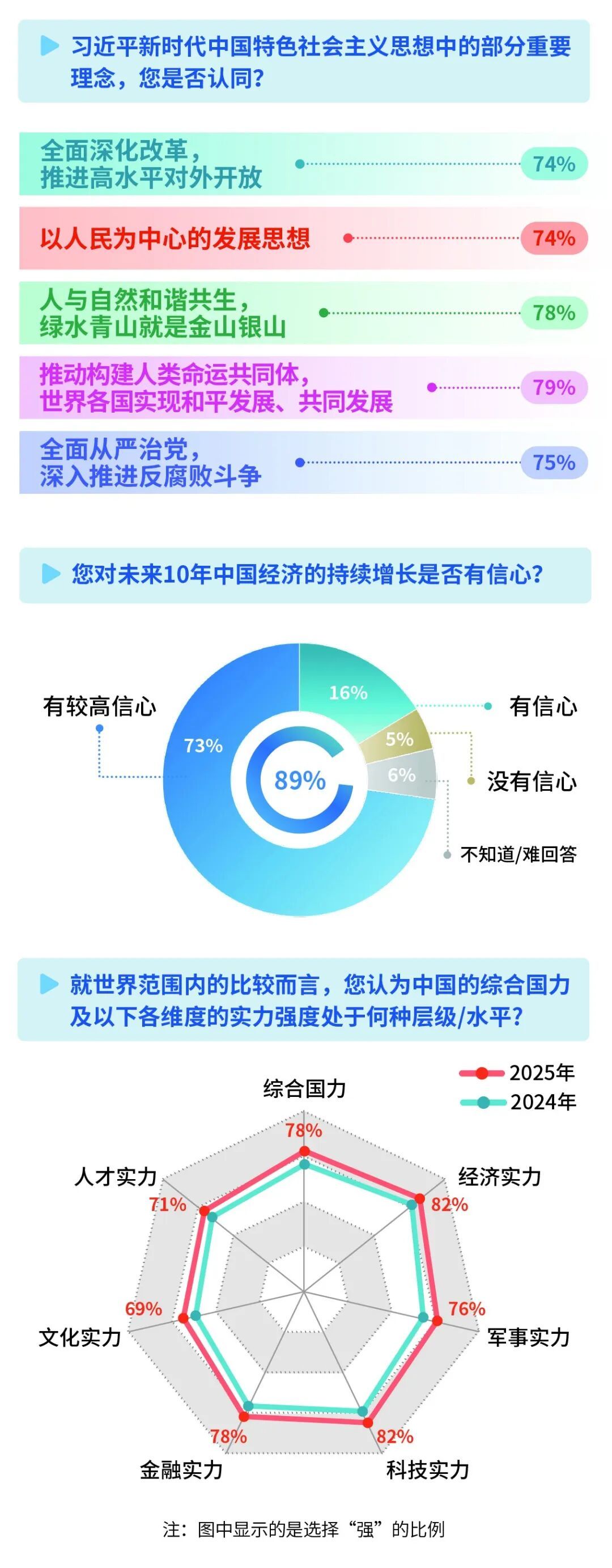
Group 1 - The survey conducted by Global Times Research Institute involved 15 developed countries and 31 developing countries, with a total of 51,689 valid samples collected from August to October 2025 [1] - The survey aimed to objectively understand foreign public perceptions of China, focusing on its international image and influence on global growth, technological change, and governance [1] Group 2 - Key concepts from Xi Jinping's Thought on Socialism with Chinese Characteristics for a New Era received high recognition internationally, with nearly 80% support for "building a community with a shared future for mankind" and "green mountains and clear waters are as valuable as mountains of gold and silver" [2] - Over 70% of respondents recognized initiatives such as the "Global Development Initiative" and "Global Security Initiative," indicating an increase in awareness compared to 2024 [2] Group 3 - Approximately 89% of respondents expressed confidence in China's comprehensive national strength, with 82% supporting its economic and technological capabilities [4][6] - The survey indicated that 78% of foreign respondents acknowledged the enhancement of China's comprehensive national strength, an increase of 8 percentage points from 2024 [9] Group 4 - Nearly 70% of foreign respondents held a favorable view of China, with the highest approval rates in Middle Eastern and ASEAN countries [10] - Interest in China was notably high, with over 90% of respondents expressing interest, particularly in cultural and technological aspects [13] Group 5 - More than 60% of respondents anticipated China's increased participation in international affairs, with a strong desire for China to contribute to resolving global issues [14] - The survey revealed that over 70% of respondents supported the idea of a fair and orderly multipolar world, with significant backing from developing countries [14] Group 6 - Over 75% of respondents viewed China's foreign policy positively, recognizing its role in promoting regional stability and development [20] - The desire for improved bilateral relations with China was expressed by over two-thirds of foreign respondents, reflecting a growing trend compared to 2024 [21]

消费有“数” 进一步释放内需潜力
Zhong Guo Jing Ji Wang· 2025-12-22 23:15
Group 1 - The core viewpoint of the articles highlights the rapid growth of digital consumption in China, with the user base expected to exceed 958 million by mid-2025, accounting for 85.3% of the total internet users, indicating that digital consumption is becoming a significant driver of overall consumption [1] - Digital consumption encompasses various forms, including digital products, services, content, and purchases made through digital channels, such as online shopping and smart product selection [1] - The growth of digital consumption is attributed to rising income levels and a shift in consumer demand towards service-oriented consumption, emphasizing experience and emotional satisfaction [1][2] Group 2 - The total digital consumption in China reached 9.37 trillion yuan in the first half of the year, representing nearly half of total household consumption expenditure [1] - New business models and scenarios, such as e-commerce live streaming and virtual shopping malls, are emerging, enriching consumer experiences and continuously stimulating market demand [1] - Challenges exist in digital consumption, including issues related to data privacy and algorithmic pricing strategies that can lead to "price discrimination" based on user profiles [2] Group 3 - Future strategies for enhancing digital consumption include deepening the integration of artificial intelligence with consumption, accelerating the digital transformation of service consumption, and focusing on key demographics and niche markets to unlock new growth opportunities [2] - Collaboration between government and enterprises is essential to advance digital consumption, with the government needing to improve infrastructure, especially in rural areas, and create a trustworthy environment for consumers [3] - Companies should adapt to changing consumer demands by exploring diverse consumption scenarios and providing high-quality offerings to lead consumption upgrades [3]