网络支付

Search documents
第57次中国互联网络发展状况统计报告
中国互联网络信息中心· 2026-03-10 01:30
Investment Rating - The report does not explicitly provide an investment rating for the industry Core Insights - As of December 2025, China's internet user base reached 1.125 billion, an increase of 17.17 million from December 2024, with an internet penetration rate of 80.1%, up by 1.5 percentage points [12][49] - The mobile internet user base reached 1.121 billion, with 99.6% of internet users accessing the internet via mobile devices [51] - The report highlights significant advancements in internet infrastructure, including the deployment of 5G base stations and the growth of IPv6 addresses, which are crucial for supporting the digital economy [14][28][15] Summary by Sections Internet Infrastructure Development and Application Status - As of December 2025, the number of IPv4 addresses in China was 35.65 million, while IPv6 addresses reached 70,215 blocks/32, with 850 million active IPv6 users [15][19] - The total number of domain names in China was 32.3 million, with ".CN" domains accounting for 20.77 million [25] - The total number of 5G base stations reached 4.838 million, representing 37.6% of all mobile base stations, an increase of 4 percentage points from December 2024 [28] - The number of internet broadband access ports reached 1.251 billion, with fiber optic access ports accounting for 1.21 billion [32] - The total length of optical cable lines reached 74,990 million kilometers [35] Internet User Scale and Structure - The rural internet user base was 314 million, making up 27.9% of the total internet users, while urban users totaled 812 million, accounting for 72.1% [59] - The non-internet user population decreased to 27.9 million, with the majority being older adults [71] - The gender ratio among internet users was 51.2% male to 48.8% female [75] - The age group of 10-49 years comprised 61.4% of internet users, while those aged 50 and above accounted for 34.4% [78] Internet Application Development Status - The number of websites in China reached 4.38 million as of December 2025 [38] - The total number of web pages was 419.8 billion, with a growth rate of 5.1% from December 2024 [41] - Mobile internet access traffic reached 395.8 billion GB, an increase of 17.3% from the previous year [43] Generative Artificial Intelligence Development Status - The user base for generative artificial intelligence reached 602 million, with a penetration rate of 42.8%, an increase of 25.2 percentage points from December 2024 [12] Development Status of Small and Medium Enterprises - The report indicates that small and medium enterprises maintained stable operations, with gradual improvements in business capabilities [9] Internet Government Development Status - The report outlines the development status of integrated government service platforms and government websites, emphasizing the growth in online government services [9]
博兴农商银行:普及数据安全知识,共筑金融数据防线
Qi Lu Wan Bao· 2026-02-27 14:36
Core Viewpoint - The integration of financial services and digital technology emphasizes the importance of safeguarding personal financial information, with 博兴农商银行 focusing on enhancing data security and promoting financial knowledge to strengthen customer awareness of risk prevention [1][2]. Group 1: Financial Knowledge Promotion - 博兴农商银行 has organized over 40 themed promotional activities this year, such as "Financial Knowledge into Thousands of Homes" and "Cybersecurity Market Fair," covering all towns and key administrative villages in the county [1]. - Customer managers provide face-to-face explanations on basic knowledge such as card management, password settings, and verification code protection, particularly targeting elderly customers with large print promotional materials [1]. Group 2: Risk Prevention Strategies - The bank implements precise and scenario-based safety reminders for high-frequency business scenarios, such as automatic pop-up prompts during transfer and remittance transactions to verify recipient information and prevent telecom fraud [2]. - A series of short videos addressing prevalent scams like "fake loans" and "rebate scams" have been produced and widely disseminated through WeChat and video platforms [2]. Group 3: Targeted Services for Key Demographics - 博兴农商银行 adopts a targeted approach to service, focusing on small and micro business owners, students, and rural elderly populations, providing tailored education on account management, personal information protection, and fraud prevention [2]. - Financial safety consultation desks are established at various branches, with lobby managers serving as safety educators to address customer inquiries about account security and information leakage [2]. Group 4: Commitment to Data Security - The bank emphasizes that protecting customer information requires both technical defenses and customer self-awareness, positioning itself as a promoter of financial safety knowledge and a companion in risk prevention [2].
新华深读 | 1.6亿“银发网民”加速“链接”数字世界
Xin Hua She· 2025-12-29 03:58
Core Insights - The number of elderly internet users in China aged 60 and above is projected to reach 161 million by June 2025, indicating a significant shift in their engagement with the digital world [1] - The digitalization of life services and social interactions is transforming the lifestyle of the elderly, with a notable increase in their online activities [2][3] Group 1: Digital Engagement of the Elderly - The elderly population's online presence has grown approximately 18 times from less than 10 million in 2010 to 161 million in 2025, reflecting a major lifestyle change [1] - Social networking is a primary reason for elderly individuals to go online, with about 97% of them using communication tools, primarily engaging in familiar social circles [1] - The online shopping rate among elderly users has reached 69.8%, with significant participation in health, entertainment, and travel sectors [2] Group 2: Content Creation and Personal Empowerment - Over 75% of elderly internet users aged 55 to 83 have experience in short video creation, with more than 27% regularly posting content, marking a shift from consumers to content creators [3] - The internet serves as a platform for elderly individuals to redefine their self-worth and engage in creative expression, positively impacting their mental health [3] Group 3: Social Connections and Family Dynamics - The internet is crucial for elderly individuals to combat loneliness and maintain social connections, especially as family structures become smaller [4] - Digital engagement has been shown to improve family relationships, with children often taking on teaching roles to help their parents navigate technology [4] Group 4: Challenges and Barriers - Despite the benefits, 82.9% of elderly internet users face various obstacles in using the internet, with this figure rising to 87.9% among those aged 70 and above [5] - Physical limitations, such as vision and hearing impairments, along with psychological barriers like fear of technology, hinder their online experience [6] Group 5: Policy and Community Support - Recent policies aim to create a more inclusive digital environment for the elderly, focusing on improving digital literacy and preventing online fraud [9][10] - Community initiatives, such as "time banks," are emerging to provide elderly individuals with support in learning digital skills, fostering intergenerational connections [11]
非现金支付再提速!银行卡交易回暖,但信用卡又减800万张
Nan Fang Du Shi Bao· 2025-12-04 10:50
Core Insights - The People's Bank of China reported a decline in credit card and combined loan card issuance, with a total of 7.07 billion cards as of Q3 2025, down 800 million from Q2 2025 and 30 million year-on-year [2][5] - Non-cash payment transactions showed significant growth, with 1,685.08 billion transactions amounting to 150.34 trillion yuan in Q3 2025, reflecting a year-on-year increase of approximately 9.06% in transaction volume and 13.7% in transaction value [7] - The electronic payment sector continued to expand, with 834.55 billion transactions worth 94.54 trillion yuan in Q3 2025, marking a notable increase from the previous year [8][9] Summary by Category Card Issuance and Usage - As of Q3 2025, there were 10.149 billion bank cards issued, including 9.442 billion debit cards and a decline in credit and combined loan cards to 7.07 billion [2][5] - The number of ATMs decreased to 760,900, down from 775,700 in Q2 2025 and 807,700 year-on-year [5] Non-Cash Payment Growth - Non-cash payment transactions totaled 1,685.08 billion in Q3 2025, with a transaction value of 150.34 trillion yuan, showing a 12.5% increase in volume and a 9.9% increase in value compared to Q2 2025 [7] - The growth in non-cash payments is attributed to the rise in credit transfers and electronic payments, driven by the central bank's easing of transfer limits and improvements in payment systems [7] Electronic Payment Trends - Electronic payment transactions reached 834.55 billion, with a total value of 94.54 trillion yuan in Q3 2025, indicating a solid growth trajectory [8] - Online and mobile payment segments both experienced growth, with online payments at 193.93 billion transactions worth 79.26 trillion yuan and mobile payments at 606.31 billion transactions worth 13.75 trillion yuan [9] Credit Card Market Dynamics - The credit card market continues to contract, with a decline in the number of credit cards issued for 12 consecutive quarters, prompting banks to halt the issuance of various credit card products [10][11] - Banks are shifting focus from mass issuance to targeted product offerings that align with consumer preferences, indicating a strategic transition in credit card business operations [12]



工行南通如东支行积极开展网络安全宣传活动
Jiang Nan Shi Bao· 2025-11-20 02:11
Core Viewpoint - The Industrial and Commercial Bank of China (ICBC) in Rudong, Nantong, is actively promoting cybersecurity awareness and knowledge among the public, aligning with national financial regulatory calls to enhance network security for high-quality development [1][2]. Group 1: Cybersecurity Training and Awareness - The bank has organized cybersecurity training for employees to recognize the severity and complexity of new telecom network crimes, enhancing vigilance against online fraud [1]. - Various promotional activities have been conducted, including the distribution of brochures and the use of eye-catching posters in bank branches to educate customers about cybersecurity [1]. Group 2: Community Engagement and Financial Knowledge Promotion - The bank has introduced a "Three Visits" service model to provide targeted financial knowledge promotion, focusing on safe usage of online payment, online finance, and online lending [2]. - Rural branches are extending financial services to local communities, collaborating with grassroots organizations to promote inclusive finance and educate residents about the dangers of illegal fundraising and high-interest temptations [2]. - Youth volunteers are actively engaging with consumers in supermarkets to explain legal regulations and provide insights on online safety and personal information protection [2].

南通农商银行:多维攻坚激活财富业务新动能
Jiang Nan Shi Bao· 2025-11-07 15:02
Core Insights - Nantong Rural Commercial Bank has implemented various measures to enhance its wealth management business amid challenges such as narrowing net interest margins, achieving both qualitative and quantitative improvements in the sector [1][2][3] Group 1: Marketing and Responsibility - The bank has adopted a grid-based marketing management approach, segmenting urban markets into defined "responsibility areas" to ensure clear accountability for each financial service touchpoint [1] - A quantitative assessment mechanism has been established, evaluating seven key indicators related to wealth management on a monthly basis, which serves as a basis for training, selection, and recognition [1] - Since the third quarter, the bank has seen a net increase of 180 million yuan in wealth management sales and a growth of 1,500 clients in its wealth management segment [1] Group 2: Training and Professional Development - The bank has conducted 23 specialized training sessions since July to enhance the professional capabilities and compliance awareness of its marketing team [2] - Regular online and weekend training sessions have been established to reinforce ongoing training, alongside targeted training for new employees and those transitioning roles [2] - Training has also focused on compliance sales and product switching, strengthening the risk management framework [2] Group 3: Customer Experience and Digital Marketing - The bank has enhanced customer engagement through diverse activities and digital marketing strategies, resulting in increased customer loyalty and business output [2] - Events such as high-net-worth client appreciation meetings have directly generated sales of 1.5 million yuan, while a new card promotion has doubled the number of new value credit card customers [2] - The bank has implemented tiered subsidies based on customer assets under management (AUM) and has seen significant growth in value credit card and online payment customer numbers since the beginning of the year [2] Group 4: Compliance and Risk Management - The bank has established a comprehensive risk control system covering the entire process from product admission to sales and evaluation, ensuring compliance with regulatory requirements [3] - Regular compliance checks and marketing training are conducted to optimize the structure of sold products and enhance suitability management [3] - The bank's efforts in responsibility assignment, precise empowerment, experience enhancement, and compliance support have laid a solid foundation for high-quality development [3]
不同消费问题,去哪投诉最有效?
Xin Lang Cai Jing· 2025-10-24 04:36
Group 1 - The article provides a comprehensive "Consumer Rights Protection Guide" to help consumers navigate various types of complaints and identify the appropriate channels for resolution [1][9] - It emphasizes the importance of understanding the type of issue and selecting the right complaint channel to effectively address consumer grievances [9] Group 2 - For e-commerce and online shopping issues, consumers are advised to first utilize the internal customer service and arbitration systems of platforms like Tmall, JD, and Pinduoduo, and escalate to the national 12315 platform if necessary [2] - Retaining evidence such as chat records, order screenshots, and payment receipts is crucial for increasing the success rate of complaints [3] Group 3 - In financial and recharge-related disputes, consumers should directly contact regulatory bodies like the China Banking and Insurance Regulatory Commission through the 12378 hotline [4] - For online payment and prepaid card issues, consumers can also report to the 12315 platform regarding the legality of business practices and use the People's Daily message board for public feedback [4] Group 4 - For communication, network, and app service issues, the Ministry of Industry and Information Technology's 12381 reporting platform is recommended for complaints related to service traps and unauthorized data collection [5] - Issues with internet service apps can also be reported on the Black Cat Complaints platform for quicker responses from companies [5] Group 5 - For offline service disputes, such as those in dining, tourism, and training, the 12315 platform is the primary channel, with the option to escalate to the 12345 government service hotline for cross-departmental issues [6] - The Ministry of Culture and Tourism has a dedicated complaint hotline for tourism-related issues [6] Group 6 - If complaints are not adequately addressed by companies or regulatory bodies, consumers can escalate their issues through public supervision channels like the People's Daily message board and the State Council's "Internet + Supervision" platform [7][8] - These platforms create a "pressure mechanism" to encourage local authorities to respond effectively [9]
二季度全国支付体系运行总体平稳
Xin Hua Wang· 2025-08-08 06:59
Group 1 - The People's Bank of China reported that in Q2, non-cash payments reached 101.72 trillion yuan, a year-on-year increase of 6.83%, reversing a slight decline in Q1 [1] - In Q1, non-cash payment volumes and amounts saw a slight decline of 5.23% and 5.2% year-on-year, respectively, due to the impact of the pandemic [1] - With effective pandemic control, the economy showed signs of recovery, leading to significant growth in non-cash payments in Q2, with volumes and amounts increasing by 6.18% and 6.83% year-on-year, respectively [1] Group 2 - The number of bank accounts opened nationwide reached 11.866 billion by the end of Q2, with a quarter-on-quarter growth of 3.05%, an increase of 1.62 percentage points compared to the previous quarter [1] - The growth rate of bank card issuance slightly rebounded, and transaction volumes also recovered in Q2, with 81.457 billion transactions amounting to 21.908 trillion yuan, representing year-on-year increases of 6.2% and 0.91% [1] - In Q1, bank card transaction volumes and amounts decreased by 5.35% and 10.51% year-on-year, respectively [1] Group 3 - Despite maintaining growth in mobile payment volumes in Q1, the growth rate of payment amounts fell below 5%. In Q2, mobile payment volumes surged, with banks processing 30.141 billion transactions amounting to 10.617 trillion yuan, reflecting year-on-year growth of 26.99% and 33.61% [1] - Non-bank payment institutions processed 203.508 billion network payment transactions in Q2, amounting to 7.022 trillion yuan, with year-on-year increases of 14.48% and 18.37%, showing a significant rebound compared to Q1 [2]
【行业前瞻】2023-2024年中国新媒体各领域用户规模统计分析
Sou Hu Cai Jing· 2025-04-27 06:06
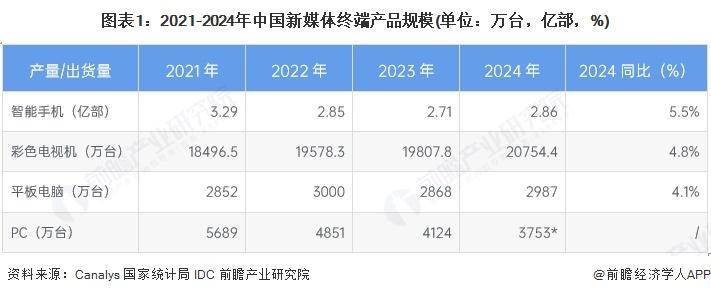
Group 1: Industry Overview - The new media industry utilizes digital technology to provide information and services through various channels, with a focus on devices like smartphones, computers, and digital TVs [1] - In 2024, China's smartphone shipments are projected to reach 286 million units, with color TV production at 207 million units, and shipments of tablets and PCs at 29.87 million and 37.53 million units respectively [1] Group 2: User Growth in New Media Applications - In 2024, user growth in various new media applications continues, with online literature, food delivery, online payment, and online travel booking seeing the fastest growth, increasing by 54.74 million, 47.77 million, 75.05 million, and 39.35 million users respectively, with growth rates of 10.5%, 8.8%, 7.9%, and 7.7% [2] Group 3: Investment Trends in New Media - From 2017 to 2024, the new media industry in China experienced 439 financing events totaling 59.452 billion yuan, with an average single financing amount exceeding 100 million yuan [3] - The peak financing year was 2019, with 65 events and a total of 12.504 billion yuan, but the number and amount of financing events have declined since then, with only 8 events and 0.395 billion yuan in 2024 [3] Group 4: Investment Funds in New Media - The number of domestic new media-related investment funds is limited, primarily concentrated in developed cities like Beijing, Zhejiang, and Guangdong, with Beijing Digital Matrix Investment Management Co., Ltd. managing the most funds, totaling 21 [5]