羊角包

Search documents
面包届,真的很需要一个“蜜雪冰城”!
东京烘焙职业人· 2025-12-18 08:33
Core Insights - The baking industry has experienced rapid growth in recent years, particularly in first-tier cities, but this growth model is facing challenges when replicated in lower-tier cities [2][14] - The high price point of baked goods may not indicate true market expansion, as it creates barriers for broader consumer access [4][16] - The industry is at a crossroads, with a choice between catering to a niche, high-end market or addressing the everyday needs of a larger consumer base [5][13] Market Structure - The domestic baking market is highly segmented, with a premium segment offering luxury products, such as "black swan" pastries from brands like Haolilai, which are positioned as luxury items [7] - There is a middle-class comfort zone represented by brands like B&C and Mr. Stone's Oven, which provide stable, quality products that resonate with middle-class aspirations for a quality lifestyle [8] - Community-oriented stores and regional flavor shops fill the market, relying on local craftsmanship and consumer habits, but struggle to create a unified commercial language [10] Industry Challenges - The rapid evolution of the industry has overlooked the essential infrastructure needed for mass-market appeal, leading to a disconnect between high-end offerings and everyday consumer needs [13][16] - The entry of high-priced bakery models into lower-tier cities does not align with the local consumer's purchasing power and structure [14] - The industry's focus on high-end narratives has created a barrier for broader market access, transforming bread from a staple into an event-driven luxury [16][28] Competitive Landscape - New retail supermarket baking sections are quietly capturing market share by offering high-quality products at significantly lower prices, leveraging efficient supply chains [19][22] - Supermarkets provide a "convenient purchase" scenario, integrating baked goods into regular shopping habits, thus reducing decision-making costs for consumers [22] - The baking industry faces challenges in scaling due to the complexity of bread production, reliance on skilled craftsmanship, and a long-standing focus on individual artisans rather than systematic approaches [23][25][27] Future Directions - The industry needs a transformative shift towards supply chain narratives, focusing on efficiency and technology in production rather than just storefront aesthetics [31] - There is a call for enhancing the value of basic baked goods, such as bread and rolls, to establish a foundation for frequent consumer purchases [33] - A balance between cultural appeal and addressing fundamental consumer needs is essential for creating a widely accepted baking brand that resonates with everyday life [35][37]


突然人山人海!上海市中心20岁老牌商超宣布回归!第六家“学习胖东来”嘉定开业,市民抢空货架
Sou Hu Cai Jing· 2025-06-05 01:45
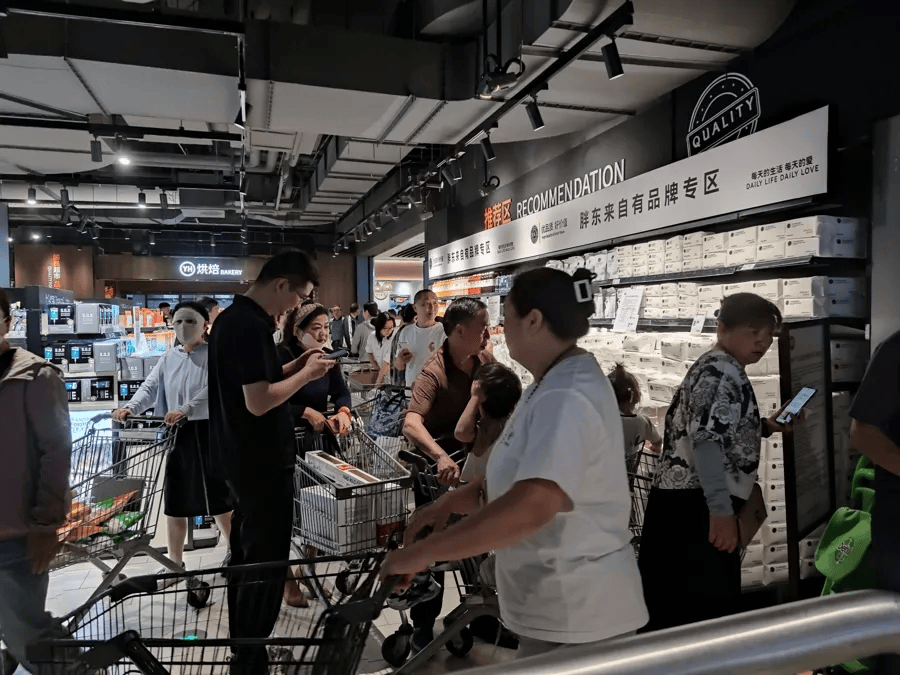
Core Insights - The opening of Yonghui Supermarket's Jiading Baolong store marks the sixth location in Shanghai adopting the "Pang Donglai" model, resulting in a significant increase in customer traffic and sales [1][5][35] - The store experienced a 318% year-on-year increase in customer flow and a 716% increase in sales during the first three days of operation [5][34] - The transformation of traditional supermarkets in Shanghai, such as the Century Lianhua Luban store, has also led to a resurgence in customer interest, indicating a broader trend in the retail sector [34][40] Group 1 - Yonghui's Jiading Baolong store has implemented a product structure that aligns with the "Pang Donglai" model, reducing the number of standard products from over 10,000 to around 8,000, with over 80% of the product structure now reflecting the "Pang Donglai" model [14][35] - The store introduced 67 self-owned brand products from "Pang Donglai," with a total of 8,868 items available after restructuring [11][14] - The bakery and ready-to-eat food sections have become particularly popular, with significant customer engagement observed in these areas [17][31] Group 2 - The store has adopted a limit purchase policy for certain "Pang Donglai" products, requiring customers to show an electronic membership code from the Yonghui app to make purchases [11][13] - The service quality at the Jiading store has been noted as a strong point, with various customer-friendly features implemented, although some staff members are still in training [24][28] - The store's layout has been optimized to enhance customer flow, separating high-traffic areas like the bakery and ready-to-eat food sections to improve shopping experience [14][31] Group 3 - The success of Yonghui's transformation is part of a larger trend in Shanghai's retail landscape, with other stores like Century Lianhua also reporting increased customer traffic following similar renovations [34][40] - The focus on community engagement and tailored services, such as the "潮银俱乐部" (潮银 Club) for the elderly, reflects a strategic shift towards meeting specific consumer needs [40][42] - The overall strategy involves reducing the number of low-efficiency, homogeneous products while enhancing the quality and variety of offerings, aiming to create a more engaging shopping experience [34][40]