老旧小区加装电梯

Search documents
936亿元!今年第一批超长期特别国债支持设备更新资金已下达
Xin Lang Cai Jing· 2026-01-22 03:40
Core Viewpoint - The Chinese government has initiated a significant investment in equipment upgrades through the issuance of 936 billion yuan in special long-term bonds, aimed at supporting various sectors and boosting domestic demand amid external uncertainties [1][4][5]. Group 1: Investment and Economic Impact - The 936 billion yuan in bonds will support approximately 4,500 projects across sectors such as industrial, energy, education, healthcare, and environmental protection, leading to a total investment exceeding 460 billion yuan [1][4]. - The policy aims to inject momentum into economic development by enhancing investment through equipment upgrades, particularly in the context of increasing external uncertainties [5]. Group 2: Financial Support and Policy Measures - The government has expanded the scope of financial support for equipment upgrades, including a 1.5% interest subsidy on fixed asset loans for businesses undertaking equipment upgrades, with a maximum subsidy period of two years [5][6]. - New areas of support include the installation of elevators in old residential communities, equipment upgrades in elderly care facilities, and enhancements in safety and commercial infrastructure [2][5][6]. Group 3: Analysts' Perspectives - Analysts highlight that the policy reflects a shift towards prioritizing public service and consumer experience, moving beyond solely enhancing manufacturing capabilities [2][6]. - The equipment upgrade initiative is expected to stimulate investment and consumption, improve advanced production capacity, phase out outdated capacity, and accelerate industrial transformation towards green and low-carbon development [2][6].
老旧小区加装电梯纳入国补, 项目“启动难”痛点迎刃而解 业内
Mei Ri Jing Ji Xin Wen· 2026-01-09 01:13
Core Viewpoint - The inclusion of elevator installation in old residential areas under national subsidies is a significant move to enhance public welfare and stimulate domestic demand, addressing the previous funding challenges that hindered project initiation [1][4]. Group 1: Policy Changes and Impacts - The National Development and Reform Commission and the Ministry of Finance have announced a new policy for 2026 that includes subsidies for installing elevators in old residential areas, optimizing support mechanisms and subsidy standards [1][4]. - The adjustment in subsidy standards from fixed amounts to tiered subsidies based on the number of floors will provide more targeted financial support for elevator installations [1][4]. - The policy aims to accelerate the installation of elevators, which has been slow due to funding issues, positively impacting the entire elevator manufacturing, installation, and service industry [4][5]. Group 2: Current Status and Statistics - As of the latest data, Beijing has completed the installation of 3,391 elevators since the start of the 14th Five-Year Plan, benefiting approximately 35,000 households [5][6]. - In 2025, Beijing plans to complete the installation of 6,073 elevators as part of its urban renewal efforts [5]. - The highest number of elevator installations in Beijing is in Haidian District, with 1,375 units, followed by Chaoyang District with 1,056 units [6]. Group 3: Installation Models and Challenges - There are three main models for elevator installation in old residential areas: owner-funded self-construction, collective funding by property units, and a leasing model encouraging private investment [8]. - The new policy is expected to alleviate cash flow pressures for companies and activate more projects, addressing the "difficult start" issue previously faced by residents [10][12]. - However, concerns remain regarding the long-term maintenance costs and the potential impact on property values, which may complicate consensus among residents [12][13]. Group 4: Market Dynamics and Future Considerations - The new policy is likely to reshape market demand and competition within the elevator installation industry, prompting companies to explore integrated construction and maintenance service models [18][19]. - Companies may need to adjust pricing strategies to reflect the differences in installation costs based on building structures and local conditions, ensuring fairness in government subsidies [19]. - The increased participation of small and medium-sized enterprises in bidding for government projects could enhance industry competitiveness [19].

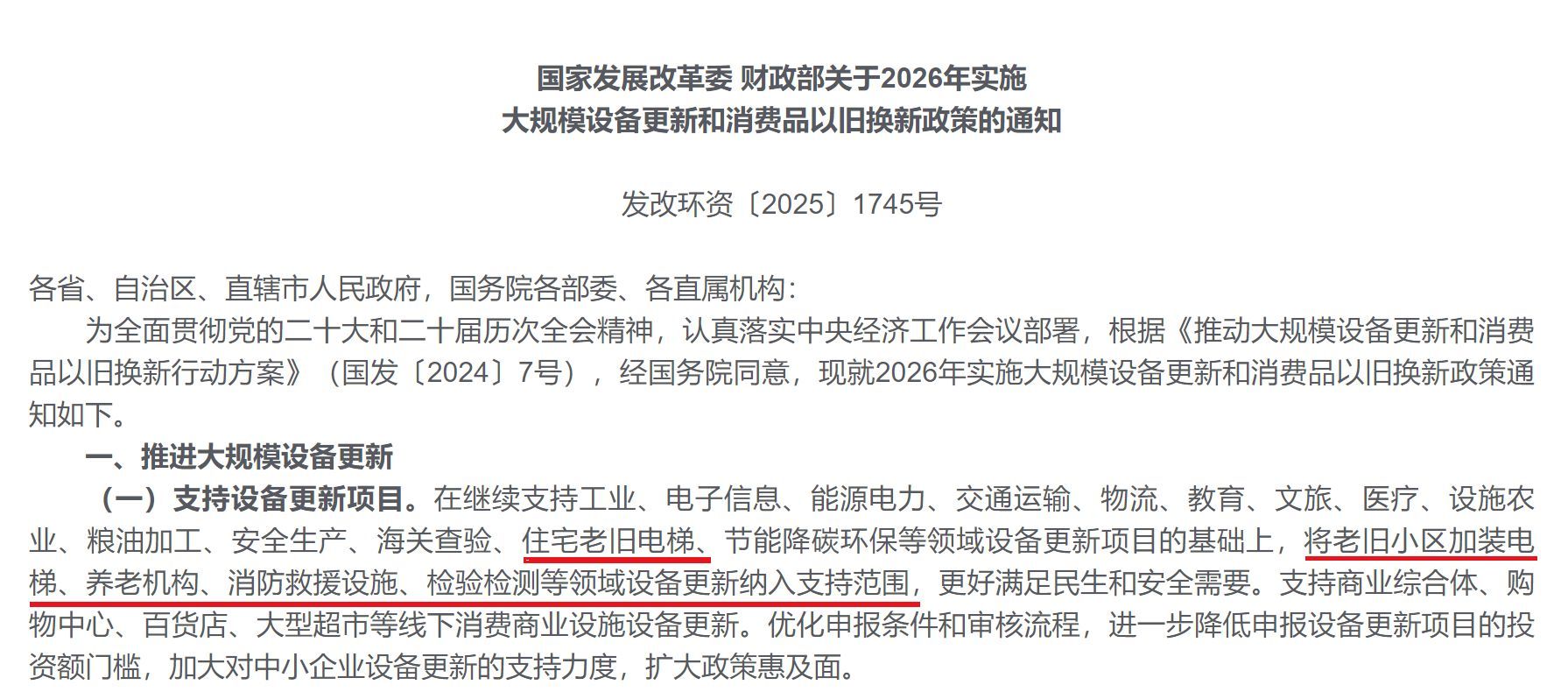
老旧小区加装电梯将被纳入“国补”
3 6 Ke· 2026-01-07 02:38
Group 1 - The core viewpoint of the article is that the new policy implemented by the National Development and Reform Commission and the Ministry of Finance in 2026 aims to enhance the installation of elevators in old residential communities, which is expected to accelerate projects that have been slow due to funding issues, positively impacting the entire elevator industry chain [1][4][10]. Group 2 - The 2026 policy introduces new subsidies for the installation of elevators in old residential areas, particularly focusing on improving living conditions and stimulating domestic demand [1][4]. - The subsidy standards have been adjusted to be more precise, with differentiated subsidies based on the number of floors for elevator updates, moving away from flat-rate subsidies [1][10]. - The policy is seen as a significant signal from the government to address the challenges faced by elderly residents in accessing their homes, potentially resolving long-standing issues [4][10]. Group 3 - Since the start of the 14th Five-Year Plan, Beijing has completed the installation of 3,391 elevators, benefiting approximately 35,000 households, with ongoing projects expected to further increase these numbers [4][5]. - The funding support from national bonds for elevator updates has led to the initiation of numerous projects, with over 9,000 elevators under construction as of late 2025 [5][10]. - The policy encourages various funding models for elevator installation, including self-funded by residents, collective funding by property units, and leasing models involving private capital [8][10]. Group 4 - The article highlights the need for a new model of "integrated construction and maintenance" in the elevator installation industry, as increased competition may require companies to adapt their strategies [21][22]. - The differentiation in subsidy standards based on construction costs and elevator installation will help residents understand the rationale behind government support, aiming to foster community harmony [22].
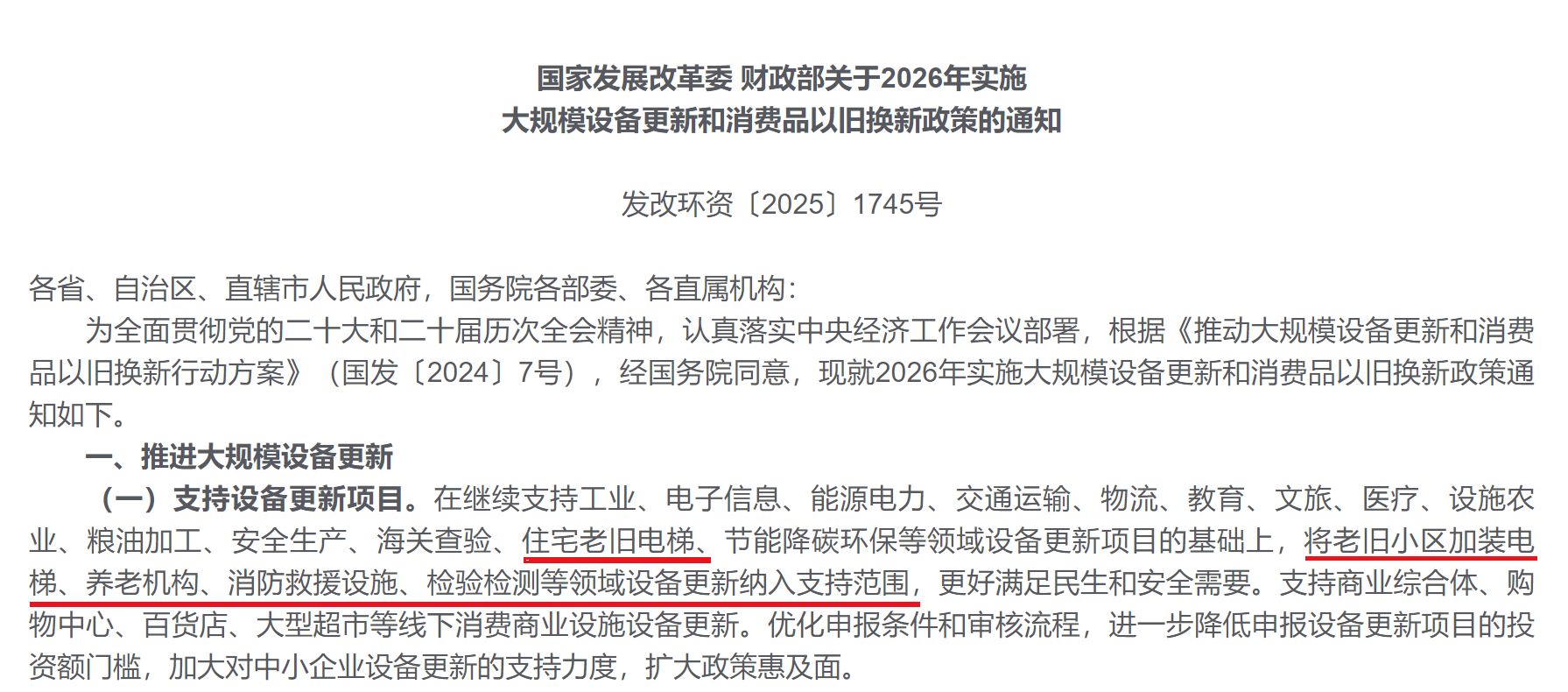
民生一件事|多举措助力“增梯”落地 按下老楼装电梯“加速键”
Yang Shi Wang· 2025-12-08 06:02
Core Viewpoint - The installation of elevators in old residential communities is a significant public welfare project, facing challenges primarily due to the lack of consensus among homeowners, particularly those living on lower floors [1][7]. Group 1: Project Implementation - The city of Kunshan has incorporated elevator installation into its old community renovation plan, facilitating accelerated progress through unified planning and financial subsidies [1][3]. - As of now, Kunshan has issued over 33 million yuan in subsidies for the renovation of old communities [6]. Group 2: Community Engagement - A major obstacle to elevator installation is opposition from low-floor residents, with 83.7% of failed installations attributed to a lack of homeowner consensus [7]. - Kunshan has established a dedicated elevator installation service studio to explore effective methods for unifying neighborhood opinions, including face-to-face meetings to foster communication and consensus among residents [7][8]. Group 3: Financial Support - The local government provides special subsidies and renovation funds, allowing residents to cover less than half of the total cost for a 550,000 yuan elevator [5].
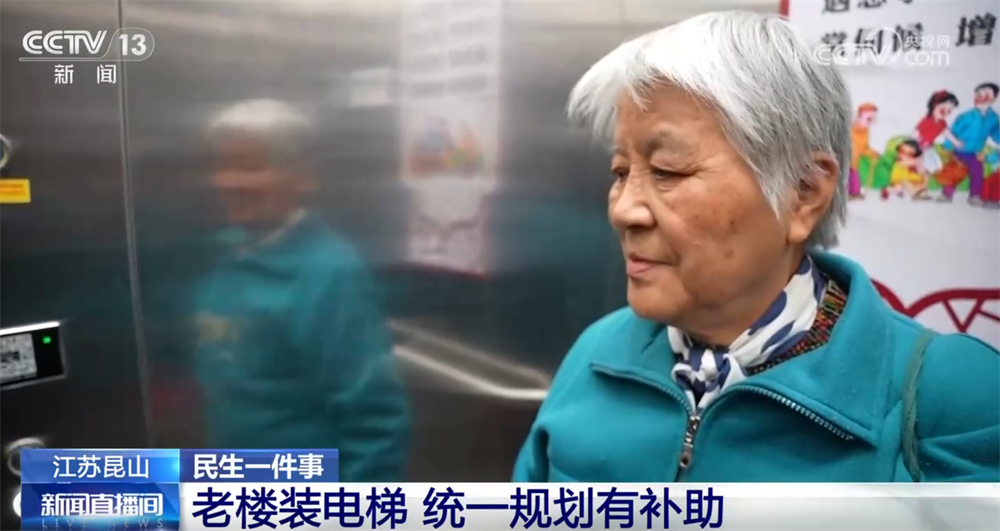
【学习贯彻四中全会精神在基层】西藏:文旅深度融合助力高质量发展 吉林:让城市发展成果更多惠及人民
Yang Shi Wang· 2025-12-06 11:59
Group 1 - The core message emphasizes the need to enhance and improve people's livelihoods while promoting common prosperity for all [1] Group 2 - Tibet is focusing on high-quality tourism development by enriching tourism product offerings and enhancing infrastructure, leading to a 10.74% year-on-year increase in domestic and international tourist arrivals, totaling 69.48 million from January to November [2] - The region aims to shift from sightseeing tourism to cultural deep tourism by leveraging its ecological and cultural resources [2] Group 3 - In Jilin, the installation of elevators in old residential buildings addresses the mobility issues faced by elderly residents, as many buildings constructed in the late 20th century lack elevators [3] - The province has initiated urban renewal projects, including the renovation of over 5,300 old residential communities and the restoration of more than 30 historical buildings, to improve living conditions [3] - Jilin plans to continue enhancing people's livelihoods through urban development and the transformation of old neighborhoods and industrial areas [3]