聚变堆主机关键系统综合研究设施

Search documents
【新华社】春晚上“夸父”追的太阳,竟然是它?
Xin Hua She· 2026-02-24 02:27
Core Insights - The article discusses advancements in nuclear fusion technology in China, particularly focusing on the "artificial sun" known as the EAST (Experimental Advanced Superconducting Tokamak) and its significance in achieving controlled nuclear fusion [5][6]. Group 1: Nuclear Fusion Technology - The concept of the "artificial sun" refers to controlled nuclear fusion, which aims to replicate the fusion reactions occurring in the sun, providing a safe, clean, and nearly limitless energy source [5][6]. - The EAST facility has achieved significant milestones, including reaching "hundred million degrees for a thousand seconds," marking the first successful simulation of the environment required for future fusion reactors [6]. - The "Kua Fu" scientific park is dedicated to developing core components for the next generation of fusion reactors, with a focus on constructing a key system for the fusion reactor [8]. Group 2: Future Prospects - The construction of the compact fusion energy experimental device (BEST) is underway, with expectations to demonstrate plasma "burning" by the end of 2027, potentially leading to the first practical application of nuclear fusion by around 2030 [8]. - The advancements in fusion technology are a result of decades of research, with early efforts dating back to the 1970s, showcasing the evolution of China's capabilities in this field [5][6].

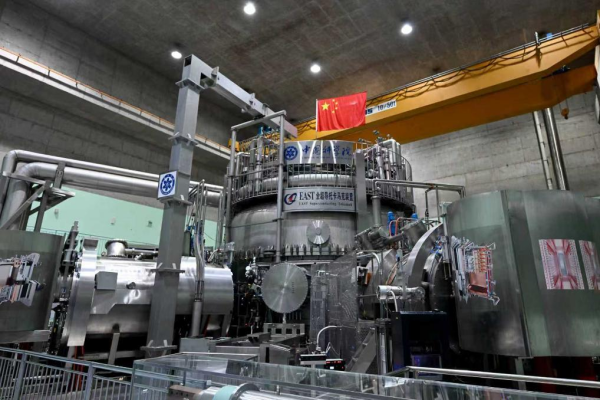
财经聚焦|“人造太阳”照进现实还有多远?
Xin Hua Wang· 2026-01-18 03:38
Core Insights - Controlled nuclear fusion is transitioning from laboratory research to engineering and commercialization, with expectations to see the first operational fusion energy by around 2030 [1] - The core of fusion commercialization lies in finding a technically feasible and economically viable path [1] - China's fusion sector is characterized by a unique collaboration model involving state-owned enterprises, private companies, and diverse partnerships [1] Group 1: Technological Developments - Advanced tokamak devices like the "East" (EAST) and "China Fusion Engineering Test Reactor" (CFETR) are leading the scientific exploration in fusion technology [2] - The construction of key systems for fusion reactor research facilities aims to support the development and verification of critical fusion technologies [2] - The next-generation "artificial sun" experimental device (BEST) aims to demonstrate power generation by 2030 [2] Group 2: Industry Collaboration - Private enterprises are emerging as key players in exploring diverse technological routes in the fusion sector [2] - Companies like Xinghuan Energy and Xinneng Xuanguang are innovating with spherical tokamaks and AI-powered energy solutions [2] - The collaboration between state-owned and private enterprises enhances the efficiency of technological iterations and accelerates the commercialization process [2] Group 3: Supply Chain and Material Demand - Major scientific advancements are driving demand for superconducting materials, vacuum equipment, and specialized power sources [3] - The successful development of extreme low-temperature heat exchange technology and ultra-high temperature radiation materials indicates significant progress in the supply chain [5] Group 4: Talent Development and Education - The establishment of fusion science and engineering programs in universities aims to cultivate interdisciplinary talent for the fusion industry [5] - Companies are enhancing practical engineering capabilities through major projects and initiatives like the Xiyuan Fusion Innovation Fund to support young researchers [5] Group 5: Financial Support and Investment - The establishment of a fusion financial institution alliance aims to align financial services with industry needs, injecting capital into the fusion sector [8] - A new investment evaluation system tailored to the characteristics of the fusion industry is being developed to support the growth of this sector [8]
财经聚焦丨“人造太阳”照进现实还有多远?
Xin Hua Wang· 2026-01-17 15:13
Core Insights - Controlled nuclear fusion is transitioning from laboratory research to engineering and commercialization, with expectations to see the first operational fusion energy by around 2030 [1] - The core of fusion commercialization lies in finding a technically feasible and economically viable path [1] - China's fusion sector is characterized by a unique collaboration model involving state-owned enterprises, private companies, and diverse partnerships [1] Group 1: Technological Developments - Advanced tokamak devices like the "EAST" and "China Fusion Engineering Test Reactor" are leading the scientific exploration in China's fusion research [3] - The construction of key facilities for fusion technology research and verification is underway, aiming for operational demonstration by 2030 [3] - Private enterprises are diversifying technological approaches in fusion, with companies like Xinghuan Energy and Xineng Xuanguang focusing on innovative solutions [3] Group 2: Industry Collaboration - The collaboration between state-owned and private enterprises enhances the efficiency of technological iterations in fusion energy [3] - Major scientific advancements are driving demand for upstream industries such as superconducting materials and vacuum equipment [4] - Cross-domain collaboration is effectively integrating research resources and industry needs, significantly improving engineering progress [6] Group 3: Talent Development - The establishment of specialized educational institutions, such as the Fusion Science and Engineering College at Hefei University, is aimed at cultivating interdisciplinary talent [6][7] - Companies are enhancing practical capabilities through major projects and initiatives like the Xiyuan Fusion Innovation Fund to support young researchers [7] Group 4: Financial Support - Financial institutions are increasingly supporting the fusion industry, with the establishment of a Fusion Financial Alliance to align financial services with industry needs [9] - A new venture capital fund focused on fusion energy aims to create an investment evaluation system tailored to the industry's characteristics [9]