腾讯欢乐斗地主

Search documents
2025年度小游戏买量数据报告
DataEye· 2026-01-22 08:33
Investment Rating - The report indicates a strong market vitality in the mini-game sector, with a projected market size of approximately 610 billion yuan in 2025, reflecting a year-on-year growth of 22% [7][6]. Core Insights - The mini-game industry is transitioning from a phase of rapid growth driven by traffic bonuses to a more refined operational phase focused on existing user engagement and content creation [7]. - The competition in the domestic mini-game market will increasingly center on operational capabilities, content creation value, and platform adaptability, with live streaming, content, social interaction, and multi-platform operations identified as four core strategies for industry breakthroughs [7]. - The number of active users on major platforms continues to rise, with the leading social software platform reaching 571 million monthly active users, and the leading short video platform seeing a 44% increase in active users [11][10]. Summary by Sections 1. Mini-Game Market Overview - The mini-game market is expected to exceed 700 billion yuan by 2026, with a significant growth rate of 22% in 2025 [7][6]. - The average daily usage frequency per user is approximately 5.1 times, with a 4.5% year-on-year increase, while the average daily usage duration has risen to 24.6 minutes, marking a 27.2% increase [15][14]. 2. Mini-Game Market Buy Volume Trends - The daily expenditure on mini-game user acquisition is approximately 144 million yuan, reflecting a 15.6% increase from Q1 [25]. - The number of games in the mini-game sector has grown by over 54% year-on-year, reaching approximately 51,000 games in 2025, while mobile app games have only seen a 5.2% increase [30]. - The number of games launched on Douyin mini-games has surged by nearly 70%, while WeChat mini-games have also shown a recovery in growth [35]. 3. Key Categories & Case Analysis - Modern themes in mini-games have seen a significant increase, with over 15,000 products launched, reflecting a 52.23% year-on-year growth [76]. - The top three gameplay types (MMORPG, idle, and card games) account for over 70.6% of the top 500 products, indicating a high market concentration [86]. - The strategy SLG segment has shown a continuous increase in the number of products, with a year-on-year growth of 38.8%, driven by user preference for lightweight operations combined with heavy strategy [89].



一条千亿级赛道雏形初现,领跑者是这家广东大厂
3 6 Ke· 2025-12-24 11:23
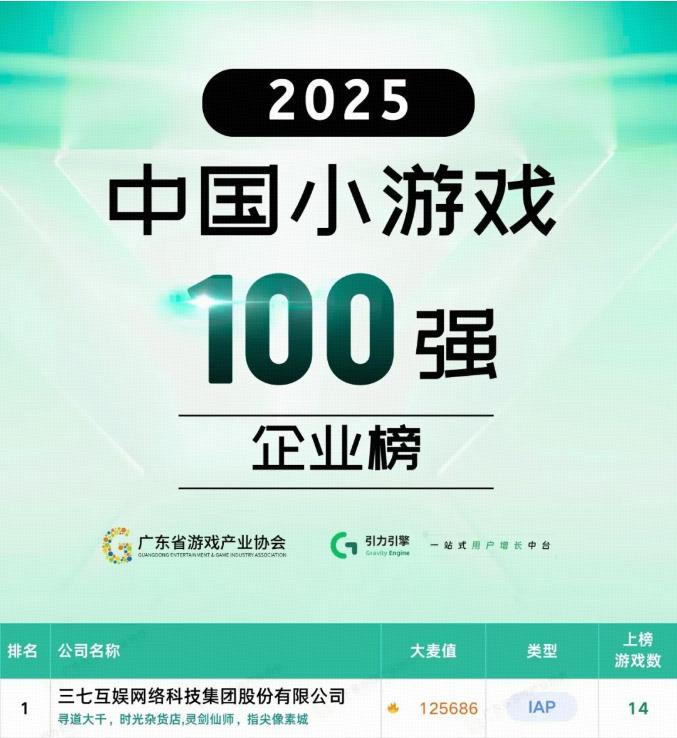
Core Insights - The "Top 100 Mini Game Companies in China 2025" list was released, highlighting significant growth in the mini game sector, with a projected revenue increase of 40% year-on-year in the first half of 2023 [1][9] - The mini game market is expected to become highly competitive by 2026, especially after a new agreement between Apple and Tencent regarding a 15% commission on payments within WeChat mini games [1] Company Highlights - 37 Interactive Entertainment ranked first in the list, attributed to its ability to adapt to industry changes and continuously refine its positioning [2][5] - The year 2023 marked a breakthrough for 37 Interactive, with successful game launches like "Seeking the Dao" and "Soul Chapter," which solidified its competitive edge in the mini game market [4] - 37 Interactive has a strong product matrix with 14 games listed in the top 100, showcasing its capability as a "hit-making machine" [4][12] Competitor Analysis - Second place was taken by Dream Dragon Path, known for its popular game "Shoot the Zombie," with five games listed in the top 100 [6] - BoKe Technology emerged as a dark horse, jumping from 15th to 3rd place, indicating a successful year with multiple products entering the top ranks [7][8] - Tencent, ranked 7th, focuses on adapting its classic games into mini game formats, achieving notable success despite a smaller number of releases [8] Market Trends - The mini game market in Guangdong is projected to generate significant revenue, with expectations of reaching 283.61 billion RMB in 2025, accounting for 80.85% of the national revenue [9] - The competitive landscape is intensifying, with a notable concentration of top companies in Guangdong and Shenzhen, indicating a robust regional advantage in the mini game sector [9]