航班选座服务

Search documents
航司免费选座位比例不低于70%,还乘客选座自由
Xin Jing Bao· 2026-01-30 08:03
Core Viewpoint - The introduction of a draft standard for seat reservation by the China Air Transport Association aims to regulate the practices of airlines regarding seat reservations, ensuring greater transparency and fairness for passengers. Group 1: Regulation of Seat Reservation Practices - The draft standard specifies that domestic flights must not offer cash seat selection services, with a minimum of 70% of economy class seats available for free selection on domestic flights and at least 65% on international and regional flights [1] - The standard addresses long-standing issues such as high seat lock rates, lack of transparency, and ambiguous charging standards, responding to previous complaints from consumer protection agencies [1][2] - A survey indicated that the seat lock rates for ten major domestic airlines ranged from 19.9% to 62.1%, with an average of 38.7%, highlighting the need for clearer regulations to protect passenger rights [1] Group 2: Transparency and Fairness in Pricing - The draft also emphasizes the need to clarify the timing for releasing reserved seats, allowing passengers to plan their seat selection more effectively [2] - The current trend of charging for seat selection is driven by multiple factors, including balancing aircraft load and meeting special passenger needs, but there must be clear regulations to protect passenger rights [2] - The standard aims to bring clarity and transparency to the practice of auxiliary charges, promoting fair competition within the industry and reducing reliance on hidden fees [3] Group 3: Implementation and Industry Impact - The draft standard is not mandatory, and its successful implementation will require airlines to focus on long-term benefits and enhance supervision while providing clear channels for passenger complaints [3] - The establishment of clear standards for seat reservation practices is expected to create a more equitable balance between airline profitability and passenger rights [2][3]
国内航班不得付费选座 航班预留座位规则征求意见
Zhong Guo Jing Ying Bao· 2026-01-30 05:25
Core Viewpoint - The China Air Transport Association has solicited opinions on the draft regulations for seat reservation rules in public air transport enterprises, aiming to guide airlines in reasonably setting their seat selection service products [1] Group 1: Regulations on Seat Reservation - The proposed rules specify requirements for free seat selection and reserved seats in economy class for airlines [1] - Operationally necessary reserved seats must be based on safety and service needs, including seats for safety personnel, emergency exit restrictions, and special passengers (e.g., wheelchair users, stretchers, unaccompanied minors) [1] - Value-added reserved seats are categorized into rights-based reservations (points/miles redemption) and paid reservations (limited to international and regional flights) [1] Group 2: Free Seat Selection Requirements - The rules clarify that for domestic flights, value-added reserved seats are limited to rights-based reservations, and paid seat selection is not permitted [1] - Free rights-based reserved seats are available for passengers traveling with infants under two years old and children aged between two and twelve years [1] - The minimum proportion of free selectable seats for domestic flights is set at 70%, while for international and regional flights, it is set at no less than 65% [1]
拟规定国内航班经济舱免费可选座位不少于七成 中国航协公开征求意见
Xin Hua Wang· 2026-01-29 10:14
Core Viewpoint - The China Air Transport Association has released a draft standard for public air transport companies regarding seat reservation rules, aiming to enhance passenger rights and improve market order [1] Group 1: Seat Reservation Management - Public air transport companies are required to establish a seat reservation management system, clarifying the reasons, quantity, and rules for obtaining and releasing reserved seats [1] - The draft specifies that for domestic flights, the number of free selectable seats in economy class should be no less than 70% of the total economy class seats, while for international and regional flights, it should be no less than 65% [1] Group 2: Release Rules for Reserved Seats - The draft addresses the issue of last-minute seat releases, stating that reserved seats for passenger rights must be made available for online selection at least 3 hours before the scheduled departure time [1] Group 3: Industry Context and Purpose - The standard aims to guide public air transport companies in reasonably offering seat selection services, thereby protecting passenger rights and maintaining market order [1] - There is significant variation in seat selection services among airlines, with some flights having a high number of "locked seats," negatively impacting passenger travel experience [1]
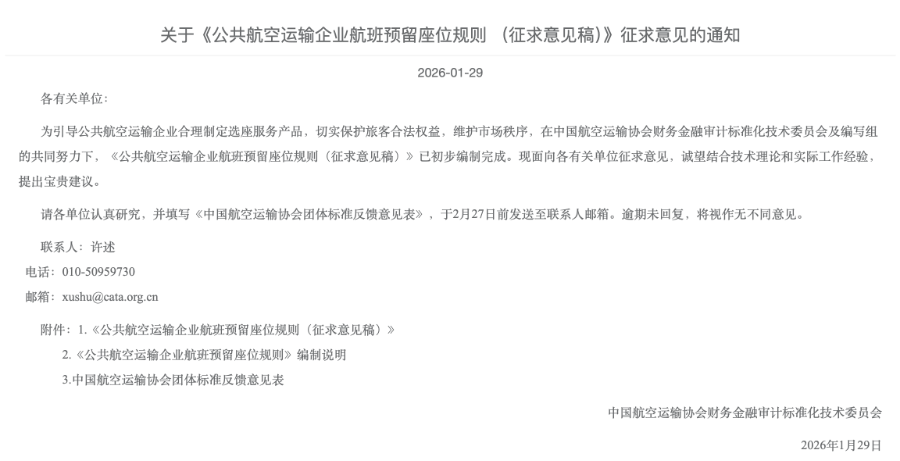
航班选座规则草案征求意见,国内航班免费可选座需在70%以上
2 1 Shi Ji Jing Ji Bao Dao· 2026-01-29 10:12
Core Viewpoint - The draft standard for "Public Aviation Transport Enterprises Flight Seat Reservation Rules" aims to standardize the reservation and release of economy class seats by domestic airlines, balancing commercial operations with passenger rights, marking a step towards refined and standardized management in China's aviation services [1][2]. Group 1: Draft Standard Overview - The draft mandates that domestic airlines must offer 70% to 80% of economy class seats as free selectable seats based on aircraft size, prohibiting paid seat selection [2]. - For international flights, at least 65% of economy class seats must be available for free selection, while paid seat selection is allowed, combining both rights-based and paid reservation options [2]. - The standard addresses the previously ambiguous issue of "seat selection fees" in aviation services, aiming to provide systematic regulation [2]. Group 2: Industry Context and Needs - The Civil Aviation Administration of China reports over 40 public aviation transport companies with an annual passenger transport volume exceeding 700 million [2]. - There is a growing demand for personalized and customized services among travelers, highlighting the importance of seat selection service experiences [2]. - Discrepancies in seat selection services among airlines on international routes have led to insufficient protection of passenger rights and inconsistent service experiences, necessitating the establishment of this standard [2][3]. Group 3: Expansion of the Standard - The standard has been expanded to cover domestic routes in addition to international ones, aiming for comprehensive regulation and alignment with global standards [3].