蓝箭航天朱雀三号

Search documents
商业航天“国家队”出手 产业发展动力足
Zheng Quan Ri Bao· 2026-01-06 16:39
Core Viewpoint - The commercial aerospace industry in China is experiencing rapid development, driven by significant capital increases and government support, which is expected to attract more social capital and enhance the industry's growth potential [1][2]. Group 1: Company Developments - China Aerospace Science and Technology Corporation's commercial rocket subsidiary increased its registered capital from 1 billion to 1.396 billion yuan, with the parent company contributing 906 million yuan [1]. - The company, established in September 2024, focuses on civil aerospace launch technology services, rocket control systems, and engine development [1]. - The increase in registered capital is seen as a symbol of the company's strength, providing advantages in bidding, credit support, and business expansion [1]. Group 2: Industry Trends - The commercial aerospace sector is in a robust growth phase, with projections indicating that by 2025, China will achieve a record number of launches and enter a scale-up phase [2]. - The industry is expected to see a significant increase in the number of launches, with estimates suggesting 100 launches per year by 2030, and a potential annual output value of 85 billion yuan for rocket launches and satellite manufacturing [2]. - The increase in capital from state-owned enterprises is anticipated to create a "central enterprise-led, multi-participation" ecosystem, driving sustained investment in the industry [2]. Group 3: Competitive Landscape - Companies are accelerating their investments in the commercial aerospace sector, with firms like ZTE Corporation focusing on integrating communication technologies for 6G and satellite networks [3]. - The rapid growth of the industry is leading to increased competition, with more companies entering the market, posing challenges for differentiation [3]. - Smaller enterprises face significant funding pressures and limited financing channels, necessitating increased R&D investment and innovative financing strategies to enhance competitiveness [3].
ChatGPT热点挖票系列:商业航天产业链与领涨股
SINOLINK SECURITIES· 2025-12-29 08:37
- The report introduces two quantitative factors: the "Leading Factor" and the "Right-Skewed Peak Factor," both constructed based on price-volume data to identify top-performing stocks within the "Commercial Space" concept stock pool[2][8] - The "Leading Factor" is designed to capture stocks with strong upward momentum, while the "Right-Skewed Peak Factor" focuses on stocks with a sharp and asymmetric price distribution, indicating potential for significant gains[8] - The enhanced portfolio derived from these factors includes five stocks: Sunway Communication, Sray Materials, China Satellite, Aerospace Development, and Aerospace Electronics[8]


中国卫星涨停!通用航空ETF(159231)午后冲高3%,机构:2030年中国商业航天发射与制造产值有望达850亿元
Xin Lang Cai Jing· 2025-12-24 05:57
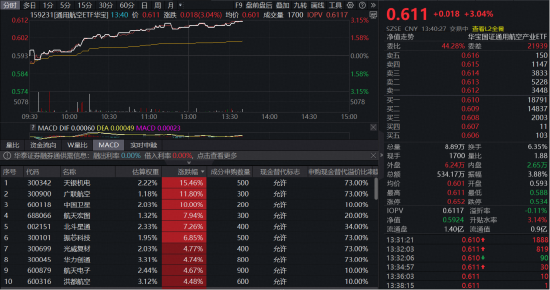
Group 1 - Aerospace and satellite internet sectors showed strong performance, with Tianyin Electromechanical rising over 15%, Guanglian Aviation up over 11%, and China Satellite hitting the daily limit up [1][4] - The General Aviation ETF Huabao (159231) saw a price increase of 3.04% in the afternoon session, reflecting a growing interest in commercial aerospace, satellite navigation, low-altitude economy, and large aircraft [1][4] - The ETF covers 50 constituent stocks across various sectors, including military and civilian aviation, with over 37% allocation to the aerospace industry, focusing on technological barriers and core commercialization aspects [3][6] Group 2 - Open-source securities highlighted that the scalability of commercial aerospace heavily relies on low-cost and high-frequency launch capabilities, with reusable rockets being a key factor [5] - China's recoverable rockets are currently in the engineering verification stage, with multiple rocket types undergoing intensive test flights, expected to enter a commercial phase in the next three years [5] - By 2030, China is projected to achieve 100 launches per year at a cost of approximately 100 million yuan per launch, with the annual output value of rocket launches and satellite manufacturing potentially reaching 85 billion yuan [5]

A股目前正处于关键位置,千万不要太上头!
Sou Hu Cai Jing· 2025-12-09 12:16
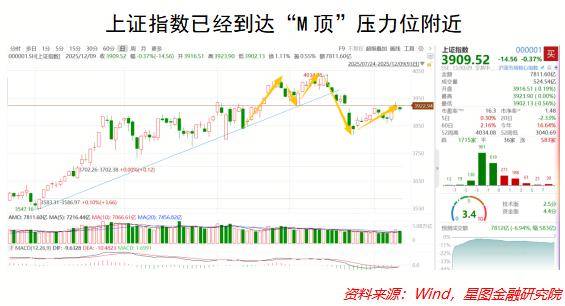
Market Overview - After two days of broad gains, A-shares experienced a correction today, with the Shanghai Composite Index down 0.37%, the Shenzhen Component Index down 0.39%, and the ChiNext Index up 0.61%. The total market turnover was 1.92 trillion yuan, a decrease of 134 billion yuan from the previous day, with over 4,000 stocks in the red [1] Reasons for Market Decline - The primary reason for today's decline is profit-taking by short-term investors after a recent rally, as the market reached a technical resistance level near 3930 points, making it difficult to break through [2] - Market participants are also in a wait-and-see mode ahead of the upcoming Central Economic Work Conference, as there are ongoing concerns about insufficient domestic demand and real estate contraction. Investors are cautious until clearer policy signals are provided [4] - External factors, particularly the anticipation of the Federal Reserve's interest rate decision, have contributed to a decrease in global risk appetite, impacting A-shares. Rising U.S. Treasury yields are putting pressure on equity valuations, especially in high-growth sectors [5] Future Market Outlook - In the medium to long term, the bullish logic for A-shares remains intact, but short-term trends indicate a continued correction until key resistance levels are broken. Institutional investors are likely to adopt a conservative approach due to year-end performance assessments and the lack of clear policy direction from the Central Economic Work Conference [6] Investment Strategies - Experienced investors are advised to focus on individual stocks rather than indices, with three key sectors to consider: - **Commercial Aerospace**: The sector is gaining attention due to government support and technological advancements that significantly reduce launch costs, with a projected market size in the hundreds of billions [7] - **Consumer Sector**: The traditional consumption peak season is approaching, with government policies aimed at boosting consumption. The consumer sector, particularly retail and food and beverage, is expected to perform well due to low valuations and stable earnings [8] - **Robotics**: The global policy push for robotics, particularly in the U.S. and China, is expected to drive growth in the sector, with market projections reaching hundreds of billions by 2030 [9]