A股牛市

Search documents
中信证券裘翔:利润率回升是A股接续牛市的关键
Xin Lang Zheng Quan· 2026-03-19 07:50
Group 1 - The core viewpoint is that the second quarter is a critical window for rebuilding confidence in the A-share market, with a focus on the stabilization and recovery of corporate profit margins as a necessary condition for the continuation of the bull market [1] - The Middle East conflict is seen as a catalyst for style switching this year, providing an opportunity to test the pricing power of China's advantageous manufacturing sector amid global supply chain disruptions [1] - Trends in the industry indicate that code inflation and physical scarcity are enhancing the pricing power of advantageous manufacturing in China, accelerated by disruptive innovation in AI and global energy supply chain disturbances [1] Group 2 - The re-evaluation of Chinese assets should not be centered around the HALO concept, as the logic differs from overseas markets; the focus should be on companies with market share and competitive advantages that can actively manage future capital expenditure [2] - The current bottom-line recommendation emphasizes industries in China with share advantages, where the cost of overseas capacity reset is high and supply elasticity is easily influenced by policy, particularly in chemicals, non-ferrous metals, power equipment, and new energy [2]



A股牛市尚能“饭否”?
经济观察报· 2026-03-17 16:26
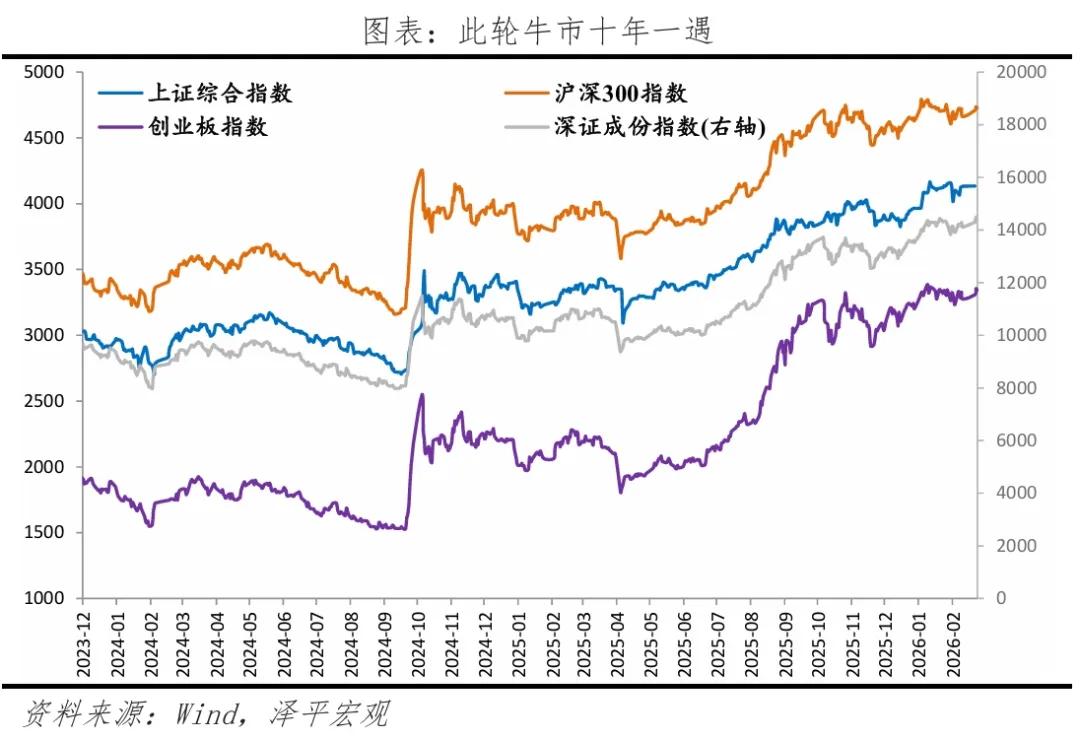
Core Viewpoint - The recent performance of A-shares is under scrutiny as the market faces both internal and external challenges, raising concerns about whether the Shanghai Composite Index will hold above the 4000-point mark [2][12]. Group 1: A-share Market Performance - The current bull market in A-shares, which began in September 2024, is experiencing difficulties, with significant net redemptions in equity ETFs, particularly those held by institutions [2][8]. - The total share of equity ETFs in China has been declining since reaching a peak of 22,236.69 billion shares at the end of 2025, dropping to 20,977.90 billion shares by the end of February 2026 [2][9]. - The Shanghai Composite Index has struggled to maintain its position above 4000 points, recently closing at 4049.91 points after a 0.85% drop, indicating a potential test of the critical 4000-point level [2][12]. Group 2: Global Market Context - Global stock indices have faced a downturn, with significant declines observed in major markets such as South Korea (down 11.12%), Japan (down 8.67%), and France (down 7.51%) since the onset of geopolitical tensions in the Middle East [5][6]. - Despite the global downturn, the Shanghai Composite Index's decline of only 2.71% during the same period suggests a degree of independence in its performance, attributed to its relatively lower valuation compared to other global markets [5][6]. Group 3: Institutional Behavior - Recent reports indicate that institutional investors have begun to exit the market, with net redemptions in equity ETFs amounting to 10.62 billion yuan, reflecting a trend of profit-taking after substantial gains during the bull market [8][10]. - Regulatory changes, including increased margin requirements, have contributed to a more cautious approach among investors, leading to a reduction in leverage and a focus on stabilizing market conditions [10][11]. - The decline in equity ETF shares is seen as a strategic move by institutions to realize profits while adhering to regulatory guidance, rather than a sign of pessimism regarding the long-term outlook for A-shares [10][14]. Group 4: Future Outlook - Historical analysis shows that the Shanghai Composite Index has only successfully maintained a position above 4000 points on two occasions, both of which were followed by prolonged bear markets [12][13]. - However, experts believe that the current market conditions are more favorable for sustaining the index above 4000 points, citing the increasing importance of the capital market and the attractiveness of Chinese valuations amid global uncertainties [12][13]. - The recent profit-taking by institutions is viewed as a normal operational strategy rather than a negative sentiment towards the market's future, with many institutions remaining optimistic about A-shares [12][14].

A股站上4100点,这七条建议你一定要听!
Xin Lang Cai Jing· 2026-02-27 16:25
Group 1 - The recent surge in A-shares has reached a ten-year high, validating predictions of a bull market in 2024, leading to increased enthusiasm among investors [1] - Market fluctuations are inherent and should be approached with a rational mindset, avoiding emotional reactions to market movements [1][2] - Investors should focus on macroeconomic, industry, and company fundamentals for informed decision-making [2] Group 2 - It is advised to allocate spare funds for investment, avoiding a gambling mentality and excessive leverage that could impact short-term living standards [3] - A bull market does not guarantee profits; investors should refrain from chasing trends and making frequent trades, as this often leads to losses [4] - Continuous improvement of knowledge and understanding of the market is essential, rather than relying on hearsay or insider information [4][5] Group 3 - Investors should operate within their capabilities and choose investment strategies that align with their expertise [6] - Maintaining a long-term perspective is crucial, avoiding decisions based solely on short-term market sentiments [7][9] - It is important to avoid selective attention bias, ensuring a comprehensive and objective evaluation of the market and companies [9]
机构称A股当下处在牛市逻辑当中,A500ETF易方达(159361)助力一键布局核心资产
Sou Hu Cai Jing· 2026-02-25 10:51
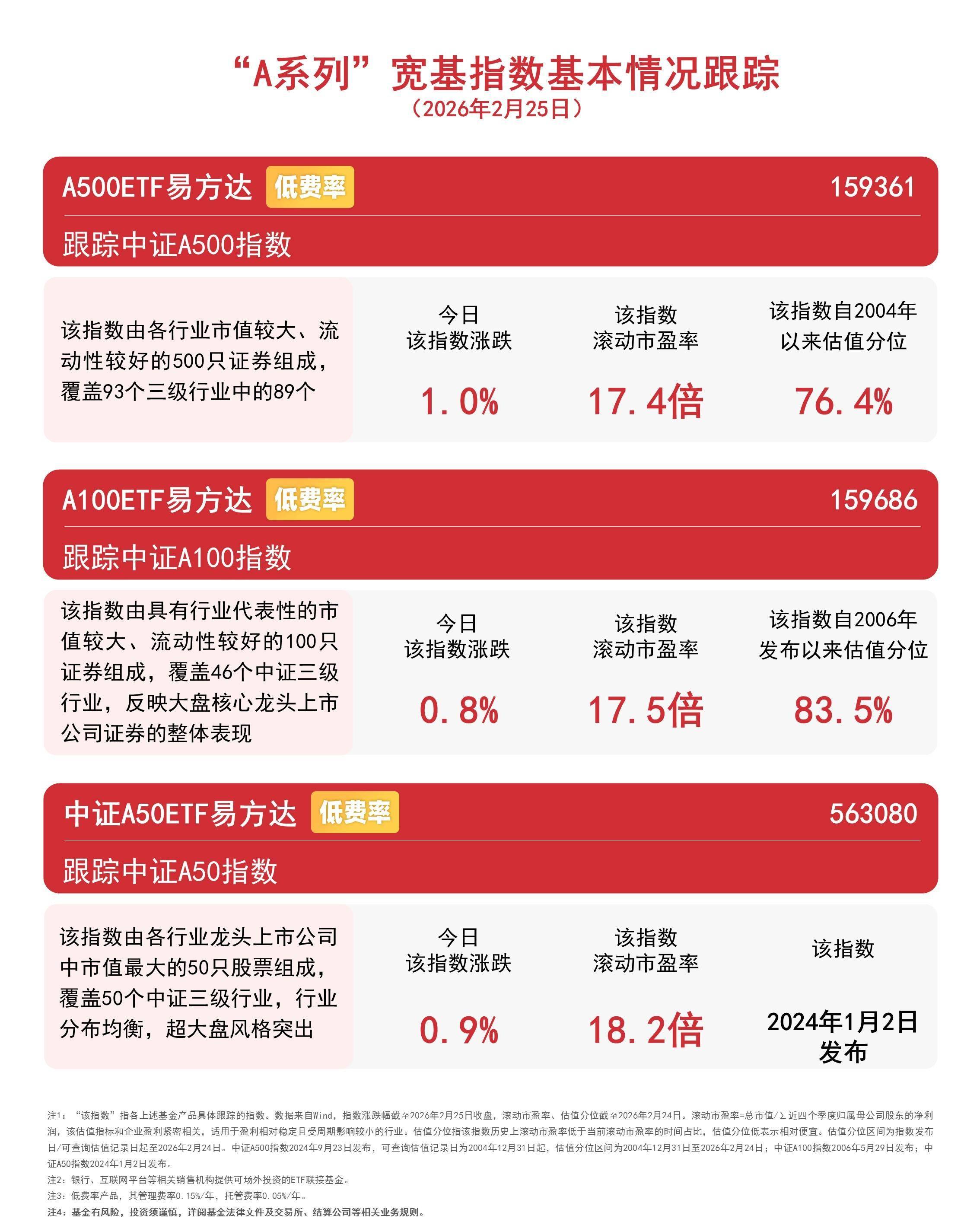
Group 1 - The core viewpoint is that the A-share market is currently in a bull market logic, and short-term fluctuations should not shake confidence in the positive trend [1] - The CSI A500 index rose by 1.0%, the CSI A50 index increased by 0.9%, and the CSI A100 index went up by 0.8% [1] - Open Source Securities maintains a bullish outlook as the core driving forces of the current bull market have not significantly tightened or shifted [1]
市场震荡,资金抢筹布局现金流资产,现金流ETF(159399)近10日净流入近10亿元
Mei Ri Jing Ji Xin Wen· 2026-02-10 13:47
Group 1 - The core viewpoint of the article highlights the increasing interest in cash flow assets amid market fluctuations, with nearly 1 billion yuan net inflow into cash flow ETF (159399) over the past 10 days [1] - Huachuang Securities points out that the current A-share bull market exhibits high Sharpe characteristics, attributed to continuous shareholder returns exceeding financing scale for four consecutive years, and a reversal in the investment and financing landscape leading to high Sharpe ratios for stocks [1] - The stable free cash flow generation capability of A-shares, with the proportion of non-financial free cash flow remaining stable at 20-25%, is expected to reduce reliance on financing environments and short-term economic cycles, thereby lowering price volatility [1] Group 2 - The FTSE cash flow index, which the cash flow ETF (159399) tracks, has outperformed the CSI Dividend Index and the CSI 300 Index for nine consecutive years from 2016 to 2024 [1] - The cash flow ETF (159399) focuses on large and mid-cap stocks, with a higher proportion of central state-owned enterprises compared to similar cash flow indices, allowing for monthly dividend assessments [1] - Investors are encouraged to pay attention to the cash flow ETF (159399) as corporate profitability is expected to improve with the completion of the transition from old to new growth drivers, and the drag from real estate nearing its end [1]
和讯投顾王海洋:大盘地量信号出现,虚拟经济引领市场
Sou Hu Cai Jing· 2026-02-10 10:25
Group 1 - The virtual economy sector has shown significant gains recently, dominating the gainers list, indicating a strong upward trend in this area [1] - The overall market is experiencing a contraction in trading volume, with a total trading volume of 550.02 billion, signaling a potential "de量" situation [1] - The market is currently at a resistance level, and for further upward movement, it may require either a minor pullback or a direct low opening to mitigate adjustment risks [1] Group 2 - The year 2026 is projected to be a peak year for the A-share bull market, with expectations of a strong rally that could push the index above 4500 points [2] - The virtual economy sector is anticipated to gain momentum after the New Year, having already shown signs of early activation before the year-end [2] - The current market phase is characterized as a bull market, with a positive trend and a transition past the developmental stage, suggesting that investors should remain patient and strategically position themselves for upcoming major market movements [2]
投资银行业与经纪业:轮动对比视角复盘,当前非银子行业如何择时选股?
Changjiang Securities· 2026-02-08 11:58
Investment Rating - The report maintains a "Positive" investment rating for the non-bank sector [14]. Core Insights - The report analyzes the performance of insurance and brokerage sectors during historical bull markets in A-shares, highlighting their relative performance and the impact of different market types on their returns [3][17]. - It suggests that the current valuation of the non-bank sector has entered a cost-effective allocation range, recommending a focus on high-elasticity insurance and financial IT stocks while timing investments according to policy and regulatory rhythms [3][9]. Summary by Sections Historical Performance Analysis - Insurance and brokerage sectors have shown certain elastic characteristics during past bull markets, with both sectors achieving relative excess returns in three out of six analyzed bull market cycles [17]. - In different types of bull markets, brokerage firms tend to outperform insurance companies in leverage-driven or rapid bull markets, while insurance performs better in slow or value-driven bull markets [8][18]. - The report notes that brokerage firms often lead in performance at the beginning of bull markets, while insurance companies show resilience throughout the early stages and may gain momentum in the latter stages as interest rates and investment returns improve [8][18]. Current Market Outlook - Since 2025, there has been a notable divergence in performance between insurance and brokerage sectors, reflecting a preference for a structural "slow bull" market in the current cycle [9]. - The current price-to-book (PB) ratio for the securities sector has adjusted to 1.44x, placing it at the 24th percentile since 2012, while the average price-to-earnings value (PEV) for the insurance sector is at the 37.5th percentile [9]. - The report emphasizes that the current market correction presents a favorable time for quality allocations in the sector, with insurance companies expected to see a significant upward trend in return on equity (ROE) driven by improved liability cost management and asset allocation strategies [9][10]. Stock Recommendations - The report recommends stocks that are likely to benefit from the slow bull market, including major life insurance companies such as Xinhua Insurance, China Life, Ping An, and China Pacific Insurance, as well as brokerage and financial IT firms like Jiufang Zhitu, Zhinan Zhen, Tonghuashun, Dongfang Caifu, CICC, Dongfang Securities, and Guotai Junan [10].




晨会纪要-20260206
Guoxin Securities· 2026-02-06 03:26
Macro and Strategy - The macroeconomic review indicates that Shenzhen's GDP is expected to grow by 5.5% in 2025, achieving the anticipated growth target, with foreign trade increasing by 1.4% despite a decline in exports due to a high base in 2024 [7] - The strategy report highlights that A-share earnings are stabilizing, driven by cost reductions and the new economy outpacing the old economy, with a projected 10% growth in A-share earnings for 2026 under neutral assumptions [8][10] Industry and Company - The North Exchange's January 2026 report shows a significant increase in market activity, with a total of 292 listed companies and a total market value of 936.3 billion yuan, reflecting a 7.7% increase in total market value [11] - In the electric power equipment sector, domestic demand is expected to remain strong, with a focus on high-voltage direct current (HVDC) and smart meters, as the State Grid's fixed asset investment is projected to reach 4 trillion yuan, a 40% increase from the previous five-year plan [14][15][17] - Yum China reported a 22% year-on-year increase in net profit for Q4 2025, with total revenue reaching $2.823 billion, driven by a 34% increase in delivery sales [18][19][21]
国信证券晨会纪要-20260206
Guoxin Securities· 2026-02-06 02:02
Macro and Strategy - The macroeconomic review indicates that Shenzhen's GDP is expected to grow by 5.5% in 2025, with foreign trade increasing by 1.4% despite a decline in exports due to a high base in 2024 [7] - The A-share market is projected to see a 10% profit growth in 2026, driven by cost reductions and the rise of new economy sectors outpacing traditional sectors [8][10] Industry and Company - The North Exchange saw a significant increase in trading activity in January 2026, with a total of 292 listed companies and a market capitalization of 936.3 billion yuan, reflecting a 7.7% increase [11] - The electric power equipment industry is expected to benefit from strong domestic demand and overseas expansion opportunities, particularly in high-voltage direct current (HVDC) technology [14][15] - Yum China reported a 22% year-on-year increase in net profit for Q4 2025, with total revenue reaching $2.823 billion, driven by a 34% increase in delivery sales [19][21] Investment Recommendations - Focus on high-voltage direct current and smart meter sectors, recommending companies like Pinggao Electric and XJ Electric for their growth potential [17] - Anticipate continued overseas expansion for Chinese companies in the electric power sector, suggesting attention to companies like Sifang Co. and Mingyang Smart Energy [17]
【招银研究|资本市场快评】如何看待A股大跌——短期震荡消化不改中期趋势
招商银行研究· 2026-02-02 11:46
Core Viewpoint - The recent decline in the A-share market is primarily driven by external liquidity shocks and internal capital withdrawal, with a significant impact from the hawkish stance of the new Federal Reserve chairman [2]. Group 1: Market Decline Reasons - The core trigger for the market drop is the hawkish expectation of the Federal Reserve's balance sheet reduction, leading to a global liquidity repricing [2]. - The A-share market, which has been largely liquidity-driven since the bull market began on September 24, 2024, is particularly sensitive to changes in policy expectations [2]. - Domestic factors, including reduced leverage by exchanges and significant ETF redemptions, have further suppressed market sentiment, with a record net redemption of 780 billion yuan in January [2]. Group 2: A-share Market Outlook - The current pricing of the A-share market reflects a certain bias against the Federal Reserve's hawkish stance, with expectations that the new chairman will balance interest rate cuts with the realities of dollar liquidity [3]. - As the market approaches a reasonable valuation, regulatory goals for cooling the market will likely be achieved, leading to a potential shift towards more positive policy [3]. - Historical patterns suggest a strong likelihood of a spring rally between the Lunar New Year and the Two Sessions, with a historical probability of around 90% for market gains during this period [3]. - Defensive attributes are expected from undervalued domestic assets during periods of external volatility, as evidenced by the resilience of banking and food and beverage sectors [3]. - Following stabilization of market sentiment, there is potential for continued investment in AI technology and overseas manufacturing, alongside increased allocation to high-dividend sectors like banking and consumer goods to enhance portfolio resilience [3].