西部利得量化优选一年持有A

Search documents
微盘股指数周报:本周市场持续缩量,微盘表现欠佳-20251208
China Post Securities· 2025-12-08 10:16
Quantitative Models and Construction Methods 1. Model Name: Diffusion Index Model - **Model Construction Idea**: The diffusion index is used to monitor the critical points of market trend changes and predict potential reversals in the micro-cap stock index[40][41] - **Model Construction Process**: The diffusion index is calculated based on the relative price changes of micro-cap stock index constituents over a specific time window. The horizontal axis represents the percentage change in stock prices (e.g., from +10% to -10%), while the vertical axis represents the length of the review or forecast window (e.g., 10 to 20 trading days). For example, a horizontal value of 0.95 and a vertical value of 15 days indicates that if all constituent stocks drop by 5% after 5 days, the diffusion index value is 0.03[40][42] - **Key Methods**: - **Left Threshold Method**: Triggered a short signal on November 14, 2025, when the index closed at 0.925[43] - **Right Threshold Method**: Triggered a short signal on November 17, 2025, when the index closed at 0.8975[46] - **Dual Moving Average Method**: Triggered a short signal on November 25, 2025[48] - **Model Evaluation**: The diffusion index is effective in identifying critical points for market reversals and provides actionable signals for trading strategies[40][41] 2. Model Name: Small-Cap Low-Volatility 50 Strategy - **Model Construction Idea**: This strategy selects 50 stocks with small market capitalization and low volatility from the micro-cap stock index constituents, aiming to achieve stable returns with reduced risk[8][35] - **Model Construction Process**: - **Stock Selection**: Identify stocks with the smallest market capitalization and lowest volatility within the micro-cap stock index[35] - **Rebalancing Frequency**: Rebalance the portfolio bi-weekly[35] - **Transaction Costs**: Assume a bidirectional transaction cost of 0.3%[35] - **Benchmark**: Use the Wind Micro-Cap Stock Index (8841431.WI) as the benchmark[35] - **Model Evaluation**: The strategy demonstrates strong performance in capturing excess returns, particularly in 2025, with a significant year-to-date (YTD) return[35] --- Model Backtesting Results 1. Diffusion Index Model - **Left Threshold Method**: Short signal triggered at 0.925 on November 14, 2025[43] - **Right Threshold Method**: Short signal triggered at 0.8975 on November 17, 2025[46] - **Dual Moving Average Method**: Short signal triggered on November 25, 2025[48] 2. Small-Cap Low-Volatility 50 Strategy - **2024 Return**: 7.07%, with an excess return of -2.93%[35] - **2025 YTD Return**: 72.07%, with a weekly excess return of 0.001%[35] --- Quantitative Factors and Construction Methods 1. Factor Name: PE_TTM Inverse Factor - **Factor Construction Idea**: This factor uses the inverse of the price-to-earnings ratio (trailing twelve months) to identify undervalued stocks[5][33] - **Factor Construction Process**: - Calculate the trailing twelve months (TTM) PE ratio for each stock - Take the reciprocal of the PE ratio to construct the factor[33] - **Factor Evaluation**: Demonstrates strong predictive power with a weekly rank IC of 0.237, significantly above its historical average of 0.016[5][33] 2. Factor Name: PB Inverse Factor - **Factor Construction Idea**: This factor uses the inverse of the price-to-book ratio to identify undervalued stocks[5][33] - **Factor Construction Process**: - Calculate the price-to-book (PB) ratio for each stock - Take the reciprocal of the PB ratio to construct the factor[33] - **Factor Evaluation**: Shows strong performance with a weekly rank IC of 0.213, well above its historical average of 0.034[5][33] 3. Factor Name: Profitability Factor - **Factor Construction Idea**: Measures the profitability of companies to identify fundamentally strong stocks[5][33] - **Factor Construction Process**: - Use metrics such as return on equity (ROE) and net profit margin to construct the factor[33] - **Factor Evaluation**: Exhibits robust predictive power with a weekly rank IC of 0.185, outperforming its historical average of 0.022[5][33] 4. Factor Name: Dividend Yield Factor - **Factor Construction Idea**: Focuses on stocks with high dividend yields to capture stable income[5][33] - **Factor Construction Process**: - Calculate the dividend yield for each stock - Rank stocks based on their dividend yield to construct the factor[33] - **Factor Evaluation**: Performs well with a weekly rank IC of 0.179, exceeding its historical average of 0.022[5][33] 5. Factor Name: Single-Quarter ROE Factor - **Factor Construction Idea**: Evaluates the return on equity for a single quarter to identify high-performing stocks[5][33] - **Factor Construction Process**: - Calculate the ROE for the most recent quarter - Rank stocks based on their single-quarter ROE to construct the factor[33] - **Factor Evaluation**: Delivers strong results with a weekly rank IC of 0.163, above its historical average of 0.021[5][33] --- Factor Backtesting Results 1. PE_TTM Inverse Factor - Weekly Rank IC: 0.237 - Historical Average Rank IC: 0.016[5][33] 2. PB Inverse Factor - Weekly Rank IC: 0.213 - Historical Average Rank IC: 0.034[5][33] 3. Profitability Factor - Weekly Rank IC: 0.185 - Historical Average Rank IC: 0.022[5][33] 4. Dividend Yield Factor - Weekly Rank IC: 0.179 - Historical Average Rank IC: 0.022[5][33] 5. Single-Quarter ROE Factor - Weekly Rank IC: 0.163 - Historical Average Rank IC: 0.021[5][33]
微盘股指数周报:微盘股领涨市场,短期可能承压长期逻辑不改-20251110
China Post Securities· 2025-11-10 07:50
Quantitative Models and Construction Methods - **Model Name**: Diffusion Index Model **Construction Idea**: The model monitors the future critical points of the diffusion index to predict market trends[6][38][39] **Construction Process**: 1. The diffusion index is calculated based on the relative price changes of constituent stocks over a specific time window 2. Horizontal axis represents future price changes (e.g., from +10% to -10%), while vertical axis represents the length of the review window (e.g., 20 days to 10 days) 3. Example: If all constituent stocks drop by 5% after 5 days, the diffusion index value is 0.69[38] 4. The model uses methods like left-side threshold, right-side threshold, and dual moving average to generate signals - Left-side threshold method triggered an opening signal on September 23, 2025, with a value of 0.0575[43] - Right-side threshold method triggered an opening signal on September 25, 2025, with a value of 0.1825[47] - Dual moving average method provided a bullish signal on October 13, 2025[48] **Evaluation**: The model is effective in identifying high-risk zones and generating trading signals[6][39][48] - **Model Name**: Small Cap Low Volatility 50 Strategy **Construction Idea**: Select 50 stocks with small market capitalization and low volatility from micro-cap stocks[8][34] **Construction Process**: 1. Stocks are selected based on market capitalization and volatility criteria 2. Portfolio is rebalanced bi-weekly 3. Transaction cost is set at 0.3% for both sides 4. Benchmark index: Wind Micro-Cap Index (8841431.WI)[8][34] **Evaluation**: The strategy has shown strong performance in 2025, with significant YTD returns[8][34] Model Backtesting Results - **Diffusion Index Model**: - Current diffusion index value: 0.82, indicating a medium-high level[38][39] - Weekly increase from 0.78 to 0.82[39] - Future prediction: If the index rises by 2% next week, it will trigger the risk threshold[39] - **Small Cap Low Volatility 50 Strategy**: - 2024 return: 7.07%, excess return: -2.93%[8][34] - 2025 YTD return: 77.82%, weekly excess return: 1.50%[8][34] Quantitative Factors and Construction Methods - **Factor Name**: Free Float Ratio Factor **Construction Idea**: Measure the proportion of free-floating shares in total shares[5][16][32] **Construction Process**: 1. Calculate the ratio of free-floating shares to total shares 2. Rank IC value for the week: 0.108; historical average: -0.012[5][16][32] **Evaluation**: Positive weekly IC indicates strong predictive power[5][16][32] - **Factor Name**: Leverage Factor **Construction Idea**: Assess the financial leverage of companies[5][16][32] **Construction Process**: 1. Calculate the ratio of total debt to equity 2. Rank IC value for the week: 0.104; historical average: -0.006[5][16][32] **Evaluation**: Positive weekly IC suggests effective factor performance[5][16][32] - **Factor Name**: 10-Day Total Market Cap Turnover Rate Factor **Construction Idea**: Measure the turnover rate of total market capitalization over 10 days[5][16][32] **Construction Process**: 1. Calculate turnover rate as trading volume divided by total market capitalization over 10 days 2. Rank IC value for the week: 0.099; historical average: -0.059[5][16][32] **Evaluation**: Positive weekly IC indicates good predictive ability[5][16][32] - **Factor Name**: 10-Day Free Float Market Cap Turnover Rate Factor **Construction Idea**: Measure the turnover rate of free-floating market capitalization over 10 days[5][16][32] **Construction Process**: 1. Calculate turnover rate as trading volume divided by free-floating market capitalization over 10 days 2. Rank IC value for the week: 0.098; historical average: -0.061[5][16][32] **Evaluation**: Positive weekly IC suggests strong factor performance[5][16][32] - **Factor Name**: Dividend Yield Factor **Construction Idea**: Measure the dividend yield of stocks[5][16][32] **Construction Process**: 1. Calculate dividend yield as annual dividend divided by stock price 2. Rank IC value for the week: 0.065; historical average: 0.022[5][16][32] **Evaluation**: Positive weekly IC indicates reliable factor performance[5][16][32] Factor Backtesting Results - **Free Float Ratio Factor**: Weekly IC: 0.108; historical average: -0.012[5][16][32] - **Leverage Factor**: Weekly IC: 0.104; historical average: -0.006[5][16][32] - **10-Day Total Market Cap Turnover Rate Factor**: Weekly IC: 0.099; historical average: -0.059[5][16][32] - **10-Day Free Float Market Cap Turnover Rate Factor**: Weekly IC: 0.098; historical average: -0.061[5][16][32] - **Dividend Yield Factor**: Weekly IC: 0.065; historical average: 0.022[5][16][32]
微盘股指数周报:微盘股新高,成交占比快速回升-20251027
China Post Securities· 2025-10-27 09:57
Quantitative Models and Construction - **Model Name**: Diffusion Index Model **Construction Idea**: The model monitors the future diffusion index's critical points to predict market changes[39][40] **Construction Process**: The diffusion index is calculated based on the relative price changes of constituent stocks over a specific time window. The horizontal axis represents the future price change percentage (from +10% to -10%), while the vertical axis represents the review period length (from 20 days to 10 days). For example, at a horizontal axis value of 0.95 and a vertical axis value of 15 days, the diffusion index is 0.42, indicating that if all constituent stocks drop by 5% after 5 days, the diffusion index value will be 0.42[39][41] **Evaluation**: The model is effective in identifying potential turning points in the market[40] - **Model Name**: First Threshold Method (Left-Side Trading) **Construction Idea**: This method triggers a buy signal when the diffusion index reaches a predefined threshold[43] **Construction Process**: The first threshold method triggered a buy signal on September 23, 2025, when the diffusion index reached 0.0575[43] **Evaluation**: The method is suitable for early-stage market entry[43] - **Model Name**: Delayed Threshold Method (Right-Side Trading) **Construction Idea**: This method provides a buy signal after the diffusion index stabilizes above the threshold[46] **Construction Process**: The delayed threshold method triggered a buy signal on September 25, 2025, when the diffusion index reached 0.1825[46] **Evaluation**: The method is more conservative and reduces false signals compared to the first threshold method[46] - **Model Name**: Dual Moving Average Method (Adaptive Trading) **Construction Idea**: This method uses two moving averages to generate trading signals based on their crossover[47] **Construction Process**: The dual moving average method provided a buy signal on October 13, 2025, at the market close[47] **Evaluation**: The method adapts to market trends and is effective in capturing medium-term signals[47] Model Backtesting Results - **Diffusion Index Model**: Current diffusion index value is 0.67, indicating a medium-high level. If the market rises by 4% next week, it will trigger the risk threshold[39][40] - **First Threshold Method**: Triggered buy signal at diffusion index value of 0.0575[43] - **Delayed Threshold Method**: Triggered buy signal at diffusion index value of 0.1825[46] - **Dual Moving Average Method**: Triggered buy signal on October 13, 2025[47] Quantitative Factors and Construction - **Factor Name**: Non-Liquidity Factor **Construction Idea**: Measures the illiquidity of stocks to predict their future performance[5][33] **Construction Process**: The rank IC for this factor is calculated weekly. This week, the rank IC is 0.147, compared to the historical average of 0.04[5][33] **Evaluation**: The factor shows strong predictive power this week[5][33] - **Factor Name**: Beta Factor **Construction Idea**: Captures the sensitivity of stock returns to market movements[5][33] **Construction Process**: The rank IC for this factor is 0.134 this week, compared to the historical average of 0.004[5][33] **Evaluation**: The factor demonstrates significant improvement in predictive ability this week[5][33] - **Factor Name**: Standardized Expected Earnings Factor **Construction Idea**: Reflects the expected profitability of stocks[5][33] **Construction Process**: The rank IC for this factor is 0.132 this week, compared to the historical average of 0.014[5][33] **Evaluation**: The factor is effective in identifying profitable stocks[5][33] - **Factor Name**: Single-Quarter Net Profit Growth Factor **Construction Idea**: Measures the growth rate of net profit in a single quarter[5][33] **Construction Process**: The rank IC for this factor is 0.088 this week, compared to the historical average of 0.02[5][33] **Evaluation**: The factor is moderately effective in predicting stock performance[5][33] - **Factor Name**: Single-Quarter ROE Factor **Construction Idea**: Reflects the return on equity for a single quarter[5][33] **Construction Process**: The rank IC for this factor is 0.045 this week, compared to the historical average of 0.022[5][33] **Evaluation**: The factor shows limited predictive power this week[5][33] Factor Backtesting Results - **Non-Liquidity Factor**: Rank IC 0.147, historical average 0.04[5][33] - **Beta Factor**: Rank IC 0.134, historical average 0.004[5][33] - **Standardized Expected Earnings Factor**: Rank IC 0.132, historical average 0.014[5][33] - **Single-Quarter Net Profit Growth Factor**: Rank IC 0.088, historical average 0.02[5][33] - **Single-Quarter ROE Factor**: Rank IC 0.045, historical average 0.022[5][33] Composite Strategy and Construction - **Strategy Name**: Small-Cap Low-Volatility 50 Strategy **Construction Idea**: Selects 50 stocks with small market capitalization and low volatility from micro-cap stocks[8][17][35] **Construction Process**: The strategy rebalances every two weeks. In 2024, the strategy achieved a return of 7.07% with an excess return of -2.93%. In 2025, the YTD return is 71.25%, with a weekly excess return of 2.65%. The benchmark is the Wind Micro-Cap Index (8841431.WI), and transaction costs are 0.3% on both sides[8][17][35] **Evaluation**: The strategy is highly effective in capturing the performance of small-cap stocks in 2025[8][17][35] Strategy Backtesting Results - **Small-Cap Low-Volatility 50 Strategy**: - 2024 Return: 7.07%, Excess Return: -2.93%[8][17][35] - 2025 YTD Return: 71.25%, Weekly Excess Return: 2.65%[8][17][35]
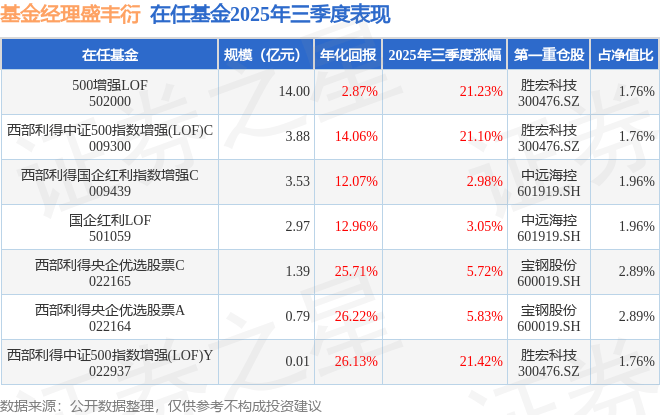
盛丰衍2025年三季度表现,西部利得中证500指数增强(LOF)Y基金季度涨幅21.42%
Sou Hu Cai Jing· 2025-10-26 21:39
Core Insights - The best-performing fund managed by Sheng Fengyan is the Western Gain CSI 500 Index Enhanced (LOF) Y, with a quarterly net value increase of 21.42% as of Q3 2025 [1] Fund Performance Summary - Sheng Fengyan manages a total of 7 funds, with the following performance metrics: - Western Gain CSI 500 Index Enhanced (LOF) Y: 14.00 billion, annualized return of 2.87%, quarterly increase of 21.23% [2] - Western Gain CSI 500 Index Enhanced (LOF) C: 3.88 billion, annualized return of 14.06%, quarterly increase of 21.10% [2] - Western Gain State-Owned Enterprise Dividend Index Enhanced C: 3.53 billion, annualized return of 12.07%, quarterly increase of 2.98% [2] - Western Gain Central Enterprise Preferred Stock C: 1.39 billion, annualized return of 25.71%, quarterly increase of 5.72% [2] - Western Gain Central Enterprise Preferred Stock A: 0.79 billion, annualized return of 26.22%, quarterly increase of 5.83% [2] - Western Gain State-Owned Enterprise Dividend LOF: 2.97 billion, annualized return of 12.96%, quarterly increase of 3.05% [2] Investment Strategy and Stock Performance - During his tenure managing the Western Gain CSI 500 Index Enhanced (LOF) A fund, Sheng Fengyan achieved a cumulative return of 113.43% with an average annualized return of 8.86% [2] - The fund had 249 stock adjustments, with a win rate of 61.85% and 4 instances of doubling returns [2] Notable Stock Adjustments - Significant stock adjustments include: - Ecovacs (科沃斯): Purchased in Q4 2020, sold in Q1 2021, with an estimated return of 173.50% and a company performance growth of 213.51% [3][5] - HIKVISION (海康威视): Purchased in Q3 2021, sold in Q3 2024, with an estimated return of -44.64% despite a company performance growth of 13.60% [4][6] - Tian Nai Technology (天奈科技): Purchased in Q2 2021, sold in Q3 2021, with an estimated return of 98.35% and a company performance growth of 179.68% [3][6]

葛兰医疗基金时隔四年再限购,3600点后机构“恐高”情绪隐现?
Hua Xia Shi Bao· 2025-08-13 10:09
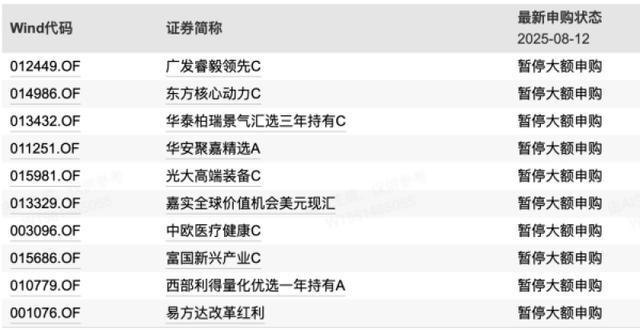
Core Insights - A number of actively managed equity funds have recently suspended large subscriptions, indicating a trend in the market as the Shanghai Composite Index surpasses 3600 points [2][3] - The suspension of large subscriptions is primarily driven by the strong performance of these funds, with several achieving significant year-to-date returns [3][4] Fund Suspension Details - Notable funds that have suspended large subscriptions include those managed by well-known fund managers, such as the China Europe Medical Innovation Stock and the China Europe Science and Technology Theme Mixed Fund, with daily limits set at 100,000 and 1,000,000 respectively [2] - Over 100 actively managed equity funds have suspended large subscriptions in the past month, many of which are top performers in the market [2][3] Performance Metrics - The China Europe Medical Innovation Stock A/C shares have year-to-date returns of 62.21% and 61.40%, ranking in the top three among similar funds [3] - The China Europe Science and Technology Theme Mixed Fund has seen a net asset value growth rate exceeding 90% over the past year, showcasing the strong momentum in the technology sector [3] Strategic Considerations - Fund managers are implementing subscription limits to balance asset growth and performance stability, as rapid growth can negatively impact investment strategies and existing investors [3][4] - The phenomenon of "scale curse" is highlighted, where exceeding a certain fund size can restrict investment flexibility and reduce the ability to generate excess returns [5][6] Market Implications - The recent trend of suspending large subscriptions may signal a protective mechanism for fund performance rather than a pessimistic market outlook [6][7] - Historical data suggests that previous subscription suspensions by prominent fund managers occurred at critical market junctures, raising questions about the sustainability of the current market rally [6][7] Future Outlook - Fund managers remain focused on sectors such as innovative pharmaceuticals, which are gaining global recognition and support from domestic policies aimed at enhancing research and development [7] - Some fund managers may also be leveraging market sentiment through subscription limits as a marketing strategy to attract investor attention during bullish phases [7]