
谷歌应用商店

Search documents
谷歌支付超1亿美元与安卓用户和解,用户最高获赔100美元
Nan Fang Du Shi Bao· 2026-01-31 03:36
Core Points - Google has agreed to pay $135 million to settle a class-action lawsuit where users accused the company of illegally collecting mobile data from Android devices without consent for personalized advertising [1][4] - The lawsuit claims that Google's actions constitute "illegal conversion of property," which is a significant legal distinction compared to typical privacy infringement cases [4] - If the settlement is approved, it could become the highest settlement amount in a "conversion of property" case in history [4] Summary by Sections Settlement Details - The settlement amount is $135 million (approximately 940 million RMB) [4] - Compensation will be provided to all users of Android devices from November 12, 2017, with a maximum payout of $100 per member [4] - An estimated 40% of the mobile market in the U.S. consists of Android users [4] Legal and Compliance Measures - The settlement includes a series of corrective measures for Google, such as stopping the alleged illegal data collection and transmission practices [4] - Google will modify its app store terms to disclose data collection practices and provide a "one-click off" button for data transmission [4] - Users must give explicit consent for changes to the initial settings of Android devices [4] Additional Context - The settlement has been submitted to the U.S. District Court in San Jose, California, with a hearing scheduled for August [5] - Google has recently been involved in multiple lawsuits, agreeing to pay significant settlements to resolve various legal issues [5]


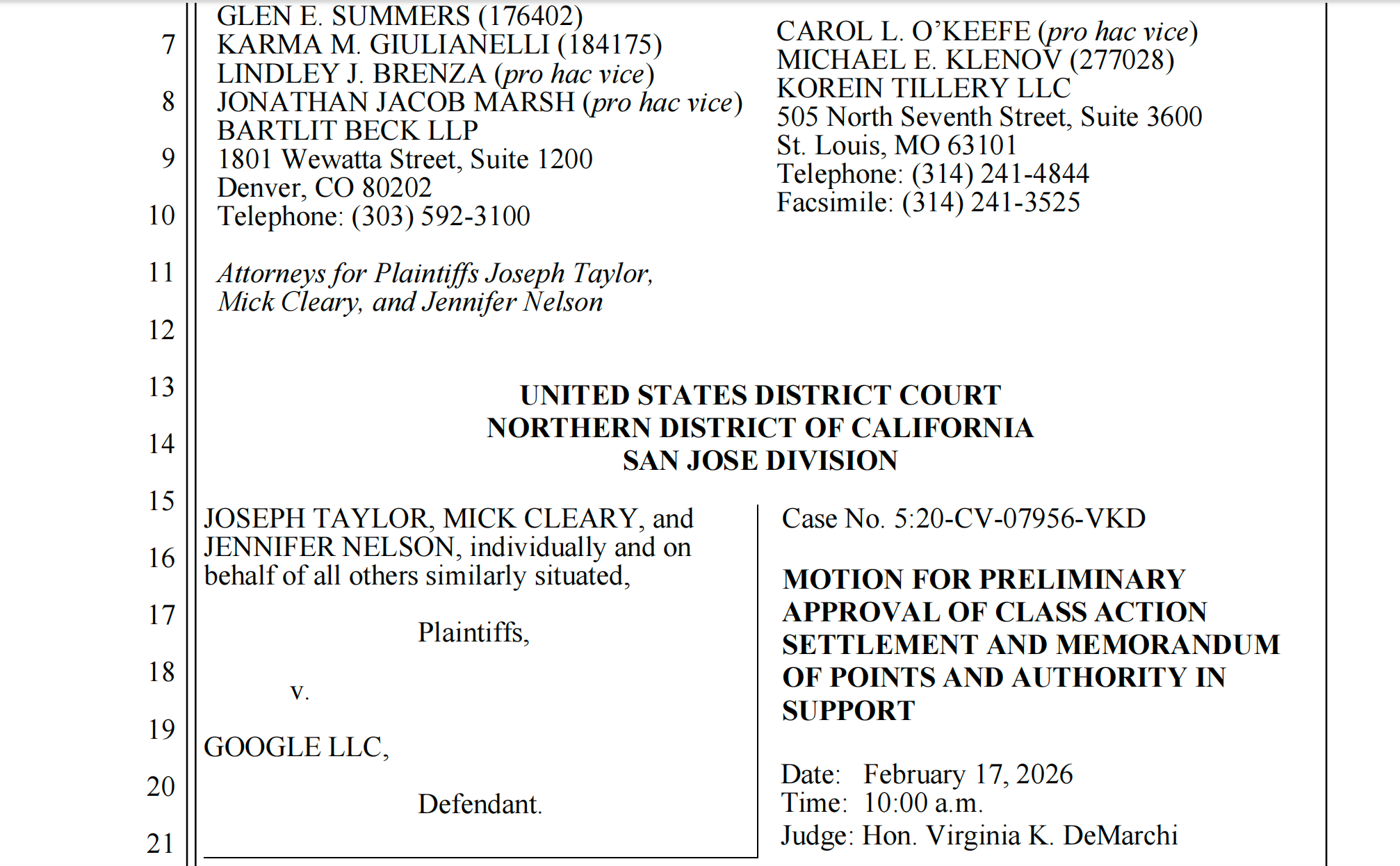
谷歌将支付1.35亿美元和解安卓系统数据传输相关诉讼
Xin Lang Cai Jing· 2026-01-28 15:57
Core Viewpoint - Google will pay $135 million to settle a class-action lawsuit filed by smartphone users who accused the company of collecting mobile network data without user consent through its Android operating system [1][3]. Group 1: Settlement Details - The settlement agreement was submitted to the federal court in San Jose, California, and is pending judicial approval [1][3]. - Google denies any wrongdoing while agreeing to the settlement, which covers all Android device users from November 12, 2017 [1][3]. - The settlement amount of $135 million sets a record for cases involving illegal appropriation, with each class member eligible for a maximum compensation of $100 [2][4]. Group 2: Allegations and User Impact - Plaintiffs claim that Google continued to collect users' mobile network data even when users disabled Google apps, turned off location sharing, or locked their phones [1][3]. - The lawsuit alleges that Google used this data for product development and targeted advertising, constituting "illegal appropriation" [1][3]. Group 3: Required Changes by Google - As part of the settlement, Google must implement several changes, including obtaining explicit consent from users before transmitting their data during the initial setup of Android devices [1][3]. - Google is also required to provide users with easier options to disable data transmission and to clearly disclose data transmission practices in the terms of service on the Google Play Store [1][3]. Group 4: Legal Fees - The plaintiffs' legal team plans to request up to $39.8 million in attorney fees, which would account for 29.5% of the settlement fund [2][4].
谷歌慌了?欧盟拿苹果当标尺,应用商店整改不达标将挨重罚
Huan Qiu Wang Zi Xun· 2025-12-11 03:40
Core Viewpoint - The European Commission is using Apple's App Store compliance measures as a benchmark to evaluate Google's App Store compliance, with potential hefty fines for Google by Q1 2025 if it fails to meet standards [1][4]. Group 1: Regulatory Context - The regulatory developments stem from the implementation of the Digital Markets Act, which led to a €500 million fine imposed on Apple earlier this year for violations [4]. - Apple's comprehensive App Store reform plan has become an "invisible benchmark" for regulatory compliance in the industry, despite not being officially recognized by the EU [4]. Group 2: Google's Compliance Measures - Google's reform measures announced in August were criticized for being insufficient, as the EU believes they do not meet core requirements such as allowing developers to direct users to third-party payment channels [4]. - Although Google reduced the initial acquisition fee for developers from 10% to 3% and introduced a tiered fee structure, the EU still sees gaps in compliance compared to Apple's approach [4]. Group 3: Implications for the Industry - The EU's stance indicates a shift towards a "benchmarking" phase in app store regulation, with Apple transitioning from a "penalized entity" to a "reference point" for compliance [4]. - This development is expected to accelerate Google's reform process and provide a new direction for global app store compliance reforms, making Google's ability to implement additional measures a key focus in antitrust regulation within the tech industry [4].

法庭文件显示:在与Epic Games的诉讼中,谷歌就改造应用商店的命令提出的上诉被驳回。
news flash· 2025-07-31 16:45
Core Viewpoint - Google's appeal regarding the order to modify its app store in the lawsuit with Epic Games has been rejected by the court [1] Group 1 - The court ruling indicates a significant setback for Google in its ongoing legal battle with Epic Games [1] - The decision may have implications for how app stores operate and the regulations they must adhere to in the future [1]
美国得州州长签署法律,对苹果和谷歌应用商店实施年龄验证
news flash· 2025-05-27 20:04
Core Points - Texas Governor Greg Abbott signed a bill requiring Apple and Google to verify the age of users in their app stores, making Texas a focal point in the debate over regulating children's and teenagers' smartphone usage [1] - Another legislative proposal has passed the Texas House and is awaiting a Senate vote, which would restrict social media app usage for users under 18 years old [1]
剥离Chrome还是温和整改?谷歌反垄断处罚的博弈分析
Hu Xiu· 2025-04-27 04:13
Core Viewpoint - In 2024, Google was found guilty of monopolistic practices by a U.S. court due to exclusive agreements with Apple and Samsung, leading to a hearing to determine the penalties for Google, with the U.S. Department of Justice advocating for severe measures, including the divestiture of the Chrome browser and opening search data to competitors, while Google proposed milder remedies [1]. Group 1: Network Effects and Market Barriers - Network effects create a barrier to entry in the search engine industry, where the value of a service increases with the number of users, making it difficult for new entrants to compete against established players like Google [2]. - The self-reinforcing nature of network effects, combined with the Matthew effect, allows Google to continuously enhance its search engine and related products, resulting in a significant competitive advantage [3]. Group 2: Proposed Penalties by the DOJ - The DOJ's proposed penalties include prohibiting Google from entering into exclusive contracts that prevent competitors from gaining market access, which would lower the switching costs for users and weaken Google's network effects [5]. - The DOJ also suggested the divestiture of the Chrome browser, although recent discussions indicate that this requirement may be softened, focusing instead on preventing bundled sales [6]. - Another key proposal involves mandating Google to share search index, advertising data, and user behavior data to eliminate information barriers, which could significantly undermine Google's competitive edge [7]. Group 3: Google's Suggested Remedies - Google proposed to cease exclusive agreements that limit market competition, including not forcing the pre-installation of its services on devices, which would impact its search engine's network effects [10]. - Google also agreed to submit annual compliance reports and allow third-party complaints regarding its compliance with antitrust regulations, indicating a willingness to cooperate with oversight mechanisms [12].