反垄断监管

Search documents
中原期货晨会纪要-20260330
Zhong Yuan Qi Huo· 2026-03-30 05:22
Report Summary 1. Report Industry Investment Rating - Not provided in the content 2. Core View of the Report - The report analyzes multiple sectors including chemicals, agriculture, energy, metals, and finance, presenting price trends, fundamental analysis, and trading strategies for each sector. It also covers macro - economic news that may impact the markets [4][7][11] 3. Summary by Relevant Catalogs 3.1 Chemicals and Energy - **Price Changes**: On March 30, 2026, in the chemical sector, plastic rose 1.376%, polypropylene PP rose 1.933%, and methanol rose 2.579%, while PTA fell 0.640%. In the energy sector, crude oil rose 2.632% and fuel oil rose 2.285% [4] - **Analysis of Specific Products**: - **Sugar**: Domestic sugar prices are expected to be range - bound in the short term due to current supply pressure, but international market changes may support far - month contracts [11] - **Corn**: Corn prices are under pressure from increased supply, and long positions need to watch risk. Support is around 2350 - 2360 yuan/ton [11] - **Peanut**: Peanut prices are in high - level oscillation. Pay attention to the performance at the key support of 8000 yuan [11] - **Pig**: The pig market has an oversupply situation, with spot prices falling and the futures market seeking new support [13] - **Egg**: Egg futures are expected to be short - term bullish, but the upside is limited [13] - **Jujube**: The jujube market is in a bottom - oscillation pattern, and intraday range trading is recommended [13] - **Cotton**: Cotton prices can consider long positions after a pull - back, but beware of demand disappointment or macro risks [13] - **Caustic Soda**: The caustic soda market is supported by device maintenance and export, but beware of near - month contract correction risks [13] - **Coking Coal and Coke**: The coking coal and coke market shows a pattern of increasing supply and demand, and the overall trend is expected to be strong [14] - **Double - offset Paper**: The double - offset paper market has a loose supply - demand situation, and the price is weak after breaking through the key level [14] - **Urea**: The urea market is expected to maintain stable prices in the short term, and attention should be paid to policies and macro - impacts [14] 3.2 Metals - **Precious Metals**: Gold and silver prices are oscillating at high levels due to geopolitical tensions and economic data. Pay attention to risks [14] - **Base Metals**: - **Copper and Aluminum**: Copper and aluminum prices are affected by the Middle - East situation and are in a downward adjustment. Wait for prices to stabilize [15] - **Alumina**: The domestic alumina supply is large, but there are concerns about bauxite supply. Adopt a long - on - dips strategy and beware of macro risks [15] - **Steel Products**: Steel prices are expected to oscillate and adjust slightly in the short term due to cost and demand factors [15] - **Ferroalloys**: Ferroalloys are affected by cost increases, with a short - term callback - long strategy recommended and avoid high - level chasing [15][17] - **Lithium Carbonate**: Lithium carbonate prices have broken through resistance, but beware of high - level chasing risks [17] 3.3 Option Finance - **Stock Index and Options**: A - share market shows mixed trends. For investors, trend investors can focus on inter - variety arbitrage, and volatility investors can trade based on price movements. The market is expected to be in a wide - range oscillation, and control positions during the rebound [19][21]
铁矿石市场周报:港库下滑+恐慌情绪减弱,铁矿期价宽幅整理-20260327
Rui Da Qi Huo· 2026-03-27 09:59
1. Report Industry Investment Rating - Not provided in the report 2. Core Viewpoints of the Report - Macro - factors: The US and Iran have different stances on "negotiation + cease - fire", which affects market sentiment. In the industry, the increase in iron ore shipments and arrivals from Australia and Brazil, along with the continuous increase in steel mill blast furnace operating rates and molten iron production, and the decline in port inventories, suggest that the expected increase in demand will drive further inventory reduction, providing support for iron ore prices. The I2605 contract can be short - bought on pullbacks, with attention to operation rhythm and risk control. Also, considering the increase in molten iron production, the continued decline in port inventories, and the expected increase in demand supporting the ore price, when the iron ore futures price pulls back, one can consider buying call options [7][54]. 3. Summary by Relevant Catalogs 3.1 Weekly Highlights 3.1.1 Market Review - Price: As of the close on March 27, the price of the iron ore main contract was 812 (-3.5) yuan/ton, and the price of 60.8% PB fines at Qingdao Port was 840 (-5) yuan/dry ton [5]. - Shipment: From March 16 to March 22, 2026, the total global iron ore shipments were 3144.3 tons, a week - on - week increase of 95.5 tons. The total shipments from Australia and Brazil were 2559.4 tons, a week - on - week increase of 95.0 tons [5]. - Arrival: From March 16 to March 22, 2026, the total arrivals at 47 Chinese ports were 2383.1 tons, a week - on - week increase of 66.1 tons; the total arrivals at 45 Chinese ports were 2271.6 tons, a week - on - week increase of 56.6 tons; the total arrivals at the six northern ports were 1050.4 tons, a week - on - week decrease of 179.8 tons [5]. - Demand: The daily average molten iron production was 231.09 tons, a week - on - week increase of 2.94 tons and a year - on - year decrease of 6.19 tons [5]. - Inventory: As of March 27, 2026, the inventory of imported iron ore at 47 ports was 17666.83 tons, a week - on - week decrease of 147.35 tons and a year - on - year increase of 2687.43 tons. The inventory of imported ore at 247 steel mills was 8978.56 tons, a week - on - week decrease of 55.5 tons and a year - on - year decrease of 131.89 tons [5]. - Profitability: The profitability rate of steel mills was 43.29%, a week - on - week increase of 0.87 percentage points and a year - on - year decrease of 10.39 percentage points [5]. 3.1.2 Market Outlook - Macro: Overseas, US President Trump postponed the strike on Iranian energy facilities by 10 days to 8 pm on April 6, 2026, US Eastern Time, and denied being eager to reach an agreement with Iran. Iran's Foreign Minister Araqchi said that ships from countries such as China, Russia, and Pakistan had safely passed through the Strait of Hormuz. Domestically, the State Administration for Market Regulation emphasized strengthening anti - monopoly supervision and law enforcement [7]. - Technical: The iron ore I2605 contract was consolidating at a high level, with the price running above multiple moving averages, and there was strong technical support at the 800 mark. The MACD indicator showed that DIFF and DEA were running above the 0 axis, and the red bar was shrinking [7]. 3.2 Futures and Spot Market - Futures price: This week, the I2605 contract was consolidating at a high level. The price of the I2605 contract was weaker than that of the I2609 contract. On the 27th, the price difference was 24 yuan/ton, a week - on - week decrease of 10.5 yuan/ton [13]. - Warehouse receipts and positions: On March 27, the number of iron ore warehouse receipts at the DCE was 3200, a week - on - week decrease of 200. The net short position of the top 20 holders of the iron ore futures contract was 6620, a decrease of 12016 from the previous week [19]. - Spot price: On March 27, the price of 60.8% PB fines at Qingdao Port was 835 yuan/dry ton, a week - on - week decrease of 5 yuan/dry ton. This week, the spot price of iron ore was weaker than the futures price. On the 27th, the basis was 23 yuan/ton, a week - on - week decrease of 2 yuan/ton [26]. 3.3 Industry Situation - Arrivals: From March 16 to March 22, 2026, the total global iron ore shipments were 3144.3 tons, a week - on - week increase of 95.5 tons. The total shipments from Australia and Brazil were 2559.4 tons, a week - on - week increase of 95.0 tons. The total arrivals at 47 Chinese ports were 2383.1 tons, a week - on - week increase of 66.1 tons; the total arrivals at 45 Chinese ports were 2271.6 tons, a week - on - week increase of 56.6 tons; the total arrivals at the six northern ports were 1050.4 tons, a week - on - week decrease of 179.8 tons [29]. - Inventory: As of March 27, the inventory of imported iron ore at 47 ports was 17666.83 tons, a week - on - week decrease of 147.35 tons; the daily average port clearance volume was 330.31 tons, a decrease of 5.61 tons. The inventory of Australian ore decreased by 26.42 tons, Brazilian ore decreased by 69.98 tons, and trade ore decreased by 84.92 tons. The total inventory of imported iron ore at steel mills was 8978.56 tons, a week - on - week decrease of 55.50 tons; the daily consumption of imported ore by sample steel mills was 284.59 tons, a week - on - week increase of 3.44 tons; the inventory - to - consumption ratio was 31.55 days, a week - on - week decrease of 0.58 days [32]. - Inventory days: As of March 26, the average inventory - available days of imported iron ore for large and medium - sized domestic steel mills was 23 days, a week - on - week increase of 2 days. As of March 26, the Baltic Dry Index (BDI) was 2014, a week - on - week decrease of 42 [36]. - Import and production: From January to February, China's cumulative imports of iron ore and its concentrates were 21002.3 tons, a year - on - year increase of 10.0%. As of March 27, the capacity utilization rate of 266 domestic mines was 63.72%, a week - on - week increase of 1.33%; the daily average fine powder output was 40.23 tons, a week - on - week increase of 0.84 tons; the inventory was 62.05 tons, a week - on - week increase of 14.17 tons. In 2026, from January to February, China's iron ore raw ore output was 16164.4 tons, a year - on - year increase of 1.3%. In February, the iron fine powder output of 433 domestic iron mines was 2261.8 tons, a month - on - month increase of 33.2 tons (1.5% increase) and a year - on - year decrease of 4.2 tons (0.2% decrease) [40][43]. 3.4 Downstream Situation - Crude steel production: In January - February 2026, China's crude steel production was 16034 tons, a year - on - year decrease of 3.6%; the daily average crude steel production was 271.8 tons, a month - on - month increase of 23.6%. From January to February, China's cumulative steel exports were 1559.1 tons, a year - on - year decrease of 8.1%, and cumulative steel imports were 82.7 tons, a year - on - year decrease of 21.7% [48]. - Blast furnace operating rate and molten iron production: On March 27, the blast furnace operating rate of 247 steel mills was 81.03%, a week - on - week increase of 1.25 percentage points and a year - on - year decrease of 1.08 percentage points; the blast furnace iron - making capacity utilization rate was 86.63%, a week - on - week increase of 1.10 percentage points and a year - on - year decrease of 2.45 percentage points. The daily average molten iron production of 247 steel mills was 231.09 tons, a week - on - week increase of 2.94 tons and a year - on - year decrease of 6.19 tons [51]. 3.5 Options Market - Option strategy: Considering the increase in molten iron production, the continued decline in port inventories, and the expected increase in demand supporting the ore price, when the iron ore futures price pulls back, one can consider buying call options [54].
20260327申万期货品种策略日报-双焦(J&J)-20260327
Shen Yin Wan Guo Qi Huo· 2026-03-27 09:39
Report Summary 1. Report Industry Investment Rating - Not provided in the report. 2. Core View - The night - session of coking coal and coke futures showed a weak trend yesterday, with a slight increase in total positions. This week's data from Mysteel indicates that the total output of the five major steel products remained basically flat week - on - week, the total inventory continued to decline (mainly due to rebar), and the total apparent demand continued to increase. The hot metal output of sample steel mills and the profitability rate of steel mills increased slightly week - on - week, and the rigid demand for coking coal and coke continued to recover. Geopolitical conflicts have led to concerns about tightened oil supply, which may indirectly affect the coking coal market with energy attributes, and the substitution effect of coal in the coal - chemical industry is expected to expand the demand for coking coal. Future attention should be paid to changes in hot metal output, mine operation schedules, and geopolitical developments [2]. 3. Summary by Relevant Catalog Futures Price and Trading Volume - **Closing Prices**: The closing prices of coking coal and coke futures contracts on the previous day were 1562.0, 1230.0, 1368.5, 1931.0, 1761.0, and 1846.0 respectively, showing decreases compared to the day before, with declines ranging from - 0.60% to - 1.48% [2]. - **Trading Volume**: The trading volumes of different contracts were 5767, 768756, 185491, 66, 14658, and 2664 respectively [2]. - **Open Interest**: The open interests were 26012, 383197, 199568, etc., with changes of 715, 492, 11465, etc. [2]. - **Spreads**: The spreads between different contracts and their changes were also presented, such as the 1 - 5 month spread having a present value of 240 and an increase of 306 [2]. Spot Price - The spot prices of different types of coking coal and coke, including Mongolian No. 5 coking coal, low - sulfur coking coal, and different grades of coke, were provided. For example, the port self - pick - up price of Mongolian No. 5 coking coal was 1308, and some prices had slight increases [2]. Market News - On March 26, the State Administration for Market Regulation held the first enterprise fair competition symposium in 2026, aiming to standardize enterprise competition behavior and build a benign competition ecosystem for enterprises going global. The deputy director emphasized strengthening anti - monopoly supervision, guiding enterprise compliance, and supporting enterprises to expand international markets [2].
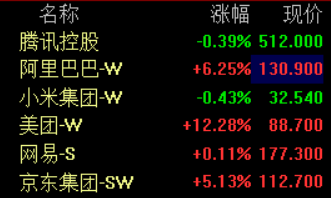
港股科网股拉升!美团-W涨超12%,市场监管总局官网转发文章《外卖大战该结束了》
Jin Rong Jie· 2026-03-25 05:53
Core Viewpoint - The ongoing "takeout war" is detrimental not only to restaurant owners but also to the livelihoods of ordinary people, as it disrupts the restaurant consumption that serves as an economic stabilizer [3][5]. Group 1: Market Impact - The State Administration for Market Regulation has initiated on-site investigations into takeout platforms, indicating a regulatory push to end the aggressive competition in the industry [3]. - The takeout war, while seemingly beneficial for consumers with low prices, ultimately burdens ordinary people and negatively impacts the macroeconomic landscape [3][4]. - The Consumer Price Index (CPI) in China has shown a continuous decline from the second quarter to the third quarter of 2025, with the core CPI rising, suggesting that restaurant prices are significantly influencing overall consumer prices [4]. Group 2: Financial Implications - During the peak of the takeout war, major platforms like Alibaba, JD.com, and Meituan collectively provided subsidies ranging from 80 billion to 100 billion yuan, leading to a significant drop in restaurant prices [4]. - The aggressive pricing strategies have resulted in a decline in restaurant revenue growth, which aligns with the overall downward trend in CPI, indicating a direct correlation between the takeout war and economic performance [4][5]. - The financial strain on restaurants due to these subsidies has led to a vicious cycle where businesses sacrifice quality and profits, ultimately hindering the broader economic recovery [5]. Group 3: Regulatory Response - The regulatory body aims to restore healthy competition in the market, focusing on innovation, efficiency, and service optimization rather than capital-intensive price wars [5][6]. - Ending the takeout war is seen as essential for maintaining normal economic operations and ensuring that businesses and workers can sustain their livelihoods [5][6].


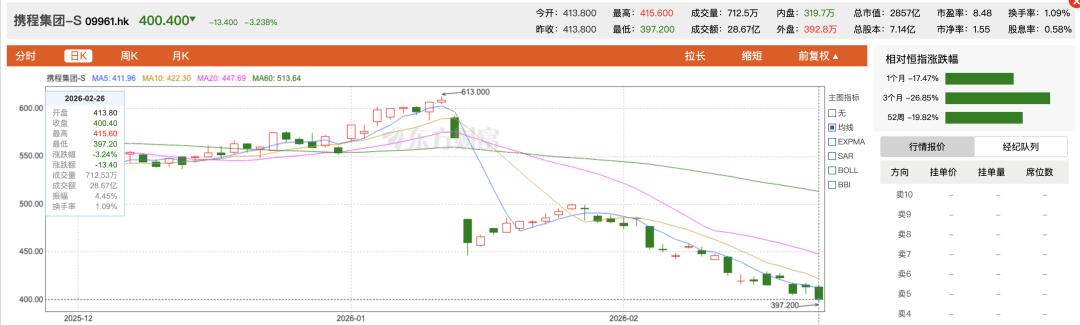
一面净利暴涨,一面股价暴跌:携程到底怎么了?
3 6 Ke· 2026-02-26 13:05
Core Viewpoint - Ctrip Group reported impressive financial results for 2025, with a net profit of 33.4 billion yuan, a year-on-year increase of 94%, yet the market reacted negatively, indicating a disconnect between financial performance and investor sentiment [1][3]. Financial Performance - Ctrip's net profit growth of 94% raises questions about its sustainability, as a significant portion of this profit (19.9 billion yuan) came from non-recurring investment gains, leading to a core net profit of 31.8 billion yuan, a 77% increase [4]. - The total revenue for 2025 reached 62.4 billion yuan, reflecting a 17% year-on-year growth, with accommodation bookings at 26.1 billion yuan (up 21%), transportation tickets at 22.5 billion yuan (up 11%), and travel management at 2.8 billion yuan (up 13%) [4]. Market Dynamics - Ctrip's international business remains a strong growth driver, with total bookings on its international OTA platform increasing by approximately 60%, serving around 20 million inbound travelers [6]. - The inbound tourism market in China is experiencing a "golden window," with the number of visa-free countries increasing, which is expected to boost Ctrip's growth significantly [8]. - Ctrip's outbound travel bookings have surpassed pre-pandemic levels, with a notable increase in orders during the recent Spring Festival [9]. Investor Sentiment - Despite strong financials, Ctrip faces declining valuations and investor confidence due to changing market dynamics and regulatory pressures, including an ongoing antitrust investigation [10][11]. - The shift in capital market pricing logic reflects concerns over Ctrip's ability to maintain high returns on equity (ROE) in a more competitive landscape [13]. Governance Changes - Ctrip is undergoing a significant governance transition, moving away from founder-led management to a more professional board structure, which includes new independent directors with expertise in finance and compliance [16][18]. - This shift aims to enhance corporate governance and reduce regulatory risks during a critical period for the company [17][18]. Conclusion - The current phase represents a pressure test for Ctrip, as it navigates industry changes and seeks to redefine its role in the market amidst evolving consumer behavior and competitive challenges [19].
Meta(META.US)欧洲数据案再迎逆风 欧盟法院总检察长站队监管
智通财经网· 2026-02-26 11:31
Core Viewpoint - The European Court of Justice's Advocate General supports the EU antitrust regulator's request for information from Meta, indicating a negative outlook for Meta's appeal against the EU's data requests [1][2] Group 1: Legal Proceedings - Meta has been contesting the EU Commission's information requests, claiming they are excessive and intrusive, involving sensitive personal data [2] - The timeline of the lawsuit shows that Meta initially sued the EU Commission over the data requests, which were then rejected by the General Court, leading to Meta's appeal to the EU Court in Luxembourg [1] - Advocate General Athanasios Rantos has recommended that the EU Court dismiss Meta's appeals and uphold the General Court's ruling, stating that the General Court did not err legally in assessing the necessity of the requested information [2] Group 2: Implications for Meta - The recommendation from the Advocate General suggests that the EU judges are likely to follow this legal opinion, which could have significant implications for Meta's operations in Europe [2] - The cases in question are C-496/23 P Meta Platforms Ireland v Commission (Facebook Marketplace) and C-497/23 P Meta Platforms Ireland v Commission (Facebook Data) [2]

欧盟反垄断起诉Meta:拟强制WhatsApp开放,严禁封杀第三方AI竞争对手
Hua Er Jie Jian Wen· 2026-02-09 13:35
Core Viewpoint - The European Union's antitrust regulators have formally charged Meta Platforms, planning to implement temporary measures to prevent the company from using its dominance in instant messaging to eliminate AI competitors [1][2]. Group 1: Regulatory Actions - The European Commission has sent a statement of objections to Meta, accusing it of violating EU competition rules and planning to enforce temporary measures to keep WhatsApp open to competitors during the investigation [1][2]. - The action reflects the EU's determination to strictly enforce antitrust rules, despite criticisms from the U.S. regarding enforcement actions against domestic tech giants [2][5]. - The core of the EU's action is to prevent irreparable market damage, as Meta's new policy, effective January 15, allows only its AI assistant to access WhatsApp, which could eliminate competitors [3]. Group 2: Meta's Response - Meta has responded to the EU's charges, claiming that the intervention lacks a factual basis and that the assumption that WhatsApp Business API is a key distribution channel for chatbots is incorrect [4]. - The company argues that there are numerous AI options available in the market, accessible through various channels, and thus believes the EU has no grounds to intervene in WhatsApp's operational strategy [4]. Group 3: Global Context - The EU's actions are part of a broader global trend of antitrust regulation against tech giants, with complexities arising from different jurisdictions, as seen in Brazil where a court recently suspended similar temporary measures against Meta [5]. - The EU's statement and proposed measures send a strong signal to the market, emphasizing that tech giants should not exploit their existing platform advantages to establish monopolistic positions in the emerging AI sector [5].
Booking反垄断启示录:告别“价格平价”,巨头如何重塑护城河?
ZHESHANG SECURITIES· 2026-02-02 10:25
Investment Rating - The industry investment rating is positive [1] Core Insights - The European Union's regulatory efforts have intensified, designating Booking as a "gatekeeper" under the Digital Markets Act (DMA), which prohibits the use of price parity clauses that restrict hotel pricing [2] - Despite antitrust measures aimed at promoting competition, Booking's market share in Europe has increased from approximately 60% in 2013 to over 71% in 2023, indicating a concentration of market power [3] - Booking is strategically shifting its business model from an agency model to a merchant model, allowing it to control pricing and cash flow while avoiding direct legal interference with hotel pricing [4] Summary by Sections Regulatory Environment - The EU's regulatory framework has evolved, with Booking being classified as a "gatekeeper" under the DMA, which mandates compliance with new rules prohibiting price parity clauses [12][18] - The historical context of antitrust actions against Booking highlights a growing trend of regulatory scrutiny across various jurisdictions [25][28] Market Competition - The competitive landscape remains concentrated, with Booking leveraging its dual-sided network effects to maintain its leading position, while competitors like Expedia and Airbnb are exploring differentiated strategies [5][6] - The cancellation of price parity clauses has not led to significant price competition among OTAs, as Booking continues to utilize algorithms and monitoring to maintain pricing control [3][56] Business Model Transformation - Booking's transition to a merchant model allows it to pre-collect payments and manage pricing, effectively circumventing legal restrictions on hotel pricing [4] - The company is investing heavily in Google advertising and membership programs to enhance its market presence and obscure pricing comparisons [4] Future Outlook - The report anticipates that the competitive dynamics in the OTA market will continue to evolve, with Booking's strong market position likely to persist despite regulatory challenges [5][6]

中国光伏 - 2025 年第四季度初步数据后:解答定价与行业格局动态的核心问题;后续策略如何?-China Solar_ Addressing key questions on pricing and landscape dynamic after prelim 4Q25 result; what to do from here?
2026-01-22 02:44
Summary of Key Points from the Conference Call Industry Overview - The conference call focused on the solar industry, particularly the performance of Tier 1 solar players in light of recent anti-monopoly regulations and preliminary results for 4Q25 [1][2]. Core Insights and Arguments 1. **Widening Losses in 4Q25**: - Six Tier 1 solar players (Tongwei, Daqo A, TZE, Longi, JA Solar, and Trina Solar) reported significant losses in 4Q25, attributed to upstream price hikes and weak downstream demand [2][3]. - An average of approximately 7% quarter-over-quarter (qoq) price increase in the value chain did not offset the negative earnings impact from lower volumes and higher costs of raw materials like Poly and Silver [2][6]. 2. **Company-Specific Financial Results**: - **Tongwei**: Reported a net loss of Rmb3.7-4.7 billion in 4Q25, significantly worse than previous expectations, primarily due to lower margins and fixed asset impairments [3][9]. - **Daqo A**: Reported a net profit range of -Rmb227 million to Rmb73 million, better than expected due to higher recognized Poly prices [9]. - **Longi**: Reported a net loss of Rmb2.6-3.1 billion, attributed to lower margins from Wafer and Module businesses [9]. - **TZE**: Reported a net loss of Rmb2.4-3.8 billion, also due to lower margins [9]. 3. **Pricing Outlook for 2026**: - The pricing outlook for 2026 is expected to be influenced by ongoing anti-monopoly regulations and supply-side measures, with a potential for cost reductions driven by R&D efforts from Tier 1 players [8][12]. - Silver paste prices are projected to increase by 120% from previous estimates, impacting profitability for integrated Module players [10][15]. 4. **Future Cost Dynamics**: - Tier 1 players are expected to adopt low-cost technologies to reduce silver usage significantly, which could alleviate cost pressures in the near term [10][16]. - Upstream Poly/Wafer prices are anticipated to decline by 11% qoq in 1Q26 and 2Q26 due to supply-side measures, with a potential recovery in 4Q26 [11][12]. 5. **Investment Recommendations**: - The report suggests a cautious approach towards companies like Tongwei and Daqo A, while recommending a "Buy" on Longi due to its potential for EBITDA inflection and better mid-cycle returns [24][28][32]. Other Important Insights - The current negative demand cycle in the solar industry is deemed unsustainable, with expectations for industry consolidation driven by R&D advancements [2][6]. - The report emphasizes the importance of company-specific unit transaction rates (UTR) and cost reduction progress as key indicators for future performance [21][22]. - The overall sentiment is cautious, with a downward revision of EBITDA estimates by approximately 16% for 2025 and varying adjustments for 2026 based on UTR changes [22][24]. This summary encapsulates the critical insights and financial performance of the solar industry and its leading players, highlighting the challenges and potential strategies moving forward.
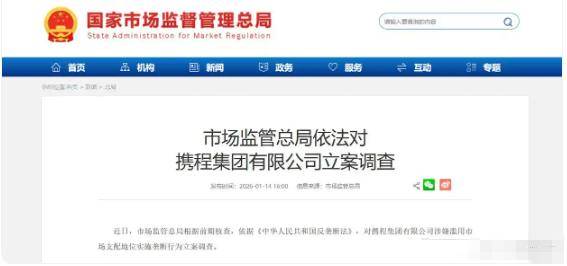
两头收割商家消费者!携程垄断立案,或面临最高罚款65亿
Sou Hu Cai Jing· 2026-01-20 14:37
Core Viewpoint - The article discusses the antitrust investigation into Ctrip, highlighting the mixed public reactions and the company's journey to its current market dominance, which has led to various complaints from users and partners [1] Group 1: Market Position and Financial Performance - Ctrip has consolidated its market position, controlling over 70% of the online travel market, making it difficult for competitors to emerge [3] - As of Q3 2025, Ctrip's net profit margin exceeded 30%, outperforming many other internet companies, raising concerns about the methods used to achieve profitability [3] Group 2: User Experience and Complaints - Users have reported negative experiences, such as default insurance options when purchasing tickets and varying hotel prices for different users, with a reported price difference of up to 15% for the same hotel [5] - The online travel sector has seen a significant increase in complaints, with over 50,000 related complaints reported in 2024, indicating a growing dissatisfaction among consumers [8] Group 3: Merchant Challenges - Merchants face high commission rates, which can exceed 20% during peak seasons, significantly squeezing their profit margins [6] - The "choose one" rule forces merchants to limit their presence on other platforms to gain better visibility on Ctrip, a practice that has drawn regulatory scrutiny [6] Group 4: Industry Impact and Innovation - The dominance of a single player like Ctrip stifles innovation and makes it difficult for new startups to enter the market, leading to a stagnation in service improvement and technological advancement [12] - The focus on maintaining market dominance has shifted resources away from enhancing user experience, resulting in minimal genuine innovation in the online travel sector [12] Group 5: Regulatory Context and Future Implications - The investigation into Ctrip is part of a broader regulatory trend that began in 2020, targeting major internet companies to ensure fair competition and prevent monopolistic practices [14] - The outcome of this investigation could serve as a turning point for the industry, encouraging other platforms to reassess their business practices and move towards a more regulated and service-oriented market [18] Group 6: Consumer Benefits and Market Evolution - Consumers stand to benefit significantly if companies shift their focus from exploiting market power to enhancing service quality, leading to fair pricing and better choices [20] - The ongoing regulatory efforts may lead to more detailed rules governing data usage, algorithm recommendations, and platform fees, fostering a stable and predictable market environment [20] Group 7: Long-term Industry Outlook - The online travel market, valued in the hundreds of billions, requires a vibrant and competitive landscape to foster better products and services [22] - The investigation may mark a significant event in the history of China's platform economy, emphasizing that size and market share do not exempt companies from accountability [22]