贝捷迈

Search documents
医药行业周报(2026/03/09-2026/03/13):本周申万医药生物指数下跌0.2%,关注创新药研发动态-20260316
Shenwan Hongyuan Securities· 2026-03-16 05:45
Investment Rating - The investment rating for the pharmaceutical industry is "Overweight," indicating a positive outlook for the sector compared to the overall market performance [28]. Core Insights - The pharmaceutical sector's performance this week saw a decline of 0.2%, while the Shanghai Composite Index fell by 0.7% and the Wind All A Index (excluding finance, oil, and petrochemicals) decreased by 0.5%. The pharmaceutical index ranked 13th among 31 sub-industries [2][3]. - The overall valuation of the pharmaceutical sector is at 30.3 times earnings, ranking 12th among 31 primary industries [6][12]. - Recent developments include the approval of the world's first invasive brain-computer interface in China, aimed at assisting patients with spinal cord injuries [10][13]. - New drug research remains active, with significant clinical trial results reported for various drugs, including the CSF-1R inhibitor and treatments for epilepsy and sepsis [14][15][16]. Market Performance - The pharmaceutical index's performance this week was -0.2%, with various sub-sectors showing mixed results. Notable increases were seen in raw materials (+1.3%) and vaccines (+1.3%), while medical devices experienced a decline of -2.0% [2][6][8]. - The pharmaceutical sector's performance is ranked 13th among 31 sub-industries, indicating a relatively stable position within the broader market context [3][6]. Recent Key Events - The Jiangsu Province has launched an action plan for the innovation and development of the brain-computer interface industry, aiming for significant advancements by 2027 [10][11]. - The acquisition of the Vietnamese pharmaceutical company IMP by Lijun Pharmaceutical has been approved, marking a strategic expansion for the company [17]. - Collaboration between Kanglong Chemical and Eli Lilly for the production of Orforglipron has been established, with an expected investment of $200 million from Eli Lilly [19]. Company Developments - Recent clinical trial results for the CSF-1R inhibitor, published in The Lancet, showed a significant improvement in treatment outcomes compared to placebo [14]. - Xenon Pharmaceuticals reported positive results from a Phase III trial for Azetukalner, indicating a substantial reduction in seizure frequency [15]. - Iwubio's IND application for a mesenchymal stem cell injection for sepsis has been accepted, highlighting ongoing innovation in treatment options [16]. Investment Recommendations - Investors are advised to monitor companies involved in raw material production due to recent price increases, including New Harmony, Zhejiang Pharmaceutical, and Tianxin Pharmaceutical [2]. - Continued focus on innovative drug development is recommended, with specific attention to companies like Heng Rui Pharmaceutical and BeiGene [2]. - The brain-computer interface sector is highlighted for potential investment opportunities, particularly in companies such as Aipeng Medical and Xiangyu Medical [2].
医药行业周报:本周申万医药生物指数下跌0.2%,关注创新药研发动态-20260316
Shenwan Hongyuan Securities· 2026-03-16 02:46
Investment Rating - The report maintains a positive outlook on the pharmaceutical industry, indicating an "Overweight" rating, suggesting that the industry is expected to outperform the overall market [2][32]. Core Insights - The pharmaceutical sector experienced a slight decline of 0.2% this week, while the Shanghai Composite Index fell by 0.7% and the Wind All A Index (excluding financials and petrochemicals) decreased by 0.5% [2][3]. - The overall valuation of the pharmaceutical sector stands at 30.3 times earnings, ranking 12th among 31 first-level sub-industries [6][14]. - Key developments include the approval of the world's first invasive brain-computer interface in China and the release of significant clinical trial results for innovative drugs [11][16][20]. Market Performance - The pharmaceutical index ranked 13th among 31 first-level sub-industries this week [3]. - Performance across various sub-sectors includes: - Raw materials (+1.3%) - Chemical preparations (-0.8%) - Traditional Chinese medicine (-0.1%) - Blood products (+0.3%) - Vaccines (+1.3%) - Medical devices (-2.0%) - Medical consumables (+4.1%) [6][10]. Recent Key Events - Jiangsu Province has launched an action plan for the innovation and development of the brain-computer interface industry, aiming for breakthroughs in technology by 2027 [11][12]. - The global first implantable brain-computer interface by Borui Kang Medical has been approved, designed for patients with spinal cord injuries [15]. - Significant clinical trial results were published for innovative drugs, including the CSF-1R inhibitor Beijiemai and the treatment for focal onset epilepsy, Azetukalner [16][17]. Company Developments - Lizhu Pharmaceutical's acquisition of the Vietnamese company IMP has been approved, valued at approximately 1.587 billion yuan [20]. - Kanglong Chemical has entered a production cooperation agreement with Eli Lilly for the oral GLP-1 receptor agonist Orforglipron, with an expected investment of 200 million USD [22]. - New drug development activities remain active, with several companies highlighted for their innovative drug candidates [2][19]. Investment Recommendations - Investors are advised to pay attention to companies involved in raw material pharmaceuticals due to recent price increases, including Xinhui Cheng, Zhejiang Pharmaceutical, and Tianxin Pharmaceutical [2]. - Continuous monitoring of innovative drug-related companies is recommended, including Heng Rui Pharmaceutical, Bai Jie Shen Zhou, and Nuo Cheng Jian Hua [2]. - The brain-computer interface sector is also highlighted for potential investment opportunities, with companies like Aipeng Medical and Xiangyu Medical being of interest [2].


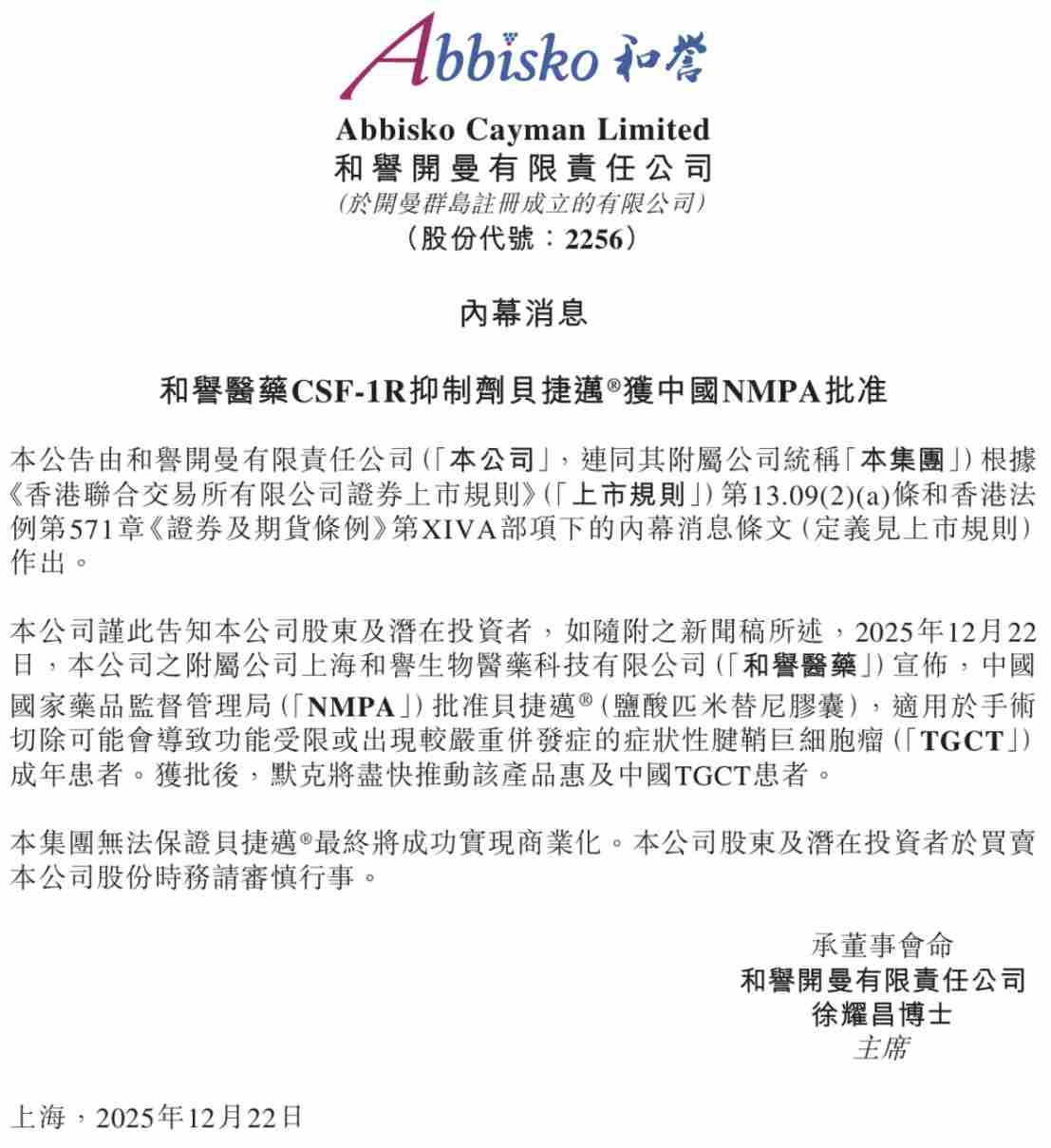
和誉-B:匹米替尼顺利获批,“十亿美元分子”价值加速兑现成配置关键
Zhi Tong Cai Jing· 2025-12-23 01:17
Core Viewpoint - The Hong Kong stock market has experienced a significant rise in innovative pharmaceuticals, with the Hang Seng Healthcare Index increasing by 102.76% from the beginning of the year to its peak in September, followed by a decline of 19.06% by December 22. Despite this, the company He Yu has seen a remarkable stock price increase of 370.95% this year, driven by the approval of its core product, Pimicotinib, in China [1][2][5]. Group 1: Product Approval and Market Impact - He Yu announced the approval of its drug Beijiemai (Pimicotinib) by the NMPA, marking it as the first systemic treatment for tenosynovial giant cell tumor (TGCT) in China [2][5]. - The approval process for Beijiemai was expedited, receiving priority review in May and being approved within six months after its NDA application was accepted [6][7]. - The drug has shown strong and durable tumor relief efficacy in clinical trials, providing significant evidence for its long-term safety and effectiveness [6][7]. Group 2: Financial and Market Potential - Pimicotinib is expected to generate substantial revenue, with estimates suggesting it could reach peak sales of approximately $1.5 billion globally [8][9]. - The company has secured a lucrative partnership with Merck, which includes an upfront payment of $70 million and potential total transaction value of up to $606 million, reflecting strong confidence in the drug's market potential [7][9]. - The approval of Pimicotinib is anticipated to enhance the company's cash flow, supporting further innovation and development of its oncology pipeline [9][10]. Group 3: Innovation Pipeline and Valuation - He Yu has established a robust pipeline of 22 differentiated innovative drugs, focusing on precision oncology and immunotherapy, with several candidates showing potential for being first-in-class or best-in-class [9][10]. - The company has been actively repurchasing shares, with a total of 39 buybacks this year, indicating a commitment to returning value to shareholders [10]. - Compared to other biopharma companies, He Yu's price-to-sales (P/S) ratio of 13.38 suggests significant upside potential in valuation, especially with the successful commercialization of Pimicotinib [10].