贾维斯

Search documents
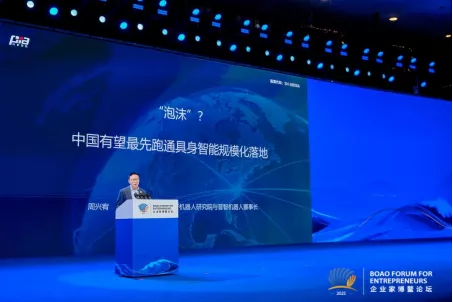
贾维斯在博鳌论坛与书法名家同台竞技 均普智能研究院董事长周兴宥演讲:中国有望最先跑通具身智能规模化落地
Cai Jing Wang· 2025-12-05 04:29
Core Insights - The 10th Entrepreneur Boao Forum, themed "Linking the World, Leading the Future: New Opportunities in the 14th Five-Year Plan," focuses on embodied intelligence and industrial digital transformation, gathering leaders from global top 500 companies to explore industrial transformation directions [1] - Zhou Xingyou, Vice President of Junsheng Group, emphasized that embodied intelligence is a "required course" for manufacturing upgrades during the 14th Five-Year Plan, with China's embodied intelligence robot industry expected to lead globally and achieve large-scale application [1] - Zhou addressed the "bubble theory" surrounding emerging technologies, stating that while all frontier tech industries experience similar phases, the eventual outcome will be a standardized development driven by practical work, strength, and technology [1] Strategic Framework - Junpu Intelligent's strategy is based on a "forward-looking R&D - independent production - scenario implementation" closed-loop model and an "ecological win-win" approach, efficiently operating through a closely coordinated entity network [2] - The core engine, Junpu AI and Humanoid Robot Research Institute, focuses on R&D of robot bodies, AI models, and cutting-edge technologies [2] - The joint venture, Puzhi Future Robot, is responsible for transforming advanced technologies into secondary development and large-scale production, acting as "experts in robot manufacturing" [2] Achievements and Production Capacity - Zhou highlighted tangible results from the strategy, including the establishment of the AI and Humanoid Robot Research Institute in September 2023 and the launch of humanoid robots Jarvis 1.0 and 2.0 in 2024 [5] - In April 2025, a joint venture with Zhiyuan was formed, and by May, the first pilot production line for embodied intelligent robots was established, leading to a 28 million yuan order for humanoid robots by the end of June [5] - By October, Junpu Intelligent announced an expansion of robot production capacity to 3,000 units per year and delivered the first batch of commercial products, showcasing significant progress in the embodied intelligence field within two years [5] Human-Centric Technology - At the forum, the humanoid robot Jarvis demonstrated its cultural aspect by creating calligraphy, showcasing the ability of technology to convey humanistic values and enhance the understanding of robots executing complex tasks [7] Value Proposition - Junpu Intelligent positions itself as a leader in industrial embodied intelligence, focusing on practical solutions rather than merely chasing concepts, leveraging 60 years of experience in high-end manufacturing [9] - The company emphasizes a commitment to "deep R&D, scenario-driven approaches, commercial closed loops, and ecological co-construction," contributing to the large-scale commercial implementation of embodied intelligence and enhancing China's competitive edge in the global arena [9]


中国机器人的八月狂欢 | 海斌访谈
Di Yi Cai Jing· 2025-08-18 11:18
Core Viewpoint - The humanoid robot industry in China is rapidly growing, with significant advancements and competitions indicating a strong potential for China to lead in the global humanoid robot race [1][10]. Group 1: Industry Developments - The World Humanoid Robot Games held in August 2025 featured 127 brands and 487 competitions, showcasing the competitive landscape of China's humanoid robot industry [1][3]. - The World Robot Conference attracted 169 global enterprises, highlighting the introduction of new technologies in various applications, including industrial and logistics sectors [3][10]. - The Far Expedition A2 humanoid robot successfully completed 24 hours of autonomous outdoor walking, demonstrating advancements in stability and environmental adaptability [3][10]. Group 2: Market Dynamics - China's humanoid robot market is expected to become the largest application market, with a focus on low-speed, high-frequency, and essential scenarios such as logistics and retail guidance [11][12]. - The industrial robot sector in China is projected to grow by 5% in 2024, increasing its global market share from 51% to 54% [12]. - The financing for the robot industry in China reached 23.2 billion yuan in the first five months of 2025, surpassing the total for 2024 [12]. Group 3: Talent and Innovation - The rapid transition of companies from traditional manufacturing to humanoid robotics has led to a significant influx of talent, with over 200 new companies established in recent years [5][6]. - The unique combination of hardware engineers and software talent in China provides a competitive advantage in the humanoid robot sector [7][8]. - The industry is currently facing challenges in developing multi-purpose humanoid robots, but breakthroughs in technology are anticipated in the near future [12].

入局人形机器人,宁波想靠这张“隐藏王牌”拼过北上深
2 1 Shi Ji Jing Ji Bao Dao· 2025-06-05 12:51
Core Viewpoint - Ningbo aims to become a significant hub for humanoid robot research, manufacturing, and application in China by 2027, as outlined in the "Ningbo Humanoid Robot Industry Innovation Development Action Plan (2024-2027)" [2][3] Industry Development - The establishment of the Zhejiang Humanoid Robot Innovation Center in Ningbo last year marks a significant step in the local humanoid robot industry, with the launch of the "Navigator 2" robot [2] - Ningbo has seen the emergence of specialized institutions for humanoid robot R&D and production, alongside a growing number of component suppliers supporting humanoid robot enterprises [3] Competitive Advantages and Challenges - Ningbo's industrial landscape is rich, providing a strong foundation for the humanoid robot industry, but it faces challenges due to its strong manufacturing focus and relatively weaker software capabilities [3][12] - The city has a well-developed parts industry, which can quickly adapt to support humanoid robot production, although the number of humanoid robot manufacturing companies remains limited [12] Market Applications - The humanoid robot sector is still in the exploratory phase, with significant potential in healthcare and service industries, but practical application remains challenging [15] - The complexity of humanoid robots, which often require extensive data training, complicates their integration into existing industrial processes [15][16] Future Prospects - The establishment of the Ningbo Embodied Intelligent Robot Innovation Center aims to address data challenges for AI training in humanoid robots, indicating a long-term commitment to this sector [18] - Industry experts predict that while humanoid robots may not be cheaper than simpler industrial robots, their unique capabilities could drive future demand in various applications [16][19]