配股

Search documents
2025年A股再融资数据盘点:沪主板高居再融资项目数量、募资额榜首 北交所无增发项目上市
Xin Lang Cai Jing· 2025-12-31 07:54
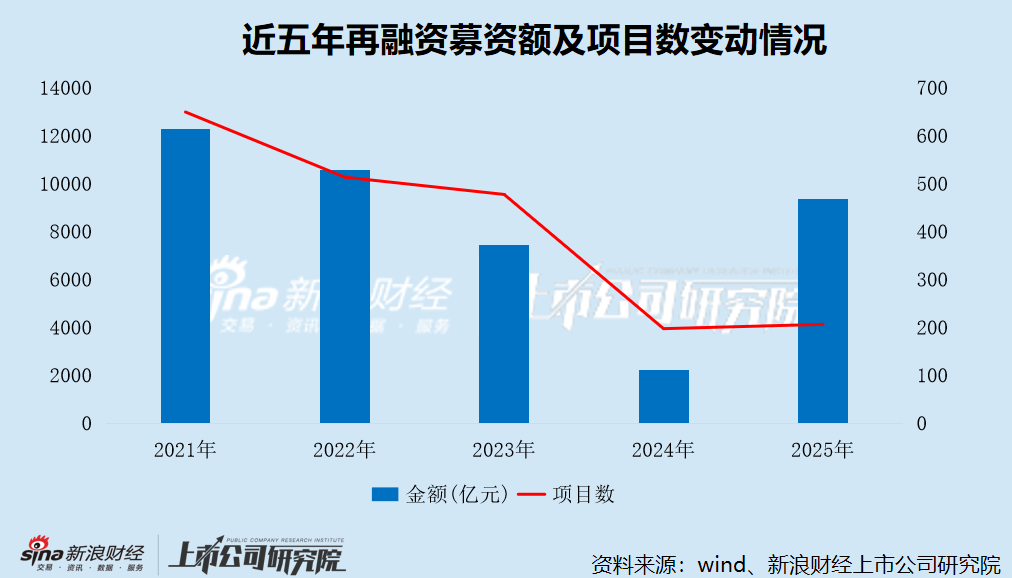
Core Insights - The A-share market in 2025 marked a significant milestone with the index surpassing a decade threshold, market capitalization exceeding one trillion, and record trading volumes, driven by policy benefits and liquidity [1][8] Summary of A-share Re-financing Market - The total re-financing scale for 2025 reached 950.865 billion, a year-on-year increase of 326.17%, with public and private placements contributing 887.732 billion, up 412.99% [3][10] - Convertible bonds raised 63.133 billion, reflecting a growth of 30.77%, while both rights issues and preferred shares raised no funds [10] - A total of 251 re-financing applications were accepted across exchanges, with 181 approved, 188 submitted to the CSRC, and 173 registered, resulting in a 100% approval rate across all listed sectors [10] Status of Re-financing Applications - Currently, 235 companies are in the re-financing queue, with 11 accepted, 108 under inquiry, 11 approved, 37 submitted to the CSRC, 62 registered, and 6 applications suspended [10] Distribution of Re-financing Projects - In 2025, there were 172 public placement projects raising a total of 887.732 billion, with the Shanghai main board leading with 72 projects and 739.712 billion raised, accounting for 41.86% and 83.33% of the total respectively [5][12] - There were 44 convertible bond projects raising 63.133 billion, with the Shanghai main board also leading with 14 projects and 29.594 billion raised, representing 34.15% and 48.57% of the total respectively [7][14]

一文读懂定向增发、再融资!
Sou Hu Cai Jing· 2025-12-03 23:46
Group 1 - The core viewpoint of the article highlights the resurgence of refinancing activities in the Chinese stock market, particularly through targeted placements, with 56 companies completing fundraising plans totaling 118.517 billion yuan as of March 30, and an additional 144 companies expected to raise approximately 260 billion yuan [2] - The article discusses the evolution of equity financing tools in China, noting that the practice of issuing new shares began in July 1998, with targeted placements gaining traction after regulatory changes in 2006 [3][5] - The historical context of the introduction of targeted placements is provided, detailing the economic reforms initiated in 1998 aimed at revitalizing state-owned enterprises, which led to the first pilot programs for share issuance [4][5] Group 2 - The article categorizes equity financing tools into public and non-public (targeted) placements, emphasizing that targeted placements have become the dominant method of equity financing in China, with 4,748 companies utilizing this method from 2010 to 2022 compared to only 37 for public placements [9] - It compares the characteristics of public and targeted placements, highlighting that targeted placements have simpler conditions and fewer restrictions, making them more attractive to issuers [11] - The article outlines the various purposes for which funds raised through targeted placements can be used, including project financing, supplementary liquidity, and strategic investments, showcasing the versatility of this financing method [14] Group 3 - The development of targeted placements is traced, noting a significant increase in the number of projects from an average of 100 annually to over 600 between 2014 and 2016, followed by regulatory adjustments that temporarily cooled the market [6][12] - The article explains the pricing mechanisms for targeted placements, distinguishing between fixed pricing and auction-based pricing, and the implications for investor participation and lock-up periods [19][22] - It discusses the impact of the recent registration system reforms on the targeted placement process, which has streamlined procedures and enhanced regulatory oversight [26] Group 4 - The investment logic behind targeted placements is examined, emphasizing the inherent discount benefits for investors compared to purchasing shares in the secondary market, and the factors influencing these discounts [29][30] - The article identifies the primary sources of returns for targeted placement investments, including discount returns, market returns, and excess returns during the lock-up period, highlighting the importance of timing and stock selection [38][39] - Various investment strategies for targeted placements are outlined, including institutional strategies, high-turnover approaches, and strategies focused on enhancing the operational capabilities of small-cap companies [45][46][48]

【锋行链盟】伦敦证券交易所上市公司再融资方式及核心要点
Sou Hu Cai Jing· 2025-10-04 11:15
Group 1: Core Financing Methods - The London Stock Exchange (LSE) offers a variety of refinancing tools for listed companies, including equity financing, debt financing, and hybrid instruments [2] - Equity financing is the most common method, with options such as Placing, Open Offer, Rights Issue, and Private Placement [2][3][5][7] - Debt financing includes Corporate Bonds, Eurobonds, and Convertible Bonds, allowing companies to raise funds efficiently while maintaining control over equity [8][10][11] Group 2: Key Points of LSE Refinancing - All refinancing activities must comply with the Financial Conduct Authority (FCA) regulations, including the Financial Services and Markets Act (FSMA) and Listing Rules [14] - Information disclosure is critical, requiring a prospectus for public offerings and adherence to market abuse regulations [15][16] - The investor base at LSE is predominantly international institutions, which prefer high liquidity and transparency in their investments [21] Group 3: Cost and Efficiency Considerations - Direct costs associated with refinancing include underwriting fees, legal/audit fees, and prospectus preparation costs, with public offerings generally being more expensive than private placements [17] - Indirect costs may involve equity dilution and short-term stock price volatility following announcements [18] - Companies on the Main Market typically have lower financing costs due to their larger size and higher credit ratings, while AIM companies often rely on private placements and need to present a clear growth narrative [19][20]

【锋行链盟】港交所上市公司再融资方式
Sou Hu Cai Jing· 2025-09-26 16:12
Group 1 - The core viewpoint of the article is that Hong Kong listed companies have a diverse range of refinancing methods, categorized into equity financing, hybrid financing, and debt financing [2][8] Group 2 - Equity financing involves issuing new shares directly to investors, which dilutes existing shareholders' equity. The methods include placing, rights issue, and private placement [2][3] - Hybrid financing combines debt and equity characteristics, balancing financing costs and equity dilution. It includes convertible bonds, which allow for flexible issuance and can avoid large-scale dilution if the issuance is small [3][5] - Debt financing raises funds in the form of liabilities, with some instruments counting as equity. This includes perpetual bonds and warrants, which can provide long-term funding without affecting control [5][6] Group 3 - The choice of refinancing method in Hong Kong must comply with the Listing Rules and consider the company's financial status, development stage, and shareholder interests [8] - Companies facing urgent funding needs may opt for placing or rights issues for quick access to capital, while those looking to minimize equity dilution might choose convertible bonds or perpetual bonds [9]