
重卡超充站

Search documents
中国石化在鄂最大重卡超充站投营
Zhong Guo Hua Gong Bao· 2025-11-25 05:55
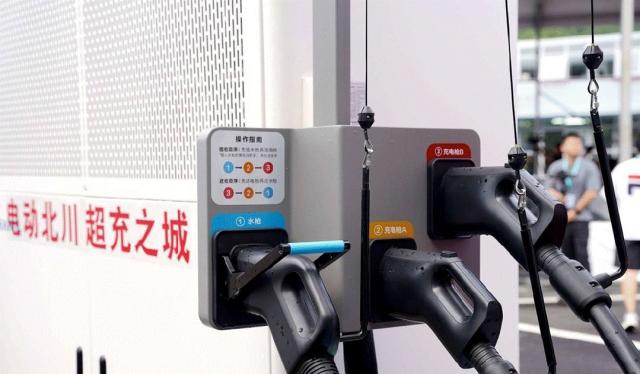
Core Insights - China Petroleum & Chemical Corporation (Sinopec) has officially launched the largest heavy-duty electric truck supercharging station in Hubei, located at Yichang, which features 14 charging piles and a total output power of nearly 5 megawatts, capable of serving up to 200 truck charging sessions daily [1] Group 1: Charging Station Details - The Yichang supercharging station occupies an area of 3,560 square meters and is equipped with 28 charging guns, providing a maximum output power of 4,960 kilowatts, with individual charging piles capable of delivering up to 800 kilowatts [1] - The station is strategically located at a key logistics hub, facilitating electric heavy-duty truck operations along the logistics corridor from Yidu to Songzi [1] Group 2: Company Strategy and Developments - Sinopec's Hubei branch is transitioning from a traditional oil supplier to a comprehensive energy service provider, focusing on charging and battery swapping as strategic priorities [2] - The company has established over 1,200 charging stations, including 27 heavy-duty truck charging stations across seven cities, with a monthly charging volume exceeding 1.3 million kilowatt-hours [2]

超充VS换电,到底谁将打赢新能源重卡的终局之战?
3 6 Ke· 2025-09-19 05:49
Core Insights - The fastest-growing segment in the new energy market this year is heavy-duty trucks, with cumulative sales reaching 113,600 units from January to August 2025, a year-on-year increase of 191% [1] - The penetration rate of new energy heavy-duty trucks has rapidly climbed to 26.07% by June 2025, nearing the critical 30% threshold [1] Market Dynamics - Continuous technological advancements have led to a relatively high maturity level for new energy heavy-duty trucks, making them more viable [2] - Strong policy support, including national and local subsidies, as well as mandatory usage policies in some areas, has significantly boosted the popularity of new energy heavy-duty trucks [3] Economic Benefits - The economic advantages of new energy heavy-duty trucks are becoming increasingly apparent, with a 49-ton electric truck consuming 150 kWh per 100 km, resulting in energy costs of only 180 RMB, which is 37% cheaper than diesel trucks of the same weight [4] - The price of new energy heavy-duty trucks has dropped from 700,000-800,000 RMB to around 400,000 RMB, making them comparable to fuel trucks priced at approximately 350,000-450,000 RMB [4] Competitive Landscape - The market is divided into two main camps: the battery swap camp, including companies like CATL and Qiyuan, and the fast-charging camp, represented by Huawei and XWANDA [5] - The competition between battery swapping and fast charging is not just about speed but involves a deeper financial and scenario-based logic [7] Cost Competition - Heavy-duty trucks are primarily evaluated based on their input-output ratio, differing from passenger vehicles [9] - Battery swapping allows for a "separation of vehicle and battery" model, significantly lowering initial investment costs, but incurs high operational costs due to the expensive infrastructure [10][12] - Fast charging stations have lower construction costs (around 2 million RMB) and offer cheaper refueling options, attracting more drivers [14] Scenario-Based Competition - Battery swapping is more suitable for high-frequency, closed-loop scenarios like ports and mines, while fast charging is better for open, price-sensitive environments like urban freight transport [16][24] - For example, a battery swapping station brand has invested heavily in a coal transport route, benefiting from concentrated demand and supportive local policies [20] Ecological Considerations - Both systems require a comprehensive ecological framework to support their operations, with fast charging needing high-standard batteries and posing significant impacts on the power grid [25][26] - The competition is balanced, with neither system achieving a decisive advantage across cost, scenarios, and ecological factors [27] - Future success in the new energy heavy-duty truck market will depend on a holistic approach considering pricing, grid impact, and user needs [28]

上峰水泥上半年净利润同比大增44.53%
Zhong Zheng Wang· 2025-08-26 07:19
Core Viewpoint - The company reported a significant increase in net profit and operational efficiency despite a decline in revenue due to a downturn in the national cement market [1][2]. Group 1: Financial Performance - The company achieved a net profit attributable to shareholders of 247 million yuan, a year-on-year increase of 44.53% [1]. - The net profit excluding non-recurring gains and losses was 282 million yuan, up 33.47% year-on-year [1]. - The net cash flow from operating activities reached 476 million yuan, reflecting a year-on-year growth of 23.99% [1]. - The comprehensive gross profit margin for the company's operations was 31.80%, an increase of 6.38 percentage points year-on-year, maintaining an industry-leading position [1]. Group 2: Cost Management and Operational Efficiency - The company continued to deepen cost reduction and efficiency enhancement, with the unit cost of main products decreasing by 14.97 yuan per ton [2]. - Controllable costs fell by 6.11 yuan per ton, with increased revenue contributions from the Xinjiang and Ningxia bases [2]. - The sales volume of sand and gravel aggregates grew by 37.46% year-on-year [2]. Group 3: New Business Developments - The company’s environmental business processed 88,800 tons of hazardous waste, generating revenue of 51.02 million yuan [2]. - In the renewable energy sector, photovoltaic power generation reached 14.16 million kWh, a year-on-year increase of 92.1%, with energy storage discharge growing by 182% [2]. - The company has initiated three new heavy-duty charging stations, achieving initial system integration of "light, storage, charging, and carbon" [2]. Group 4: Investment Activities - The company made new equity investments in projects such as Guangzhou New Sharp Photomask and Hefei Fangjing Technology, focusing on semiconductor materials [2]. - The company has accumulated a rich ecosystem in semiconductor-related materials over more than six years of investment, laying the foundation for the development of new business lines [2]. - Several investment projects have begun the process of going public, including Anhui Jinghe, which has been listed, and others that have received acceptance for listing on the Science and Technology Innovation Board and Hong Kong Stock Exchange [2]. Group 5: Corporate Governance and ESG Performance - The company actively supported the recommendation mechanism for independent directors by minority shareholders, becoming the first non-public enterprise listed company to respond to this reform [3]. - The company was rated A-level in the "2025 China Cement Enterprise ESG Ranking," placing it among the top ten for its performance in environmental, social, and governance aspects [3]. - Various subsidiaries received honors such as "Top 30 Local Enterprises," "Top 30 Local Taxpayers," "Green Factory," and "Provincial Green Mine" during the reporting period [3].
