铁矿石运输

Search documents
对话产业专家-散运运价淡季偏强-后续怎么看
2026-01-30 03:11
Summary of Conference Call Records Industry Overview - The conference call primarily discusses the dry bulk shipping industry, focusing on iron ore and bauxite markets, as well as coal transportation dynamics [1][2][3][4][5]. Key Points and Arguments Iron Ore and Bauxite Market - **Optimistic Price Forecasts**: The Cape FFA index is expected to exceed $25,000 per day in January 2026, driven by fundamental factors, particularly iron ore and bauxite as major incremental sources [1][2]. - **Global Iron Ore Exports**: Significant growth in global iron ore exports is anticipated in 2025, with Brazil, Australia, and West Africa contributing the majority of the increase. The Simandou project is expected to add approximately 20 million tons of production in 2026 [1][2]. - **Bauxite Exports**: Guinea is projected to maintain its dominance in bauxite exports, with expectations of a rebound to 200 million tons in 2026, an increase of about 30 million tons from the previous year [1][2]. - **Price Dynamics**: An increase in iron ore supply is expected to lead to a price decline from $160 per ton in 2021 to around $90 per ton this year. However, this price drop is not expected to significantly impact emerging projects like Simandou due to Chinese policy support [3][12]. Coal Transportation - **Declining Coal Transport Volumes**: Global sea transport of coal is projected to decrease by 58 million tons in 2025, with Capesize coal transport volumes dropping by 46 million tons, indicating a continued decline in coal's competitiveness among bulk commodities [4][5]. - **Impact of Coal Prices**: The decline in coal prices has limited trade flows, particularly affecting Colombian coal exports due to high transportation costs [5]. Steel and Shipping Dynamics - **Chinese Steel Exports**: China’s steel exports, which reached approximately 120 million tons last year, are crucial for absorbing domestic surplus and provide incremental support to the global shipping market, with 70% transported via dry bulk [8]. - **New Ship Orders**: Following the suspension of the US 301 investigation, new ship orders have rebounded significantly, indicating restored confidence in Chinese shipyards [9]. Environmental Regulations and Fleet Aging - **Impact of Environmental Policies**: Stricter environmental regulations are leading to a trend of slower ship operations and an increase in the average age of the fleet, as older vessels are less likely to be replaced due to previous high freight rates [10][14]. - **Future Supply Dynamics**: The aging fleet and environmental policies are expected to support the supply side in the medium to long term, as older ships are gradually replaced by new builds [10][12]. Market Outlook - **Demand Growth**: The overall demand for iron ore and bauxite is expected to grow by approximately 3% in 2026, with new capacity additions projected to be around 2-2.5% [11]. - **Geopolitical Considerations**: Potential geopolitical changes may introduce short-term uncertainties that could impact market dynamics [11]. Additional Important Insights - **Coal vs. Ore Transportation**: There are significant differences in the transportation and storage of coal compared to iron ore and bauxite, with coal being less suitable for long-term storage [6]. - **Trade Route Changes**: The grain market remains stable, but trade routes have shifted significantly due to geopolitical factors, particularly between the US and China [7]. This summary encapsulates the key insights from the conference call, highlighting the dynamics of the dry bulk shipping industry, particularly in relation to iron ore, bauxite, and coal transportation.
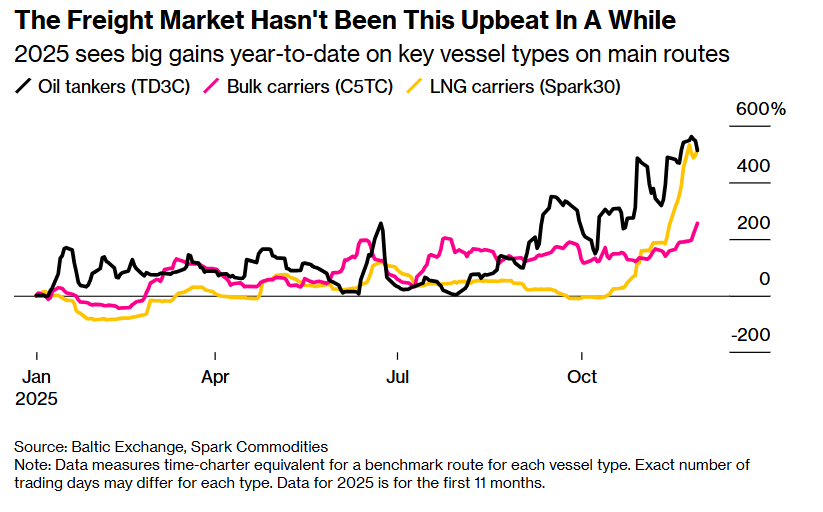
航运费飙升467%! 地缘冲突与制裁正在颠覆全球大宗海运格局
智通财经网· 2025-12-04 02:46
Core Viewpoint - The global shipping freight rates for commodities, including energy and bulk minerals, are experiencing an unprecedented year-end surge due to ongoing geopolitical conflicts, Western sanctions, and rising production levels, which are disrupting global shipping supply lines [1] Group 1: Freight Rate Increases - The daily earnings for transporting crude oil products on key global routes have surged by 467% from the beginning of the year to the end of November [1] - Freight rates for liquefied natural gas and iron ore have increased by over four times and two times, respectively [1][4] - The benchmark for shipping bulk commodities, including grain and minerals, reached a 20-month high by the end of November due to expectations surrounding a major iron ore project in Guinea and weather-related delays near China's coast [4] Group 2: Supply Chain Disruptions - Geopolitical tensions, such as attacks by Houthi forces on Red Sea commercial vessels, have forced some ships to reroute, increasing the "ton-miles" metric, which indicates longer transportation distances [5] - The effective shipping capacity has been artificially reduced due to slower turnaround times, with the same fleet now able to complete fewer trips per year [5] - The shipping industry is facing a static number of vessels, leading to a significant impact on freight rates due to reduced effective capacity [5] Group 3: Market Dynamics and Future Outlook - Despite a slight decline from the peak in late November, high transportation costs continue to have a positive ripple effect across the shipping market [6] - Major U.S. LNG buyers have considered delaying shipments, while some oil tanker operators are opting for longer routes to secure higher profits [6] - Shipping companies remain cautious about fleet renewal and strategic decisions due to high new ship prices and potential price declines following the reopening of the Red Sea [6] - Analysts suggest that the current year-end freight rate surge is driven by a combination of strong demand, reduced effective supply, and longer shipping routes, rather than seasonal trends or market speculation [7]