
铅锑精矿(含银)

Search documents
绝对稀缺资源!吃透【稀土+小金属】产业链及 5 大核心公司
Sou Hu Cai Jing· 2026-02-27 14:20
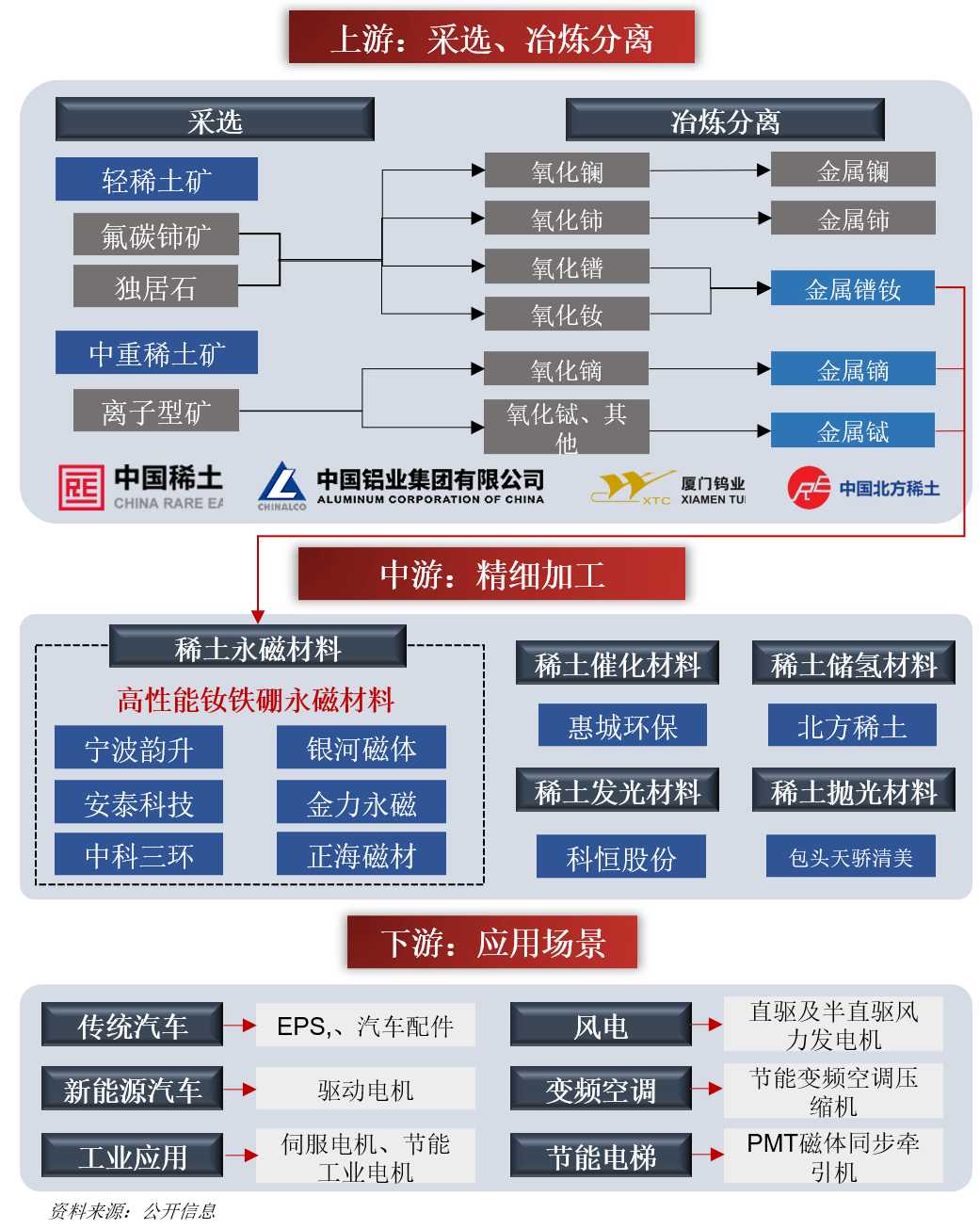
Core Insights - The article emphasizes that while there are concerns about AI replacing jobs, the essential resources for AI operation, such as rare earth elements and minor metals, are irreplaceable and finite, making companies that control these resources stable investments in the tech wave [1]. Industry Overview - Rare earth elements consist of 17 metals, including 15 lanthanides, scandium, and yttrium, known for their unique electronic structures that enhance magnetic, optical, and electrical properties, making them critical for various high-tech applications [3][4]. - The global rare earth reserves exceed 85 million tons, with China holding 44 million tons, accounting for 51.59% of the total, indicating a highly concentrated resource distribution among the top four countries [5]. Supply Chain Analysis - China dominates the rare earth separation market, with projections indicating that by 2025, it will account for 63% of light rare earth production and 16% of heavy rare earth production, totaling nearly 90% of global separation capacity [8]. - Despite being a major rare earth reserve holder, China remains a key importer of rare earth concentrates due to its technological advantages in the refining and separation processes, reinforcing its monopolistic position in the global supply chain [12]. - The political instability in Myanmar poses significant uncertainties for rare earth supply, as it is a major source for China, contributing 64.18% of its rare earth imports [14]. Demand Dynamics - The demand for neodymium-iron-boron magnets is diverse, with significant applications in electric vehicles (18% of demand), home appliances (8.8%), and industrial robots (10%) [24]. - The global sales of electric vehicles are projected to grow from 3.31 million units in 2020 to 23.54 million units by 2025, reflecting a compound annual growth rate of 48.05%, which will drive the demand for high-performance neodymium-iron-boron magnets [27]. - The industrial robotics sector is expected to maintain stable growth, with global installations increasing from approximately 420,000 units in 2018 to around 550,000 units in 2022, providing consistent demand for permanent magnets [32]. Key Companies in Rare Earth and Minor Metals - Shenghe Resources focuses on rare earth refining and processing, with a significant global resource footprint and a projected net profit increase of 650.09% in the first half of 2025 [36]. - China Tungsten High-Tech operates across the tungsten value chain, with a resource reserve of 1.23 million tons, and anticipates a production increase in tungsten concentrates to approximately 25,000-26,000 tons in 2025 [37]. - Luoyang Molybdenum is a leading producer of copper and cobalt, expecting a net profit of 20-20.8 billion yuan in 2025, driven by its mining operations in the Democratic Republic of Congo [40]. - Huayu Mining specializes in non-ferrous metal mining, with a focus on antimony and zinc, projecting a production of over 2,000 tons of antimony concentrates in 2025 [42]. - Baowu Magnesium is a leader in magnesium alloy production, benefiting from the lightweight trend in electric vehicles, with an expected output of over 100,000 tons of magnesium alloys in 2025 [43].

华钰矿业:截至目前,公司国内产品主要为锌精矿以及铅锑精矿(含银)
Zheng Quan Ri Bao Zhi Sheng· 2025-11-25 11:37
Group 1 - The company, Huayu Mining, confirmed that its business operations comply with national industry policy requirements [1] - The company's main domestic products are zinc concentrate and lead-antimony concentrate (including silver) [1] - The primary customers of the company are large downstream smelting enterprises and traders [1]
