阿尔法狗(AlphaGo)

Search documents
十年前,“棋圣”聂卫平预见了AI时代
3 6 Ke· 2026-01-15 13:42
Group 1 - The article highlights the legacy of Nie Weiping, a legendary figure in Chinese Go, who passed away at the age of 74, and his contributions to the game and the promotion of Go among younger generations [1][19] - Nie's career included significant victories in the 1970s and 1980s, establishing him as a national hero and a symbol of Chinese Go [1][19] - The article discusses the impact of AI on Go, particularly the historic match between Lee Sedol and AlphaGo in 2016, which marked a turning point in AI's capabilities [2][3] Group 2 - The article notes that AI has transformed the landscape of Go, with AI systems like AlphaGo and its successors achieving unprecedented success against top human players [2][3][11] - It emphasizes that while AI has conquered Go, it cannot replace human wisdom, as Nie Weiping believed in the importance of human creativity and insight in the game [4][15] - The rapid integration of AI into everyday life is highlighted, with the launch of AI applications like DeepSeek, which have significantly impacted various industries, including sports [5][10][16] Group 3 - The article reflects on the dual nature of AI's influence, where it can enhance human capabilities while also raising concerns about the quality and reliability of AI-generated content [9][14] - Nie Weiping's perspective on AI's role in Go is presented as a balanced view, recognizing AI's potential to enrich the game without diminishing the human element [15][18] - The ongoing evolution of AI technology is acknowledged, with a call for individuals and industries to adapt and embrace these changes for future growth [16][19]

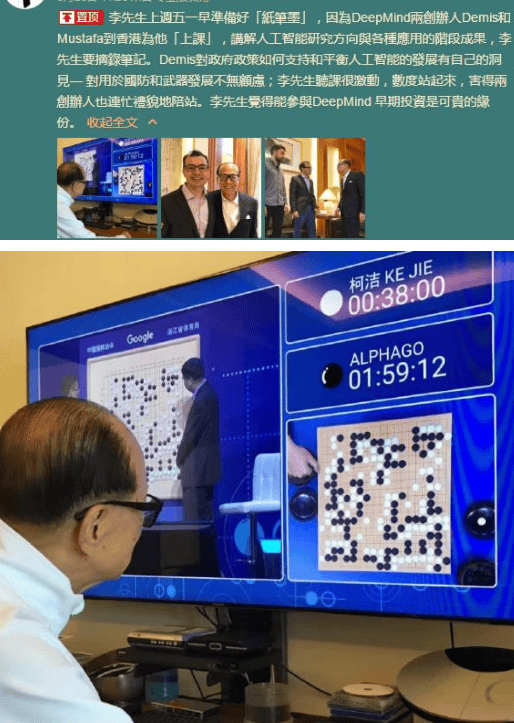
回头看,关于AI时代的生存法则,李嘉诚早就说透了!(发人深省)
Sou Hu Cai Jing· 2025-08-19 14:15
Core Insights - Li Ka-shing, at 89, remains engaged with advancements in artificial intelligence, demonstrating a lifelong interest in the field and a history of successful investments in AI-related companies like DeepMind [1][3] Group 1: AI and Adaptability - The AI era demands continuous learning, independent thinking, and the ability to synthesize information creatively to remain competitive [3][7] - Those who conform to outdated practices will struggle to adapt, emphasizing the need for agility and a proactive approach to learning new skills [3][5] Group 2: Overcoming Challenges - Individuals often become complacent due to fear of difficulties, but facing challenges is essential for personal growth and success [5][8] - A strong attitude and the ability to make rational choices are crucial for mastering one's destiny, especially in the face of adversity [8][9] Group 3: Personal Development and AI - To thrive in the AI age, one must transcend self-imposed limitations and cultivate a unique personal identity [11][12] - The era of AI is also a time for the rise of personal strength, where self-discipline and continuous self-improvement are vital for success [12]
异化与突围:AI一代的爱与忧愁
3 6 Ke· 2025-07-28 11:37
Group 1 - The core theme of the discussion revolves around the impact of AI on human life, emphasizing the transformation in how individuals interact with the world and each other due to AI technologies [2][3][10] - AI is seen as a revolutionary force comparable to historical agricultural and industrial revolutions, fundamentally altering the nature of cognitive labor and creating new demands [13][14][17] - The conversation highlights the duality of AI's role, where it can enhance efficiency but also raises concerns about job displacement and the quality of content produced [15][16][18] Group 2 - The discussion addresses the unique qualities of human experience that AI cannot replicate, such as emotional depth, intuition, and the physicality of human interactions [29][30][32] - There is a recognition that while AI can provide information and support, it lacks the embodied experience that shapes human understanding and creativity [29][30][34] - The potential for AI to redefine social interactions and emotional connections is explored, particularly in the context of companionship and mental health support [39][40] Group 3 - The panelists express concerns about the implications of AI on professional fields, particularly in areas like psychology and content creation, where AI may outperform human capabilities [38][39][40] - The conversation touches on the ethical considerations of AI's decision-making processes and its lack of moral reasoning, which could lead to challenges in human-AI interactions [24][36] - The future of AI is discussed in terms of its potential to develop self-awareness and its implications for human values and societal norms [36][37]
异化与突围:AI一代的爱与忧愁|4万字圆桌实录
腾讯研究院· 2025-07-28 09:30
Core Viewpoints - The article discusses the transformative impact of AI on human cognition, relationships, and societal structures, emphasizing the need for individuals to adapt to an AI-driven world [2][3][10]. Group 1: AI's Impact on Human Cognition and Relationships - AI is reshaping how individuals perceive and interact with the world, leading to a reliance on AI tools for information and assistance [3][4]. - The emergence of AI has created a new dynamic in human relationships, where individuals may seek emotional support and companionship from AI, raising questions about the nature of human connection [39][41]. - The unique human qualities of creativity, intuition, and emotional depth remain challenging for AI to replicate, highlighting the distinctiveness of human experience [10][32][37]. Group 2: Societal and Employment Changes - The rise of AI is leading to structural changes in employment, with a divide emerging between knowledge workers who heavily utilize AI and those in manual labor who remain less affected [6][15]. - AI is expected to drive significant societal changes, potentially creating new demands and altering existing job roles, although the immediate effects may lead to job displacement rather than new opportunities [15][19]. - The conversation around AI also touches on the potential for increased social inequality, as access to AI tools and knowledge may not be evenly distributed across different societal groups [2][8]. Group 3: The Future of AI and Human Interaction - The discussion raises concerns about the ethical implications of AI, particularly regarding its ability to provide psychological support and companionship, which may challenge traditional human roles in these areas [41][43]. - The potential for AI to develop self-awareness and its implications for human values and ethics is a significant topic of debate, suggesting a future where AI could redefine human understanding of consciousness and morality [38][40]. - The article concludes with reflections on how future generations, raised in an AI-centric environment, may develop different cognitive frameworks and social interactions compared to previous generations [22][23].

智能涌现:无尽前沿
Hua Xia Shi Bao· 2025-05-29 08:51
Group 1 - The article discusses the historical context of industrial revolutions, emphasizing that each revolution is driven by scientific advancements and the flow of research results into industry, leading to exponential economic growth [3][5][11] - The emergence of artificial intelligence (AI) is positioned as a potential catalyst for the fourth industrial revolution, similar to previous technological breakthroughs [4][10] - The concept of "emergence" in AI models is introduced, highlighting that when data and model parameters reach a certain scale, significant improvements in accuracy and predictability occur [3][4] Group 2 - AI is identified as the most transformative technological force of the current era, with deep learning technologies achieving human-level performance in various tasks [5][11] - The launch of ChatGPT is noted as a significant milestone, marking the first instance of a machine passing the Turing test, which has implications for the future of AI and its applications [6][11] - The rapid growth of AI applications, exemplified by the Chinese company DeepSeek achieving 100 million users in just seven days, underscores the potential for AI to drive digital transformation across industries [8][10] Group 3 - The article emphasizes the need for a new paradigm in research and development to adapt to the complexities of the fourth industrial revolution, integrating academic knowledge with industry needs [13][14] - The importance of AI in transforming various sectors, such as automotive and healthcare, is highlighted, indicating that AI will redefine traditional roles and operational frameworks [12][14] - The concept of "endless frontiers" is referenced, suggesting that continuous efforts in AI research and application are essential for harnessing its full potential for societal benefit [14][15]