
集成电路高端互连材料

Search documents
A股开年297单并购,跨界扎堆半导体
21世纪经济报道· 2026-01-29 00:12
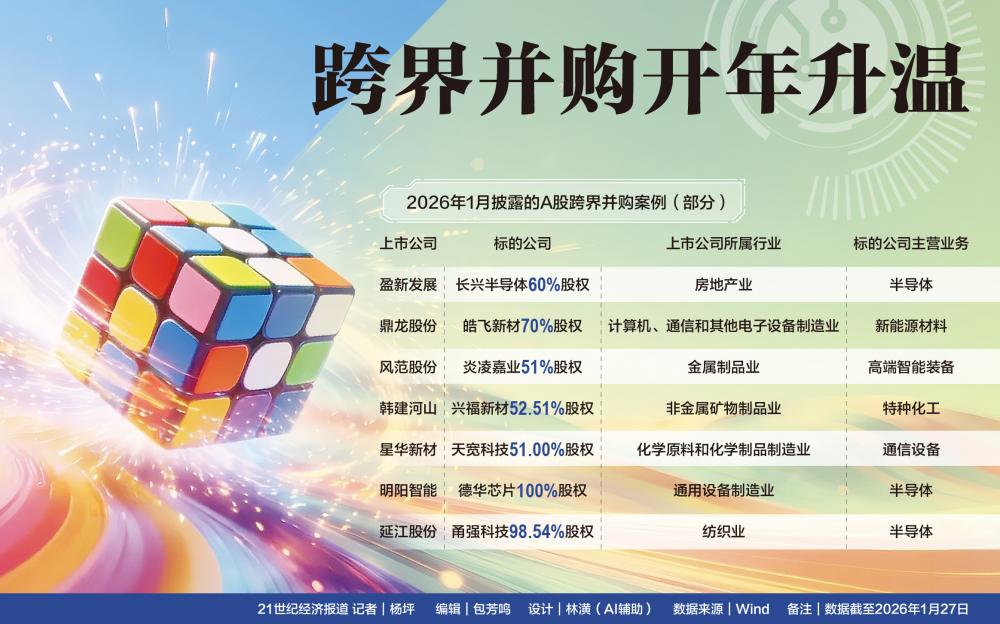
Core Viewpoint - The A-share merger and acquisition (M&A) market remains active in early 2026, with over 297 disclosed M&A cases, including 12 major asset restructurings, particularly in strategic emerging industries like semiconductors and artificial intelligence [1][6]. Group 1: M&A Activity - In January 2026, several companies, including Yingxin Development, Kangxin New Materials, and Dinglong Co., announced cross-industry M&A plans, with many traditional manufacturing firms transitioning towards semiconductors and high-end equipment [1][3]. - Notable cross-industry M&A cases include: - Yingxin Development acquiring 60% of Changxing Semiconductor for 520 million yuan [8]. - Kangxin New Materials planning to acquire 51% of Wuxi Yubang Semiconductor for 392 million yuan [8]. - Mingyang Smart Energy's acquisition of 100% of Dehua Chip Technology [8]. Group 2: Regulatory Scrutiny - Several cross-industry M&A cases have attracted regulatory attention due to concerns over the authenticity of disclosures and valuation rationality, with companies like Kangxin New Materials and Fengfan Co. receiving inquiry letters from regulators [2][12]. - The regulatory stance is supportive of cross-industry M&A that enhances company quality but is strict against speculative and high-risk transactions [2][15]. Group 3: Financial Performance and Challenges - Many companies engaging in cross-industry M&A face challenges in their core business performance, with some reporting continuous losses: - Yanjiang Co. has struggled with net profits below 30 million yuan [9]. - Kangjian Heshan is projected to incur a net loss of 8 to 12 million yuan in 2025 [9]. - Fengfan Co. anticipates a net loss of 320 to 380 million yuan in 2025 [9]. Group 4: Market Dynamics - The recent regulatory framework encourages compliant companies to pursue cross-industry M&A for industrial transformation and growth, reviving interest in cross-industry deals that had previously declined [5][6]. - The market is witnessing a surge in cross-industry M&A cases, with at least eight disclosed in early 2026, four of which involve semiconductor assets [7].


A股跨界并购扎堆半导体 监管紧盯并购真实性
Xin Lang Cai Jing· 2026-01-28 23:06
Core Viewpoint - The A-share merger and acquisition (M&A) market remains active in early 2026, with over 297 disclosed M&A transactions, including 12 major asset restructurings as of January 28, 2026 [1]. Group 1: M&A Activity - Strategic emerging industries, particularly in semiconductors and artificial intelligence, are the core areas for listed companies' M&A activities [2]. - In January 2026 alone, several companies, including Yingxin Development, Kangxin New Materials, and Dinglong Co., announced plans for cross-industry mergers, indicating a trend of traditional manufacturing companies transitioning towards high-tech sectors [2][4]. - Notably, there have been at least eight disclosed cross-industry M&A cases this year, with four targeting semiconductor assets [4]. Group 2: Regulatory Scrutiny - Regulatory bodies have heightened scrutiny over cross-industry mergers, focusing on the authenticity of disclosures and the reasonableness of valuations [2][10]. - Companies like Kangxin New Materials and Fengfan Co. have received inquiry letters from regulators regarding their cross-industry M&A plans, highlighting concerns over speculative practices and high-risk transactions [2][10]. - The Shanghai Stock Exchange has raised questions about the feasibility of performance commitments made by companies involved in these transactions, particularly when historical performance has been poor [11][12]. Group 3: Financial Performance and Challenges - Many companies pursuing cross-industry mergers are facing challenges in their core business operations, with some reporting continuous losses [7][8]. - For instance, Yingxin Development and Han Jian Heshan have been struggling with profitability, prompting them to seek new growth avenues through M&A [7][8]. - The financial data of targeted companies, such as YB Semiconductor, shows significant projected losses, raising concerns about the viability of these acquisitions [4][11].



延江股份拟跨界并购半导体资产 日振幅达24.9%
Zhong Guo Jing Ying Bao· 2026-01-23 10:45
Core Viewpoint - The stock price of Xiamen Yanjing New Materials Co., Ltd. (Yanjing Co., 300658.SZ) experienced dramatic fluctuations following the announcement of its acquisition plan for a semiconductor materials company, highlighting the volatility and potential risks associated with such cross-industry mergers [1][2]. Group 1: Acquisition Details - Yanjing Co. plans to acquire 98.54% of Ningbo Yongqiang Technology Co., Ltd. through a combination of issuing shares and cash payments, with funding from its controlling shareholder [2]. - The acquisition is aimed at expanding Yanjing Co.'s business into the high-end electronic information interconnection materials sector, which is crucial for integrated circuits [3]. - Yongqiang Technology has reported losses for three consecutive years, with total losses exceeding 110 million yuan, raising concerns about its profitability despite its strong technical team and client base [3]. Group 2: Market Reactions and Regulatory Concerns - Following the acquisition announcement, Yanjing Co.'s stock price surged by 20% before experiencing a significant drop, indicating market volatility and potential insider trading investigations [2][4]. - The company acknowledged the risk of regulatory scrutiny due to abnormal stock price movements, which could lead to the suspension or termination of the acquisition [4]. Group 3: Industry Trends - The trend of traditional companies entering the semiconductor sector through acquisitions has accelerated since 2025, with various firms attempting to diversify their business and capitalize on the semiconductor industry's growth potential [5][6]. - Notable examples include companies like Tanshan and Ankai Micro, which have made significant acquisitions in the semiconductor field to enhance their product offerings and market competitiveness [6][7]. Group 4: Policy and Market Dynamics - Government policies aimed at supporting the semiconductor industry, including simplified approval processes and financial incentives, are driving traditional companies to pursue cross-industry acquisitions [8]. - While some acquisitions may bring in new capital and attention to the semiconductor sector, there are concerns about the irrational aspects of the acquisition wave, with many companies lacking operational experience in the semiconductor industry [9].