零售商业空间

Search documents
第一太平戴维斯:2026年中国房地产市场展望报告
Sou Hu Cai Jing· 2026-02-06 08:27
Core Insights - The Chinese real estate market is in a deep reassessment phase, transitioning from a growth model based on scale and price increases to a structural transformation, with a focus on breaking the cycle of cost reduction and service decline [1][7] - The macroeconomic outlook for 2026-2027 indicates a relatively stable growth trajectory, although the growth rate is expected to be lower than in 2025, with a "slow recovery" pattern emerging [1][9] - The industry is characterized by a "three-speed economy," where traditional sectors like real estate are in a slow adjustment lane, necessitating a redefinition of their roles to align with new development orders [1][14] Market Segmentation - The office market is shifting towards quality and efficiency, adopting a "less is more" strategy, focusing on multifunctional spaces and optimizing value through stock renovation and intensive management [2][18] - The retail market shows stable overall data but increasing differentiation among segments, with traditional core business districts losing their advantages, while regional projects and unique operators are rising [2][26] - The logistics market is closely tied to the real economy, with high-quality assets demonstrating resilience, and the industry is transitioning towards "quality asset holding + refined operations" [2][33] - The residential market is stabilizing at low levels, with sales steady but confidence fragile, emphasizing quality delivery and livability as key competitive factors [2][40] Investment Market Outlook - The investment market is likely to remain sluggish in 2026, but structural opportunities are emerging, with a preference for high-quality assets with stable cash flows [2][48] - The financialization of the industry is accelerating, with an increase in public REITs and holding-type ABS issuance, pushing the industry towards a "hold and operate" model [2][56] - Long-term capital is gradually entering the market, with a shift in valuation systems rewarding discipline and operational capability, making transparent pricing and precise positioning crucial for asset differentiation [2][53] Key Opportunities - The core opportunity for the real estate industry in 2026 lies in aligning with economic transformation and reshaping asset value logic, focusing on quality upgrades, operational optimization, and innovative models [3][8] - Each segment must return to its essence: offices focusing on collaboration efficiency, retail enhancing emotional connections, logistics adapting to supply chain upgrades, and residential emphasizing livability [3][40]



未来4年武汉甲级写字楼市场新增供应超百万方 精细化运营与差异化竞争成关键
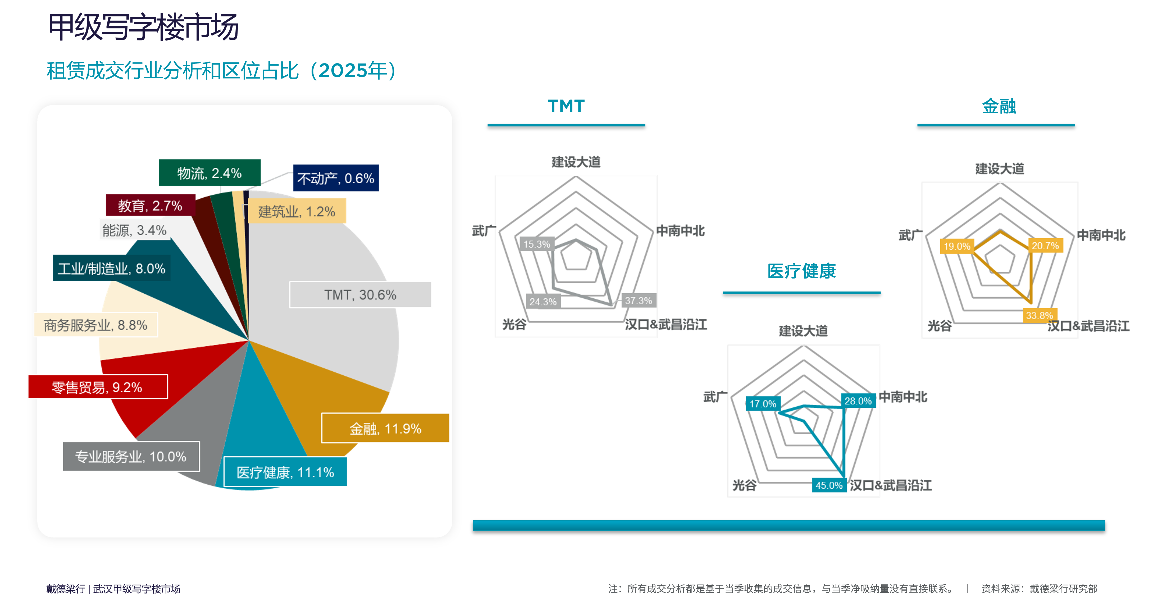
Zhong Guo Jing Ying Bao· 2026-01-16 23:58
Core Insights - The Wuhan Grade A office market is expected to experience a significant increase in supply, with approximately 1.12 million square meters set to be added over the next four years, primarily concentrated in the Hankou and Wuchang riverside areas [1][4]. Grade A Office Market Overview - In 2025, the Wuhan Grade A office market will see an addition of about 230,000 square meters, raising the total stock in the core business district to 3.433 million square meters [4]. - The TMT (Technology, Media, and Telecommunications) sector is projected to be the main driver of leasing activity, accounting for 35.9% of the new space leased in 2025 [4][6]. - Average rental rates for Grade A offices in Wuhan fell to 73.3 yuan per square meter per month, a decrease of 11.2% year-on-year, while the vacancy rate rose to 39.1%, an increase of 2.7 percentage points compared to the previous year [5]. Market Dynamics and Trends - The overall demand for Grade A office space in Wuhan is undergoing a phase of contraction due to cautious expansion attitudes among companies, with a net absorption of 59,000 square meters in 2025, reflecting a year-on-year decline of 33.4% [5][6]. - Operators are adopting diversified leasing strategies, including co-working spaces and customized services, to attract tenants amid rising competition and increased vacancy rates [5][6]. Sector-Specific Demand - The main sectors supporting the Grade A office leasing market in 2025 are TMT, finance, and healthcare, contributing 30.6%, 11.9%, and 11.1% respectively to the leasing activity [6]. - Cost control remains a core driver for relocations, accounting for 58.3% of demand, while new demand remains limited [6]. Future Outlook - The competition in the Grade A office market is expected to intensify, particularly along the Yangtze and Han rivers, challenging landlords to enhance operational efficiency and differentiate their offerings [6].