雷克萨斯ES系列

Search documents
进口车去年猛降32%,雷克萨斯却逆势上涨
3 6 Ke· 2026-01-29 10:56
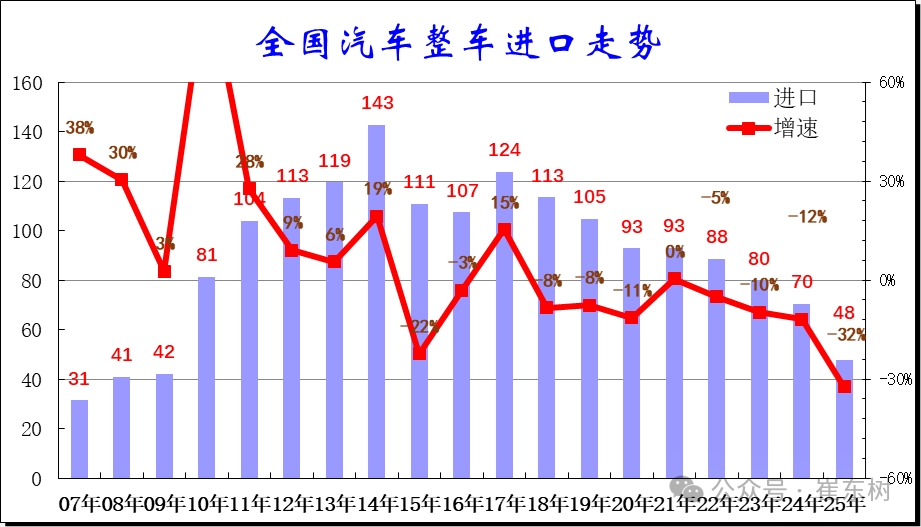
Core Insights - The import car market in China has been under pressure, with a projected decline of 32% in imports for 2025, totaling 480,000 units, marking four consecutive years of negative growth [2][4] - Luxury vehicles are the mainstay of the import market, while non-luxury imports are experiencing significant shrinkage [3][5] - Lexus stands out with a 2% increase in sales for 2025, reaching 184,000 units, marking a four-year high [6][8] Import Market Trends - The import car volume has seen a consistent decline from 2014's peak of 1.43 million units, with 2024 imports down 12% to 700,000 units [2][4] - Monthly data for 2025 indicates a sharp decline in early months due to price observation, followed by a brief recovery in July, but continued weakness from August to November [4] Sales Performance - Total retail sales of imported cars for 2025 are expected to be 540,000 units, down 33% year-on-year [5] - Luxury brands dominate the import market, accounting for 90.7% of total sales, with significant declines in brands like BMW (down 62% to 64,400 units) and Mercedes-Benz (down 37% to 94,800 units) [5][6] Luxury Segment Analysis - Lexus's sales growth is attributed to timely product adjustments and strong performance of hybrid models, with the ES series and RX series contributing significantly to overall sales [8] - The super-luxury segment has faced declines, with brands like Bentley, Ferrari, and Lamborghini experiencing three consecutive years of sales drops [8][9] Regional Insights - Shanghai has become the leading market for super-luxury imports in 2025, surpassing Tianjin, while traditional affluent areas face significant market pressure [9] Domestic Competition - Domestic brands are increasingly targeting the luxury segment, with models like the Huawei-backed ZunJie S800 and NIO ET9 entering the market, challenging traditional luxury brands [10][12] - The shift in consumer preferences indicates a growing acceptance of domestic luxury vehicles, driven by technological advancements and changing consumer habits [10][12]

崔东树:进口车持续剧烈下行的压力明显 2025年1-12月进口汽车48万辆 同比下降32%
智通财经网· 2026-01-26 11:55
Core Insights - The import of automobiles in China is experiencing significant declines, with a projected total of 480,000 vehicles imported in 2025, representing a 32% year-on-year decrease. December 2025 alone saw imports drop to 30,000 units, down 56% year-on-year and 30% month-on-month [1][5][6]. Group 1: Overall Trends in Automobile Imports - The peak of automobile imports occurred in 2014 with 1.43 million units, followed by a continuous decline, with imports dropping to 700,000 units in 2024, a 12% decrease from the previous year [5][6]. - The first twelve months of 2025 are expected to show a total of 480,000 imported vehicles, marking a significant decline of 32% compared to the same period in 2024 [1][5]. Group 2: Monthly and Quarterly Trends - December 2025's imports were particularly low, with only 30,000 vehicles imported, reflecting a 56% year-on-year decline and a 30% decrease from November 2025 [1][6]. - The overall trend indicates a continuous decline in imports over the past three years, with a cumulative negative growth trend extending to seven years when smoothing out fluctuations [5][6]. Group 3: Country-Specific Import Data - The top ten countries for imports in December 2025 included Japan (11,179 units), Germany (8,228 units), and the United States (4,487 units), with Finland showing a notable increase in imports [1][5]. - For the entire year of 2025, Japan remains the largest supplier with 203,107 units, followed by Germany and Slovakia, indicating a shift in import dynamics [1][5]. Group 4: Market Segmentation and Vehicle Types - Passenger vehicles dominate the import market, accounting for 99% of total imports, with a notable decline in the import of traditional fuel vehicles and a slight increase in diesel vehicle imports [12][16]. - In 2025, the share of imported passenger cars with engine displacements below 2 liters increased to 49%, reflecting a shift in consumer preferences towards smaller, more fuel-efficient vehicles [16][17]. Group 5: Performance of Luxury Brands - Lexus has emerged as a standout performer in the luxury segment, achieving sales of 184,000 units in 2025, maintaining its position as the leading imported luxury car brand despite the overall market decline [2].