
霍尔推力器

Search documents
中国首个星际航行学院院长接受《环球时报》采访:星际航行距离我们有多远?
Huan Qiu Wang Zi Xun· 2026-01-28 23:05
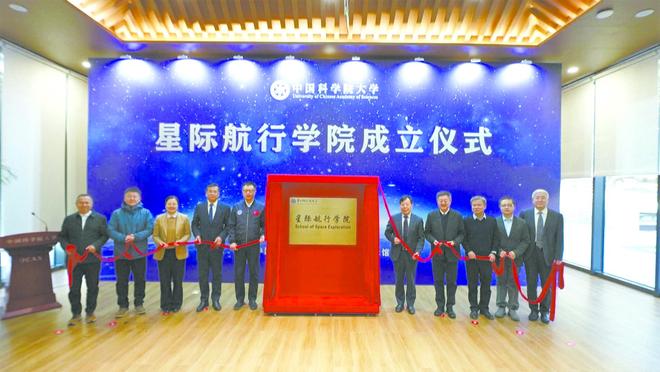
Core Viewpoint - The establishment of the Interstellar Navigation College at the University of Chinese Academy of Sciences marks a significant step in talent cultivation for interstellar exploration, aiming to develop interdisciplinary talents with both scientific and engineering perspectives [1][4]. Group 1: College Establishment and Curriculum - The Interstellar Navigation College will offer over 100 courses, including 22 new core courses focused on cutting-edge topics such as interstellar propulsion and planetary dynamics [6]. - The college's primary discipline is aerospace science and technology, with a focus on areas like spacecraft design and propulsion engineering [6][7]. - The college aims to serve as an innovation hub and talent cultivation base for the long-term development of interstellar navigation in China [7]. Group 2: Research and Technological Significance - The research into interstellar navigation is increasingly important due to rapid advancements in space technology, which are bringing interstellar travel closer to reality [4]. - The next 10 to 20 years are identified as a critical window for breakthroughs in interstellar navigation, which will reshape deep space exploration and impact national competitiveness [4]. Group 3: Challenges and Future Directions - Key challenges for interstellar travel include propulsion technology, fuel efficiency, and long-term life support systems for humans in space [8][9]. - Future plans include launching a series of scientific satellites to explore fundamental questions about the universe, with China aiming to lead in addressing these space science issues [9][10]. - The development of Hall thrusters is highlighted as a crucial technology for deep space exploration, with ongoing advancements expected to enhance their application in future missions [10].


商业航天的星辰大海-2026产业节奏与核心赛道洞察
2026-01-28 03:01
Summary of Key Points from the Conference Call Industry Overview - The conference discusses the commercial aerospace industry, focusing on satellite deployment plans and technological advancements in satellite manufacturing and communication systems. Key Insights and Arguments 1. **National Satellite Constellation Plans** - The National Grid Constellation aims to deploy 12,992 satellites, with 145 launched as of January 2026, targeting 300 by 2025 and 1,200 by 2029. Delays in reusable rocket technology may impact these timelines [1][2][3] 2. **Shift in Satellite Configuration** - Transition from closed to flat-panel satellite designs signifies a shift from artisanal to assembly line production, enhancing electronic integration and necessitating advancements in flexible solar wings and laser terminal technologies [1][5] 3. **Phased Array Antenna Development** - Phased array antennas enable multi-target tracking without mechanical rotation, crucial for low Earth orbit communications. Focus is on developing ultra-low-cost TR components while addressing heat dissipation challenges [1][6] 4. **Challenges in Laser Communication Technology** - Despite high bandwidth, laser communication faces issues like long chain establishment times and instability due to high-energy particles and momentum wheel vibrations, necessitating reliable mass production [1][7] 5. **Electric Propulsion Technology** - Electric propulsion, particularly Hall thrusters, is vital for satellite maneuvering. Common propellants include xenon and krypton, with SpaceX using cost-effective argon. Cost differences are significant, with xenon at 40,000 CNY/kg and argon at 20 CNY/kg [1][8][9] 6. **Satellite Superfactory Efficiency** - Modern satellite superfactories, like SpaceX's, can produce over 3,000 satellites annually, significantly reducing production time from 10 months to a streamlined process. Domestic factories aim for similar efficiencies [1][10] 7. **Market Size Projections** - Anticipated satellite launches during the 15th Five-Year Plan exceed 10,000, with market sizes projected for various components: laser terminals (300 billion CNY), flexible solar wings (150-300 billion CNY), and phased array antennas (250-300 billion CNY) [1][12] 8. **Impact of Space Environment on Satellite Operations** - The operational environment affects satellite longevity and necessitates high-quality components to mitigate risks from radiation and atmospheric drag, particularly in the South Atlantic Anomaly [1][14] 9. **Advancements in Reusable Rocket Technology** - Reusable rocket technology is evolving, with materials like stainless steel being used for better strength at low temperatures. The use of methane fuel is increasing due to its advantages over kerosene [1][15][21] 10. **Future of Space Tourism** - Space tourism is emerging, with companies planning suborbital flights by 2028. Current ticket prices range from 2 to 3 million CNY, expected to decrease as launch costs drop [1][17] Additional Important Insights - **Cost Reduction in Testing** - Companies are exploring data-driven methods to optimize testing processes and reduce costs while ensuring reliability through component-level testing [1][11] - **Trends in Downstream Applications** - The competition between IoT and satellite internet is intensifying, with significant potential in remote sensing and space tourism. The development of composite satellites with both optical and communication capabilities is still in progress [1][20] - **Challenges in Satellite Lifespan Extension** - Extending the lifespan of low Earth orbit satellites is critical to reduce replacement costs, with fuel replenishment methods facing technical barriers [1][16] This summary encapsulates the critical points discussed in the conference call, highlighting the advancements, challenges, and market dynamics within the commercial aerospace sector.
国泰海通:天地一体化建设提速 关注卫星制造与火箭发射端龙头
智通财经网· 2026-01-13 13:29
Group 1 - The core point of the article highlights that China has submitted an application for 203,000 new satellites covering 14 constellations, marking a significant increase in satellite applications and indicating a new era in low Earth orbit (LEO) satellite construction [1][2] - The application includes two major constellations, CTC-1 and CTC-2, which account for nearly 193,000 satellites, reflecting a strategic intent to secure frequency resources for future 6G integrated networks [2][3] Group 2 - The entry of traditional telecom operators like China Mobile and China Telecom into the satellite sector signifies a shift from a single professional satellite operator model to a diversified structure involving national teams, commercial aerospace, and traditional operators [3] - This integration is expected to accelerate the commercial viability of satellite internet services, facilitating the Direct to Cell business model by leveraging the operators' extensive user base and ground infrastructure [3] Group 3 - The new satellite constellations face strict deployment timelines as per ITU regulations, requiring the first satellite to be launched within seven years and full deployment within 14 years, necessitating a significant increase in satellite manufacturing and rocket launch capabilities [4] - The industry must achieve an exponential increase in production capacity to meet the demand for launching thousands of satellites annually over the next decade [4]

安徽安庆:商业航天“发动机”轰鸣 未来产业加速“升空”
Zhong Guo Jing Ji Wang· 2026-01-13 06:37
Group 1 - The core viewpoint of the news is that the launch of the Xi Jia Aerospace Power project marks a significant step for Anqing in cultivating new productive forces in the aerospace information sector, transitioning from traditional industries to innovative and future-oriented sectors [2] - The Xi Jia Aerospace Power project, which focuses on the production of Hall propulsion systems, is expected to achieve an annual production capacity of 500 sets, contributing to the development of high-end manufacturing in the region [1] - Anqing is actively attracting core supporting enterprises like Xi Jia Aerospace and has successfully facilitated the establishment of companies such as Anhui Space Zhihang Technology Co., forming an initial industrial chain covering rocket assembly, satellite manufacturing, and launch services [2] Group 2 - By the end of 2027, Anqing is projected to implement no less than 30 commercial aerospace projects, with an industry scale exceeding 10 billion yuan, aiming for a significant increase in enterprise quality, technical capabilities, and industrial scale [3] - Anqing's development strategy includes the establishment of investment funds to lead capital, high-standard construction of various R&D platforms, and strengthening industrial chain investment and cluster cultivation [2] - The successful launch of Anqing's first satellite, "Tianxianpei," on November 11, 2024, serves as an important milestone in the city's aerospace information industry development [2]