顺风车业务

Search documents
顺风车,没人坐了吗?
3 6 Ke· 2025-08-27 00:24
Core Viewpoint - Dida Chuxing, as a leading ride-sharing platform, has faced significant business and performance declines since its IPO in June 2024, reflecting broader challenges in the ride-sharing market [1][3][2] Business Performance - In the first half of 2025, Dida's revenue was 286 million yuan, a year-on-year decrease of 29.1%, while net profit fell by 86.0% to 135 million yuan [4] - The core ride-sharing business has been under pressure, with order volume dropping by 30.0% to 43.2 million and overall transaction value decreasing by 34.9% to 2.608 billion yuan [5] - Despite a growing user base, with registered users increasing from 368 million in June 2024 to 395 million in June 2025, this has not translated into sustained business growth [4] Market Environment - The overall ride-hailing market is experiencing contraction, with the user base at 511 million as of June 2025, showing a decline in growth rate and the lowest usage rate of 45.6% since the end of 2023 [5][6] - The decline in ride-hailing prices, the entry of Robotaxi brands, and increased penetration of public transport and private cars are impacting the usage rate of ride-sharing services [6] Profitability and Revenue Streams - Dida's ride-sharing business maintains a high gross margin of 67.2%, despite a year-on-year decline of 7 percentage points [8] - Revenue from the ride-sharing segment was 275 million yuan, with a segment profit of 172 million yuan, resulting in a net margin of 62.5% [8] - The company's taxi-hailing business, which operates in 96 cities, has not significantly contributed to revenue and has been eroding profitability, with revenue of 249,700 yuan, down 19.4% [8] Competitive Landscape - Dida faces increasing competition from major players like Didi, Gaode, and others who are expanding their ride-sharing services, putting pressure on Dida's market position [14] - The shift in the market dynamics has led to a situation where Dida's core business is being challenged by competitors who have more resources and diversified service offerings [14][19] Strategic Direction - Dida has recognized the limitations of a single business model and has attempted to diversify by exploring taxi-hailing services since 2017, but this has not gained market acceptance [14][15] - The company is under pressure to reassess its business direction to maintain competitiveness in a rapidly evolving market [19]


小拉出行如何“虎口求生”?
虎嗅APP· 2025-05-09 13:14
Core Viewpoint - The article discusses the saturation of the ride-hailing market in China, highlighting the challenges faced by drivers and the emergence of a new platform, "Xiao La Chuxing," which offers a different business model aimed at improving driver income and providing a more flexible working environment [1][2][3]. Group 1: Market Saturation and Driver Challenges - Multiple transportation authorities have issued warnings about market saturation in ride-hailing services, with Shenzhen and Haikou being notable examples [1]. - The number of ride-hailing drivers surged by 1.48 million in 2023 and an additional 910,000 in 2024, leading to a situation where drivers are struggling to earn a sustainable income [2]. - Drivers report a significant disparity in earnings, with some making as much as 20,000 yuan a month while others earn as little as 80 yuan a day, reflecting the competitive and challenging nature of the market [1][2]. Group 2: Emergence of Xiao La Chuxing - Xiao La Chuxing has become a new avenue for drivers seeking better income opportunities, particularly in smaller cities like Guiyang and Zunyi [4][6]. - The platform's unique "self-picking order model" allows drivers to choose orders based on their preferences, providing greater flexibility and reducing the pressure associated with forced dispatch [6][9]. - Drivers on Xiao La Chuxing report feeling more respected and having more control over their work compared to traditional platforms [6][8]. Group 3: Business Model and Competitive Advantage - Xiao La Chuxing differentiates itself by maintaining lower commission rates, with membership drivers facing a maximum commission of 10% and some cities offering rates as low as 1% [16][19]. - The platform's approach avoids the high commission structures prevalent in the industry, which often exceed 30%, thus providing a more favorable environment for drivers [14][15][16]. - By focusing on a low-commission model and avoiding aggressive subsidy strategies, Xiao La Chuxing aims to create a sustainable business that benefits both drivers and passengers [19][20]. Group 4: Market Positioning and Growth Strategy - Xiao La Chuxing is positioned as a "Plan C" for drivers, offering a low-cost alternative in the ride-hailing market, akin to how Pinduoduo operates in e-commerce [25][26]. - The platform leverages partnerships and traditional marketing methods, such as collaborations with logistics services, to enhance its visibility and user base without incurring high advertising costs [21][23]. - The introduction of additional services, such as "four-wheel small items" delivery and ride-sharing, has further diversified the platform's offerings and income sources for drivers [23][24]. Group 5: Challenges and Future Outlook - Despite its innovative model, Xiao La Chuxing faces challenges related to market saturation and uneven order distribution, particularly in smaller cities where demand may not meet supply [29][30]. - Drivers report difficulties in securing orders, leading to income instability, especially in regions with lower demand [30][31]. - The platform's focus on low-cost services may limit its appeal to higher-end customers, as it does not provide vehicle quality options, which could affect user experience [31][32].

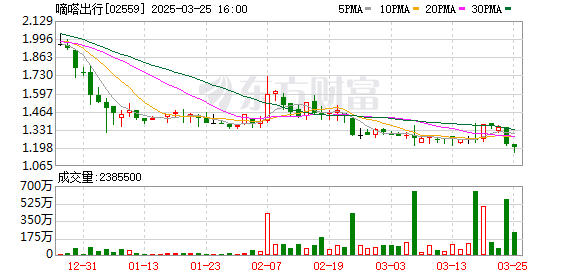
嘀嗒出行公布上市后首份年报:营收毛利双降 股价较发行价暴跌超七成
Zhong Guo Jing Ying Bao· 2025-03-25 09:23
Core Viewpoint - Dida Chuxing, the first ride-hailing company to go public, reported a decline in both revenue and gross profit in its first annual report post-IPO, with a significant drop in stock price exceeding 70% from its issue price [3][9]. Financial Performance - In 2024, Dida Chuxing's revenue was 787 million yuan, a decrease of 3.4% from 815 million yuan in the previous year [4][9]. - The company's gross profit fell to 567 million yuan, down 6.3% year-on-year [3][4]. - Despite the decline in revenue and gross profit, net profit surged by 234.4% to 1.004 billion yuan, primarily due to significant changes in the fair value of preferred shares [3][9]. - Adjusted net profit, excluding the impact of preferred shares, was 211 million yuan, a decrease of 6.6% from 226 million yuan in the previous year [3][9]. Business Segment Analysis - The ride-hailing segment generated 754 million yuan in revenue, a decline of 2.7%, accounting for 95.7% of total revenue [4][5]. - Service costs for the ride-hailing segment increased to 207 million yuan, up approximately 20 million yuan from the previous year [4]. - Incentives for drivers and passengers were significantly reduced, totaling 38.463 million yuan compared to 67.074 million yuan in the previous year [4]. - The ride-hailing segment's profit was 508 million yuan, down 2.3% year-on-year, indicating a slower decline in profit compared to revenue [4]. Strategic Outlook - Dida's CFO indicated that the ride-hailing industry is still developing in China, with untapped market demand, and plans to collaborate with third-party platforms for growth [5]. - The company aims to expand its user base through targeted marketing strategies and explore various ride-hailing scenarios, such as employee commuting and student transportation [5]. - As of the end of 2024, Dida provided ride-hailing services in 366 cities, with 18.9 million certified private car owners, a year-on-year increase of 21.4% [5]. Marketing and Cost Management - Marketing expenses decreased by 26.8% to 17.1 million yuan, attributed to a cautious promotion strategy and more precise marketing through algorithms [6]. - The effectiveness of future marketing and promotional activities in driving user growth and revenue remains a critical point of interest [6]. Taxi Business Performance - Dida's smart taxi service revenue significantly declined to 6.154 million yuan in 2024, a drop of 45.7%, representing only 0.8% of total revenue [7][8]. - The management stated that the revenue decline was due to a strategic shift from online ride-hailing to a new integrated approach [7]. - The taxi segment is currently operating at a loss, with a gross loss of 3.098 million yuan in 2024, although this loss has narrowed compared to the previous year [8]. Market Position and Challenges - Dida's business model is heavily reliant on the ride-hailing segment, which constitutes only about 5% of the overall ride-hailing market, limiting growth potential [10][11]. - The company faces challenges in diversifying its business and developing new revenue streams to enhance its market position [11].