移动出行

Search documents
优步(UBER.US)FY25Q4电话会:公司是自动驾驶落地最理想的平台
智通财经网· 2026-02-05 13:41
Core Insights - Uber's management emphasizes the company's strong cash flow and commitment to expanding its consumer, earner, and merchant base through advanced market matching technology and global scale [1] - The company positions itself as the ideal platform for the commercialization of autonomous vehicles (AV), leveraging its operational experience and pilot programs in multiple cities to validate its platform strategy [1] - For 2026, Uber plans to focus on six strategic priorities to ensure sustainable long-term growth, including transitioning from single rides to lifetime value, investing in local e-commerce, and expanding gig economy opportunities [1] Market Dynamics - Uber's total bookings in cities like San Francisco and Austin have accelerated despite competition from Tesla and Waymo, indicating that AV is expanding the overall market rather than cannibalizing it [2] - The company expects to cover 15 cities with AV partnerships by the end of the year, benefiting from higher utilization rates and positioning itself as the preferred platform for AV manufacturers [2] - 60% of Uber's mobility bookings come from international markets, providing a strong competitive moat through geographic diversity [2] User Growth Strategy - Uber's user growth strategy focuses on new products, scenarios, demographics, and regions, with initiatives like the low-cost Moto product and the Reserve service for suburban and airport travel [2] - Monthly active users have increased to over 202 million, with a year-on-year growth rate rising from 14% to 18% by year-end, driven by improved user retention and quality [3] - The Uber One membership program has seen a 55% year-on-year increase, enhancing user frequency and loyalty [3] Financial Performance - Uber's free cash flow is projected to reach approximately $10 billion, growing 40% year-on-year, allowing for significant reinvestment in core business opportunities while returning cash to shareholders [5] - The company maintains a dual strategy of "buyback + investment" to maximize long-term shareholder value, with a focus on maintaining an attractive stock price [5] Autonomous Vehicle Strategy - Uber's AV strategy involves investing in software developers to ensure future supply, while maintaining a fleet financing model to optimize capital efficiency [7] - The company aims to establish operational loops in 15 cities by securing partner agreements and building necessary infrastructure, while addressing regulatory challenges [8] - Uber's approach to AV deployment is gradual, initially retaining safety drivers before transitioning to fully autonomous operations [9] Advertising and Delivery Growth - The advertising penetration rate in delivery has surpassed previous expectations, with significant growth opportunities in various sectors, including SMBs and enterprise clients [12] - The delivery business has seen record growth driven by supply-side expansion and increased market penetration in low-density areas, with a focus on retail and grocery sectors [13] - Uber's membership system enhances user engagement across multiple product categories, contributing to high lifetime value [13]

Uber第四季度净利暴跌96%,押注自动驾驶
第一财经· 2026-02-05 02:08
Core Viewpoint - Uber's Q4 2025 financial report shows a 20% year-over-year revenue growth to $14.4 billion, but a significant 96% drop in net profit to $296 million, primarily due to tax valuation releases and investment re-evaluations [2][3]. Financial Performance - Q4 revenue increased by 20% to $14.4 billion compared to the previous year [2]. - Net profit for Q4 was $296 million, down 96% year-over-year [2]. - Non-GAAP net profit for Q4 grew by 25% to $1.5 billion [2]. - The company reported a 22% increase in order volume to 3.8 billion [3]. User Growth and Product Development - Monthly Active Platform Users (MAPC) rose by 18% to 200 million [3]. - The ride-hailing segment's transaction volume increased by 20%, while the delivery segment's transaction volume grew by 26% [3]. - New product offerings, such as Moto and Reserve, have attracted diverse user groups, including suburban residents and those with urgent travel needs [3]. Autonomous Driving Initiatives - CEO Dara Khosrowshahi emphasized the potential of autonomous vehicles to create significant business opportunities, estimating trillions of dollars in market potential [4]. - Uber is collaborating with companies like Pony.ai and WeRide to enhance its autonomous driving capabilities [4]. - Recent advancements include a partnership with NVIDIA for AI-driven autonomous technology and the establishment of AV Labs to accelerate development in this field [5].


Uber第四季度净利暴跌96% 押注自动驾驶
Di Yi Cai Jing· 2026-02-05 02:05
Core Insights - Uber's Q4 2025 revenue increased by 20% year-over-year to $14.4 billion, but net profit dropped by 96% to $296 million, primarily due to tax valuation releases and investment re-evaluations [2][3] - The company reported a 22% increase in order volume to 3.8 billion, driven by an 18% rise in monthly active platform users (MAPC) to 200 million [3] Financial Performance - Q4 2025 GAAP net profit was $296 million, down 96% year-over-year [2] - Non-GAAP net profit for Q4 2025 grew by 25% year-over-year to $1.5 billion [2] - The company anticipates a $1.6 billion pre-tax net loss in Q4 2025 due to investment re-evaluations [2] User Growth and Product Development - Uber's transaction volume in the rideshare segment grew by 20%, while the delivery segment saw a 26% increase [3] - The introduction of new products, such as Moto and Reserve, has attracted new user segments, including suburban residents and those with urgent travel needs [3] Autonomous Driving Initiatives - CEO Dara Khosrowshahi emphasized the potential of autonomous vehicles to create significant business opportunities, estimating trillions in potential revenue [4] - Uber is collaborating with companies like Pony.ai and WeRide on autonomous driving technology and has launched L4 autonomous Robotaxi services in Abu Dhabi [4] - The establishment of AV Labs aims to enhance Uber's capabilities in autonomous driving through data mining, simulation, and system-level improvements [4]
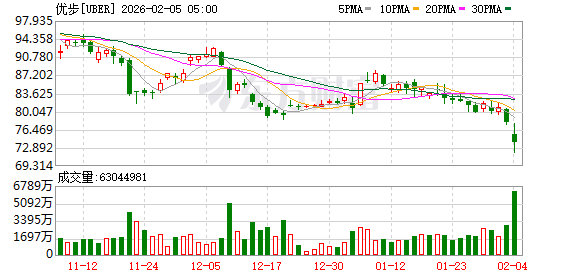
Uber第四季度净利暴跌96%,押注自动驾驶
Di Yi Cai Jing Zi Xun· 2026-02-05 01:57
Core Insights - Uber's Q4 2025 revenue increased by 20% year-over-year to $14.4 billion, but net profit dropped by 96% to $296 million, influenced by tax valuation releases and investment re-evaluations [1] - The company reported a 22% increase in order volume to 3.8 billion, driven by an 18% rise in monthly active platform users (MAPC) to 200 million [1] Financial Performance - Q4 2025 net profit included a $6.4 billion gain from tax valuation releases and a $556 million pre-tax gain from investment re-evaluations, while the non-GAAP net profit rose by 25% to $1.5 billion [1] - The stock price fell over 5% following the announcement of the net profit decline [1] User Growth Strategies - CEO Dara Khosrowshahi highlighted that product segmentation and market targeting have driven user growth, with lower-priced offerings like Moto attracting new user demographics [2] - New products such as "Reserve" and "Women Preferred" have successfully reached non-target user groups, including suburban residents and those with urgent travel needs [2] Autonomous Driving Initiatives - The company sees autonomous vehicles as a significant opportunity for customer acquisition, estimating trillions in potential market value [4] - Khosrowshahi noted that the autonomous driving sector will not have a single winner, with multiple suppliers like Pony.ai and WeRide developing their technologies [5] - Recent advancements include a partnership with NVIDIA for AI-driven autonomous technology and the establishment of AV Labs to enhance core capabilities in autonomous driving [5]

网经社2025《数字经济系列年终盘点&报告&百强榜》计划发布
Sou Hu Cai Jing· 2026-01-06 06:21
Core Insights - The company is launching the 2025 "Digital Economy Year-End Review & Report & Top 100 List"招商计划, covering various sectors such as digital retail, digital life, mobile travel, industrial e-commerce, cross-border e-commerce, digital education, digital health, and logistics technology [1][11] Group 1: Year-End Review Series - The company is initiating its 17th annual "Year-End Review" series, which aims to provide a professional retrospective and trend prediction rather than just a simple listing of events [2] - The series will include significant events in various sectors, including fresh e-commerce, digital retail, content e-commerce, second-hand e-commerce, logistics technology, AI e-commerce, and major players like Alibaba, Pinduoduo, and JD [5][6] Group 2: Reports and Rankings - The company will release the 2025 annual series of reports and rankings, utilizing its self-developed e-commerce database "DianShuBao" and various research methods such as data analysis, partner surveys, platform evaluations, user surveys, and expert interviews [9][12] - The reports will cover a wide range of topics, including market data reports for various sectors like cross-border e-commerce, digital health, and digital education, as well as investment and financing reports [16][17] Group 3: Publication Channels - The reports and rankings will be published through multiple channels, including the company's own media, self-media matrix, and a registered user base of over 500,000, which includes government departments, investors, and e-commerce service providers [20][25] - The annual reports and rankings are considered influential indicators in the e-commerce and digital economy sectors, useful for public relations, financing endorsement, brand promotion, and market research [36]

【环球财经】银河国际:Grab第三季度业绩超预期 上调目标价至7.20美元
Xin Hua Cai Jing· 2025-11-05 11:15
Core Viewpoint - Grab Holdings reported strong Q3 2025 performance, exceeding market expectations in revenue and adjusted EBITDA, leading to an upgraded target price from $7.00 to $7.20 by CGS International [2] Group 1: Financial Performance - Q3 revenue reached $873 million, representing a 7% quarter-over-quarter increase and a 22% year-over-year increase [2] - Adjusted EBITDA was $136 million, with a 25% quarter-over-quarter growth and a 51% year-over-year growth, surpassing expectations from CGS International and Bloomberg [2][3] Group 2: Business Drivers - Strong growth in Grab's core businesses, Deliveries and Mobility, contributed to robust GMV growth both year-over-year and quarter-over-quarter [2] - Key drivers included higher user engagement, product innovations like GrabMart and Saver, increased advertising penetration among merchant partners, and strong loan issuance in the financial services sector [2] Group 3: Financial Services and Future Outlook - In the financial services segment, loan issuance grew by 23% quarter-over-quarter and 56% year-over-year, with management confident in achieving breakeven by the second half of 2026 [3] - CGS International raised Grab's EPS expectations, anticipating positive adjusted EBITDA across all business segments by FY 2027 [3]
韩政府公布150万亿韩元规模国家增长基金方案
Shang Wu Bu Wang Zhan· 2025-09-15 16:03
Group 1 - The South Korean government announced an increase in the National Growth Fund to 150 trillion KRW, with 75 trillion KRW sourced from pension funds, financial institutions, and private capital, and the remaining 75 trillion KRW established by the Korea Development Bank (KDB) for advanced strategic industry funding [1] - The National Growth Fund will support key industries aligned with President Lee Jae-myung's vision of becoming one of the top three AI nations, achieving a potential growth rate of 3%, and ranking among the world's top five economies, with specific allocations of 30 trillion KRW for AI, 20.9 trillion KRW for semiconductors, 15.4 trillion KRW for mobile transportation, 11.6 trillion KRW for biotechnology and vaccines, and 7.9 trillion KRW for secondary batteries [1] - The Vice Chairman of the Financial Services Commission emphasized that the fund will prioritize large projects that can create significant ripple effects in the industry and serve as turning points for economic growth, aiming to create a "Korean version of Nvidia" [1] Group 2 - The financial industry suggests that to ensure participation and sustainability of the fund, tax incentives and a robust management system should be established to enhance fund returns [1]
东风日产启辰与哈啰达成战略合作
Zheng Quan Shi Bao Wang· 2025-09-12 09:49
Core Insights - Dongfeng Nissan's Venucia brand has officially entered into a strategic partnership with the domestic internet and mobility platform Hello, aiming to advance L4 level autonomous driving technology development, application, and commercialization [1] Group 1 - The partnership was announced at the Shanghai Bund Conference on September 11 [1] - A significant order of 10,000 units of the Venucia VX6 was signed as part of this collaboration [1] - The focus of the partnership is on promoting the research and development of autonomous driving technology [1]
嘀嗒顺风车,没人坐了吗?
凤凰网财经· 2025-08-27 14:01
Core Viewpoint - The article discusses the significant decline in the performance of Dida Chuxing, a leading ride-sharing platform, highlighting the challenges it faces in a competitive market and the impact of macroeconomic changes on its business model [5][10][36]. Group 1: Business Performance - Since its IPO in June 2024, Dida Chuxing has experienced a substantial decline in business performance, with a 30% drop in ride-sharing volume and nearly a 35% decrease in GMV [5][9]. - In the first half of 2025, the company's revenue was 286 million yuan, a year-on-year decrease of 29.1%, while net profit plummeted by 86.0% to 135 million yuan [9]. - Despite a growing user base, with registered users increasing to 395 million by June 2025, this has not translated into business growth, as order volume fell by 30% to 43.2 million [9][10]. Group 2: Market Challenges - The ride-sharing market is facing significant pressure due to a changing macroeconomic environment, leading to a contraction in the overall market and a decrease in user engagement [10][11]. - Dida Chuxing's reliance on a commission-based revenue model has proven insufficient for sustaining growth, especially as competitors enter the market with more diversified offerings [6][24]. - The entry of major players like Didi and Meituan into the ride-sharing space has intensified competition, putting Dida at a disadvantage [25][26]. Group 3: Financial Metrics - Dida Chuxing's ride-sharing business maintains a gross margin of 67.2%, despite a 7 percentage point decline year-on-year [13]. - The company's advertising revenue remains minimal, contributing only 9.2 million yuan in the first half of 2025, a decrease of 22.1% [15]. - The smart taxi business, while expanding to 96 cities, has not significantly contributed to revenue and has been a drain on profitability, with a revenue of only 249.7 thousand yuan and a gross margin of -42.3% [14]. Group 4: Strategic Positioning - Dida Chuxing was initially successful in the ride-sharing market due to a lack of competition, but as the market has normalized, it faces challenges from larger competitors who have integrated ride-sharing into their broader service offerings [22][24]. - The company has attempted to diversify by entering the smart taxi market, but this strategy has not gained market acceptance and has led to operational inefficiencies [30][32]. - The stock price has dropped significantly from its IPO price of 6 HKD to 1.32 HKD, reflecting investor concerns about the company's future prospects [33].

顺风车,没人坐了吗?
3 6 Ke· 2025-08-27 00:24
Core Viewpoint - Dida Chuxing, as a leading ride-sharing platform, has faced significant business and performance declines since its IPO in June 2024, reflecting broader challenges in the ride-sharing market [1][3][2] Business Performance - In the first half of 2025, Dida's revenue was 286 million yuan, a year-on-year decrease of 29.1%, while net profit fell by 86.0% to 135 million yuan [4] - The core ride-sharing business has been under pressure, with order volume dropping by 30.0% to 43.2 million and overall transaction value decreasing by 34.9% to 2.608 billion yuan [5] - Despite a growing user base, with registered users increasing from 368 million in June 2024 to 395 million in June 2025, this has not translated into sustained business growth [4] Market Environment - The overall ride-hailing market is experiencing contraction, with the user base at 511 million as of June 2025, showing a decline in growth rate and the lowest usage rate of 45.6% since the end of 2023 [5][6] - The decline in ride-hailing prices, the entry of Robotaxi brands, and increased penetration of public transport and private cars are impacting the usage rate of ride-sharing services [6] Profitability and Revenue Streams - Dida's ride-sharing business maintains a high gross margin of 67.2%, despite a year-on-year decline of 7 percentage points [8] - Revenue from the ride-sharing segment was 275 million yuan, with a segment profit of 172 million yuan, resulting in a net margin of 62.5% [8] - The company's taxi-hailing business, which operates in 96 cities, has not significantly contributed to revenue and has been eroding profitability, with revenue of 249,700 yuan, down 19.4% [8] Competitive Landscape - Dida faces increasing competition from major players like Didi, Gaode, and others who are expanding their ride-sharing services, putting pressure on Dida's market position [14] - The shift in the market dynamics has led to a situation where Dida's core business is being challenged by competitors who have more resources and diversified service offerings [14][19] Strategic Direction - Dida has recognized the limitations of a single business model and has attempted to diversify by exploring taxi-hailing services since 2017, but this has not gained market acceptance [14][15] - The company is under pressure to reassess its business direction to maintain competitiveness in a rapidly evolving market [19]