风吃海带

Search documents
卫龙:魔芋赛道打开长期增长空间,面制品26年有望迎来边际改善-20260323
海通国际· 2026-03-23 13:35
Investment Rating - The report maintains an "OUTPERFORM" rating for the company, with a target price of HK$12.13, indicating a potential upside of 14.6% from the current price of HK$10.17 [1]. Core Insights - The company is positioned as a leading player in the spicy snack food sector and a pioneer in konjac products, with growth driven by both vegetable and flour products. The konjac segment is expected to open long-term growth opportunities, while the flour products are anticipated to see marginal improvements in 2026 [1][2]. - Revenue projections for the company are set at RMB 7,345 million for 2025, RMB 8,211 million for 2026, and RMB 9,087 million for 2027, reflecting year-on-year growth rates of 17.2%, 11.8%, and 10.7% respectively. Net profit is expected to reach RMB 1,387 million in 2025, RMB 1,575 million in 2026, and RMB 1,768 million in 2027, with growth rates of 29.9%, 13.6%, and 12.3% respectively [1][14]. Summary by Sections Company Overview - The company has transitioned from a focus on flavored noodle products to vegetable-based products, with konjac and seaweed becoming core revenue drivers. In the first half of 2025, vegetable products accounted for 61% of revenue, expected to rise to 63% for the full year [2][10]. - The company has achieved a compound annual growth rate (CAGR) of 49.8% in vegetable products from 2018 to 2024, significantly outpacing other categories [10]. Product Strategy - The flavored noodle segment is undergoing a strategic optimization, with a reduction in SKUs to enhance profitability. This is expected to lead to marginal improvements in 2026 as new products are launched and the low base effect takes hold [3][14]. - The company is focusing on launching new products, such as the "high-fiber mushroom konjac," which debuted in Sam's Club, reinforcing its competitive edge in the konjac market [2]. Financial Performance - The company has demonstrated strong financial performance, with a revenue of RMB 6,266 million in 2024, a 28.63% increase year-on-year. The net profit for the same year was RMB 10.7 billion, with a net profit margin of 17.0% [8][19]. - The gross profit margin for 2024 was reported at 48%, significantly higher than the industry average of around 30% [19]. Market Position and Growth - The company has established a robust distribution network, primarily through offline channels, with a significant presence in East and South China. The company is also expanding its online sales through platforms like Tmall and JD.com [30][34]. - The company has plans for further expansion, including a new factory in Nanning, which is expected to enhance production capacity and efficiency [42]. Cost Management - The company has maintained stable raw material prices, which is expected to support gross margin growth. Key raw materials like soybean oil and flour have shown price stability, contributing to the overall cost management strategy [45].
卫龙美味(09985):魔芋赛道打开长期增长空间,面制品26年有望迎来边际改善
Haitong Securities International· 2026-03-23 11:03
Investment Rating - The report maintains an "OUTPERFORM" rating for Weilong Delicious Global Holdings with a target price of HK$12.13, indicating a potential upside of 14.6% from the current price of HK$10.17 [1]. Core Insights - Weilong is positioned as a leading player in the spicy snack food sector and a pioneer in konjac products. The company's growth is driven by two main segments: vegetable products and flour products. The vegetable segment, particularly konjac, is expected to see robust growth, while the flour products segment is anticipated to experience marginal improvement in 2026 due to product optimization and new launches [1][2][3]. Revenue and Profit Forecast - Revenue projections for Weilong from 2025 to 2027 are as follows: Rmb 7,345 million in 2025, Rmb 8,211 million in 2026, and Rmb 9,087 million in 2027, reflecting year-on-year growth rates of 17.2%, 11.8%, and 10.7% respectively. Net profit is expected to reach Rmb 1,387 million in 2025, Rmb 1,575 million in 2026, and Rmb 1,768 million in 2027, with growth rates of 29.9%, 13.6%, and 12.3% respectively [1][14]. Product Segmentation - The vegetable products segment, which includes konjac and kelp, has become the core revenue driver, accounting for 61% of revenue in the first half of 2025, with expectations to rise to 63% for the full year. This segment has a compound annual growth rate (CAGR) significantly higher than other categories, indicating its role as the main engine for the company's performance [2][10]. - The flour products segment is undergoing a strategic optimization, with a focus on reducing the number of SKUs to enhance profitability. This is expected to lead to marginal improvements in 2026 as new products are launched and the low base effect comes into play [3][14]. Market Trends and Competitive Position - The domestic snack food market is expanding steadily, with trends towards health and branding aligning well with Weilong's product transformation. The konjac products, known for their low-calorie and high-fiber benefits, are gaining popularity in the snack food category [2][3]. - The company has successfully transitioned from a focus on flavored flour products to vegetable-based products, with vegetable product revenue growing from Rmb 3.0 billion in 2018 to Rmb 33.7 billion in 2024, representing a CAGR of 49.8% [10][14]. Financial Performance - Weilong's gross profit margin was reported at 48% in 2024, outperforming peers in the snack food industry, which typically hover around 30%. The net profit margin was 17%, slightly above comparable companies [19]. - The company has maintained a strong financial performance, with net profit reaching Rmb 10.7 billion in 2024, reflecting a steady increase in operational efficiency and profitability [8][19]. Sales Channels and Distribution - The company primarily relies on offline distribution channels, with a significant presence in the East and South China regions. As of mid-2025, Weilong had partnered with 1,777 offline distributors, covering major supermarkets and convenience stores [30][32]. - Online sales have also been growing, with a focus on platforms like Tmall and JD.com, as well as social media channels like Douyin and Kuaishou, to reach younger consumers [31][35]. Production Capacity and Efficiency - As of mid-2025, Weilong operates five production bases in Henan Province, with overall capacity utilization rates exceeding 75%. The company is investing in automation and digital upgrades to enhance production efficiency [42][44]. - The company has plans for further expansion, including a new factory in Nanning, which is expected to enhance production capabilities and support business growth [42].
卫龙美味(09985.HK):从单极领先到双轮驱动 以美味勾勒品类扩张新路径
Ge Long Hui· 2025-09-28 03:24
Core Viewpoint - The company has successfully transformed from a street snack into a national business over the past two decades, with a strong focus on product innovation, channel expansion, and governance efficiency [1][2] Group 1: Product and Revenue - The classic spicy strips continue to provide stable cash flow, while vegetable products like konjac and seaweed snacks are capturing the growing health-conscious demand, with projected revenue of 3.37 billion yuan in 2024, accounting for 54% of total revenue [1] - The spicy strip industry is experiencing expansion, with the company leading in the sweet and spicy segment, supported by a differentiated product strategy that includes five major flavor types [1][2] Group 2: Channel Strategy - The company has a solid foundation in traditional retail channels such as supermarkets and convenience stores, while rapidly expanding into bulk snacks and live e-commerce, achieving 94 live broadcasts on Douyin in 90 days [1] - The company employs a dual-channel strategy to enhance control over distributors, with the number of cooperative distributors increasing to 1,879, a year-on-year growth of approximately 10% [1] Group 3: Supply Chain and Governance - The company operates five direct-owned factories in Henan and has introduced 5G production lines, which have reduced costs and ensured food safety [1] - Family ownership of 78% enhances decision-making efficiency, and equity incentives are in place to bind the core team for future expansion [1] Group 4: Growth Potential in Konjac Products - The konjac food segment has shown a compound annual growth rate of over 20% from 2014 to 2023, indicating significant market potential [2] - The company is focusing on enhancing flavor research and expanding its product offerings to solidify its leading position in the konjac market [2] Group 5: Financial Projections - Revenue projections for the company are 7.517 billion yuan, 9.019 billion yuan, and 10.630 billion yuan for 2025, 2026, and 2027, respectively, with year-on-year growth rates of 20.0% for the first two years and 17.9% for 2027 [2] - Expected net profit for the same years is 1.408 billion yuan, 1.739 billion yuan, and 2.151 billion yuan, with growth rates of 31.8%, 23.5%, and 23.7% respectively [2]
国投证券:予卫龙美味“买入-A”评级 目标价14.27港元
Zhi Tong Cai Jing· 2025-09-26 07:44
Company Overview - Guotou Securities has issued a "Buy-A" investment rating for Weilong Delicious (09985) with a 6-month target price of HKD 14.27 [1] - The classic spicy strips continue to provide stable cash flow, while vegetable products like konjac and seaweed snacks are capturing the health-conscious demand, with projected revenue of CNY 3.37 billion in 2024, accounting for 54% of total revenue, marking the first time these products become the largest category [1] Industry Trends - The spicy strip industry is experiencing expansion, with flavor differentiation reshaping the competitive landscape, where Weilong's sweet and spicy flavor leads the market [2] - The industry has seen a compound annual growth rate (CAGR) of over 20% from 2014 to 2023, indicating a robust growth trajectory [3] Competitive Advantages - Weilong has established itself as a high-trust brand through automated and transparent factories, enhancing production efficiency [2] - The company employs a differentiated strategy with five major flavor categories: sweet, spicy, fragrant, durian spicy, and regional spicy, continuously innovating its product matrix [2] - Weilong has effectively turned spicy strips into a social currency among younger consumers, increasing user engagement [2] Distribution and Supply Chain - The company maintains a solid foundation in traditional channels such as supermarkets and convenience stores while rapidly expanding into bulk snacks and live e-commerce, with 94 live broadcasts on Douyin in 90 days, leading to a continuous increase in online sales proportion [1][2] - The number of cooperative distributors is expected to increase to 1,879 in 2024, a year-on-year growth of approximately 10% [2] - Weilong's supply chain includes five direct-operated factories in Henan, incorporating 5G production lines to reduce costs and ensure food safety [1] Future Outlook - The konjac food segment is still in its early growth phase, with significant market potential, and the versatility of konjac allows for extensive flavor innovation [3] - To maintain its leading position, Weilong needs to enhance flavor research and development, leverage its brand influence to promote new flavors, and expand its distribution network and SKU offerings [3]
国投证券:予卫龙美味(09985)“买入-A”评级 目标价14.27港元
智通财经网· 2025-09-26 07:43
Company Overview - Guotou Securities has given Wei Long Delicious (09985) a "Buy-A" investment rating with a 6-month target price of HKD 14.27 [1] - Wei Long's classic spicy strips continue to provide stable cash flow, while products like konjac snacks and seaweed cater to health-conscious consumers, with projected revenue of CNY 3.37 billion in 2024, accounting for 54% of total revenue, making it the largest product category for the first time [1] Industry Trends - The spicy strip industry is experiencing expansion, with flavor differentiation reshaping the competitive landscape, where Wei Long's sweet and spicy flavor leads in market size [2] - The industry has seen a compound annual growth rate (CAGR) of over 20% from 2014 to 2023, indicating robust growth potential [3] Competitive Advantages - Wei Long leverages automated and transparent factories to enhance production efficiency and establish itself as a high-trust brand among consumers [2] - The company employs a differentiated strategy with five major flavor categories: sweet, spicy, fragrant, durian spicy, and regional spicy, continuously innovating its product matrix [2] - Wei Long capitalizes on the social aspect of spicy strip consumption, positioning its products as social currency among younger consumers, thereby increasing user engagement [2] Distribution and Channel Strategy - Wei Long's traditional dual-channel strategy strengthens control over distributors, with the number of cooperative distributors expected to increase to 1,879 in 2024, a year-on-year growth of approximately 10% [2] - The company has established a multi-channel approach with "snack wholesale - online platforms - O2O," creating a comprehensive competitive advantage [2] Future Outlook - The konjac food segment is still in its early growth phase, with significant market potential, and the versatility of konjac allows for extensive flavor innovation in the midstream processing [3] - Wei Long is encouraged to enhance flavor research and development, fully utilize its brand influence to promote new flavors, and expand its distribution network and SKU offerings to solidify its leading position [3]
卫龙美味20250924
2025-09-26 02:29
Summary of Wei Long Mei Wei Conference Call Company Overview - Wei Long Mei Wei is a leading domestic spicy snack company that started with spicy strips and has expanded into vegetable products, achieving significant growth from 2018 to 2024 [2][7]. Key Points Industry Insights - The snack food industry is a massive market, potentially reaching a trillion yuan scale. Despite disruptions from the pandemic, the industry is expanding with steady economic growth [4]. - The market is fragmented, lacking the concentration seen in industries like liquor or beer, primarily due to diverse product attributes and regional tastes in China [4]. Company Performance - Revenue from vegetable products reached 3.5 billion yuan in 2024, a nearly 60% year-on-year increase, surpassing the revenue from noodle products for the first time [2][12]. - The company expects vegetable product growth to approach 50% in 2025, with a projected overall revenue increase of over 20% [5][16]. - Online sales grew nearly 40% year-on-year in 2024, accounting for about 10% of total revenue [5][15]. Product Development - Wei Long has successfully launched new vegetable products like konjac snacks, creating a second growth curve [2][8]. - The core product, spicy strips, remains stable despite competitive pressures, with new flavors introduced to maintain market leadership [10]. - Konjac products, particularly konjac snacks, have become a significant growth driver, benefiting from the rapid development of the domestic konjac industry [11]. Competitive Advantages - The company has a stable governance structure and an experienced management team, continuously introducing external talent [9]. - Wei Long employs intelligent production and modern channel management, demonstrating excellent cost control, which supports sustainable development [9]. Future Growth Potential - The company is exploring new growth avenues beyond spicy strips and konjac, including products like stinky tofu and seaweed [14]. - The management anticipates maintaining a net profit of over 1.35 billion yuan in 2025, increasing to around 2 billion yuan by 2027, with a corresponding price-to-earnings ratio of about 20 times [5][16]. Market Trends - The snack industry has undergone significant channel transformations, with rapid growth in offline emerging channels and online social e-commerce replacing traditional shelf e-commerce [6]. - Companies that adapt to these channel changes tend to achieve better growth [6]. Margin Management - Wei Long's choice of low-cost raw materials, such as noodle and konjac products, has helped maintain a gross margin close to 50%, which is higher than the overall company level [3][13]. Conclusion - Wei Long Mei Wei is well-positioned for continued growth in the snack food industry, leveraging its innovative product development, strong management, and effective channel strategies to capitalize on market opportunities and consumer trends [2][8][16].
半年挣35亿,魔芋爽养肥了卫龙
Xin Lang Cai Jing· 2025-08-25 09:17
Core Insights - The core viewpoint of the articles is that Wei Long's revenue structure is shifting, with vegetable products, particularly "Konjac Shuang," becoming the main growth driver, while traditional products like spicy strips are experiencing a decline in popularity [1][7][10]. Revenue Growth - In the first half of 2025, Wei Long achieved total revenue of approximately 3.483 billion yuan, a year-on-year increase of 18.5%, and a net profit of 733 million yuan, also up about 18% [1]. - The vegetable products segment's revenue reached 2.109 billion yuan, growing by 44.35% year-on-year, and accounted for 60.5% of total revenue, surpassing the contribution of other segments for the first time [3][11]. Product Segmentation - Wei Long's product lineup includes three main segments: spicy noodle products (spicy strips), vegetable products (Konjac Shuang, Wind Eating Seaweed), and bean products [2]. - The vegetable products segment has become the largest contributor to the company's performance, with its share exceeding that of spicy noodle products for the first time in 2024 [2]. Marketing and Branding - Wei Long has signed popular young actors as brand ambassadors for its key products, indicating a strategic focus on enhancing brand influence and expanding consumer reach [1]. - The marketing strategy emphasizes the low-calorie aspect of "Konjac Shuang," aligning with health trends, which has significantly contributed to its popularity [3]. Channel Strategy - The growth in revenue is primarily driven by offline channels, which contributed 3.147 billion yuan, a 21.5% increase, accounting for 90.4% of total revenue [5]. - Wei Long is actively expanding into emerging channels, such as snack wholesale stores, to meet consumer demand for quality and price [4]. Competitive Landscape - The spicy strip segment is facing challenges, with a decline in revenue and consumer complaints about taste and price [8][9]. - Competitors like Yan Jin Pu Zi are rapidly gaining market share in the vegetable product category, indicating increasing competition in this segment [10][11]. Management Changes - In 2025, Wei Long experienced significant changes in its executive team, with the CEO and CFO positions being filled by family members of the founding Liu brothers, indicating a strong family influence in management [12][13][15]. - The company is focusing on a multi-category product strategy, aiming to replicate the success of "Konjac Shuang" with new products like "Wind Eating Seaweed" [16][17].
魔芋零食收入激增155%,盐津铺子半年报亮眼
Mei Ri Jing Ji Xin Wen· 2025-08-21 08:02
Core Insights - The konjac snack segment has seen significant revenue growth, with companies reporting substantial increases in sales figures for these products [1][2]. Company Performance - Salted Fish (002847.SZ) reported that its konjac snack products generated revenue of 791 million RMB, accounting for 26.90% of total revenue, marking a year-on-year growth of 155.10% [1][4]. - Wei Long's parent company, Wei Long Mei Wei (09985.HK), reported a revenue of 2.11 billion RMB for its vegetable products segment, which includes konjac snacks, reflecting a year-on-year increase of 44.3% and representing 60.5% of total revenue [2][6]. Market Trends - The demand for konjac snacks is driven by their low-calorie and high dietary fiber attributes, leading to increased consumer interest [2]. - Despite the growth in konjac snack sales, the prices of raw materials, particularly konjac powder, have risen by over 30% year-on-year [2]. - The konjac snack market is expected to surpass traditional spicy strips in market size due to its diverse flavors and forms, appealing to a broader consumer base [2].

卫龙美味2025中期业绩稳增长第二曲线收入同比增长44.3%
Qi Lu Wan Bao· 2025-08-20 11:04
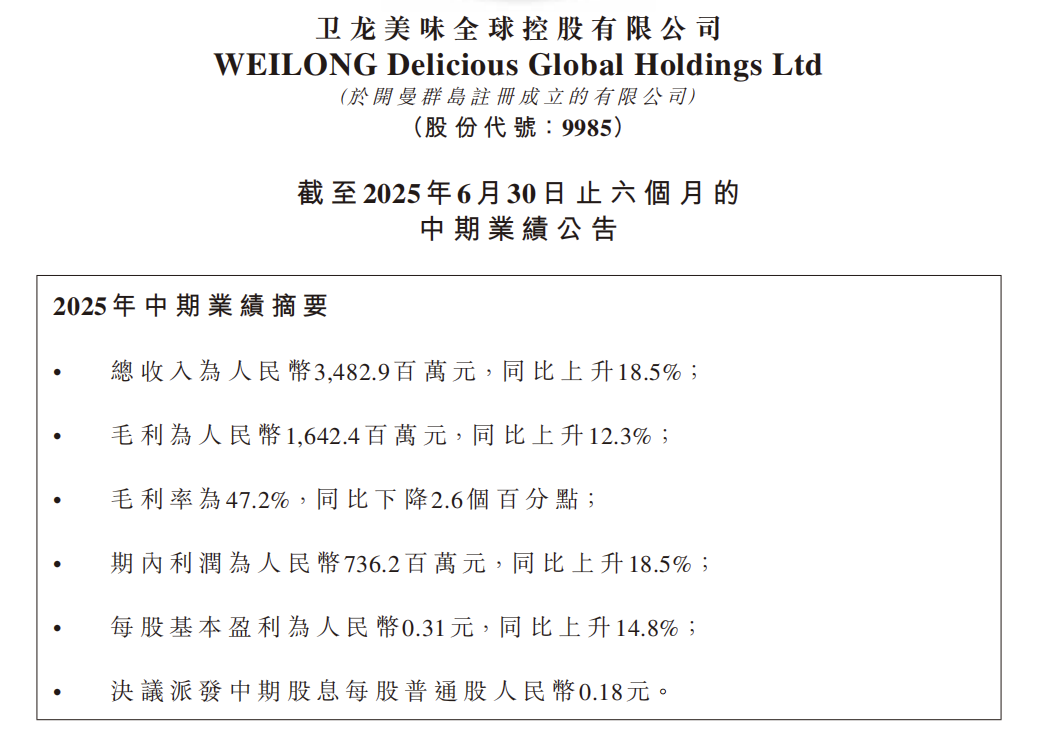
Core Insights - The company reported a total revenue of 3.483 billion RMB for the first half of 2025, reflecting an 18.5% year-on-year growth, with net profit also increasing by 18.5% to approximately 736 million RMB, showcasing strong operational efficiency and growth potential [1][4][12] Revenue and Profit Growth - The company achieved a total revenue of 3.483 billion RMB, with a net profit of approximately 736 million RMB, both showing double-digit growth compared to the previous year [1] - The core categories of the company demonstrated a structural growth pattern, contributing significantly to the overall revenue increase [3][4] Product Innovation and Market Expansion - The company launched several new products in the first half of 2025, including various flavors of snacks, which contributed to an accelerated market share expansion [3][4] - The vegetable product line, particularly the konjac snacks, generated over 2.1 billion RMB in revenue, marking a 44.3% increase year-on-year, and now accounts for 60.5% of total revenue [4][12] Channel Strategy and Marketing - The company has strengthened its omnichannel strategy, achieving over 3.4 billion RMB in revenue from both online and offline channels, with offline sales growing by 21.5% year-on-year [7][9] - The company has engaged in co-branding marketing strategies, collaborating with various brands to enhance its market presence and brand image [9][10] Production Efficiency and Sustainability - The introduction of the seventh-generation konjac production line has significantly improved production efficiency, doubling capacity while reducing the footprint by half [10][12] - The company has implemented smart technologies for energy monitoring and water-saving processes, aligning with green and low-carbon production goals [12] Future Outlook - The spicy snack market is projected to reach 132.38 billion RMB by 2029, indicating a robust growth trajectory for the industry [12] - The company aims to continue its multi-category strategy and deepen its structural transformation to maintain resilience in a competitive market [12]
卫龙2025半年报亮眼:蔬菜制品营收大增44.3%,千亿辣味零食赛道新格局浮现
Mei Ri Jing Ji Xin Wen· 2025-08-20 03:20
Core Viewpoint - Wei Long's performance report for the first half of 2025 shows a total revenue of 3.483 billion yuan, a year-on-year increase of 18.5%, and a net profit of 736 million yuan, also up 18.5%, indicating a steady growth trend. The company's revenue structure has shifted from a reliance on spicy strips to a diversified product range, with vegetable products now accounting for 60.5% of total revenue, highlighting significant changes in consumer preferences and market dynamics [1][3][4]. Part 1: Financial Performance - In the first half of 2025, Wei Long achieved a total revenue of 3.483 billion yuan, up from 2.939 billion yuan in the same period last year, marking an 18.5% growth. Net profit also increased by 18.5% to 736 million yuan, with basic earnings per share at 0.31 yuan, reflecting effective management of profitability during expansion [3][4]. - The gross profit for the first half reached 1.642 billion yuan, a 12.3% increase year-on-year, with a stable net profit margin of 21.1%, despite rising raw material costs [3][4]. - The board has declared an interim dividend of 0.18 yuan per share, maintaining a payout ratio of nearly 60%, consistent with its stable return strategy since listing [3]. Part 2: Product Structure Transformation - Wei Long's core product category, flavored noodle products, generated 1.31 billion yuan in revenue, accounting for 37.6% of total revenue. In contrast, vegetable products, primarily including konjac and seaweed, saw revenue soar by 44.3% to 2.109 billion yuan, now representing 60.5% of total revenue [4]. - The shift in product structure is attributed to Wei Long's precise response to changing consumer demands, focusing on health, personalization, and diverse consumption scenarios [4][6]. Part 3: Market Trends and Consumer Insights - The Chinese spicy snack food market is entering a golden growth period, with a projected compound annual growth rate of 9.6%, expected to reach a market size of 273.7 billion yuan by 2026 [11]. - The primary consumer demographic for spicy snacks is the post-90s and post-00s generations, with a notable preference for mild and fusion flavors [11][13]. - The demand characteristics include diversified consumption scenarios, quality upgrades, and emotional value addition, with Wei Long's strategies aligning well with these trends [14].