
飞书AI

Search documents
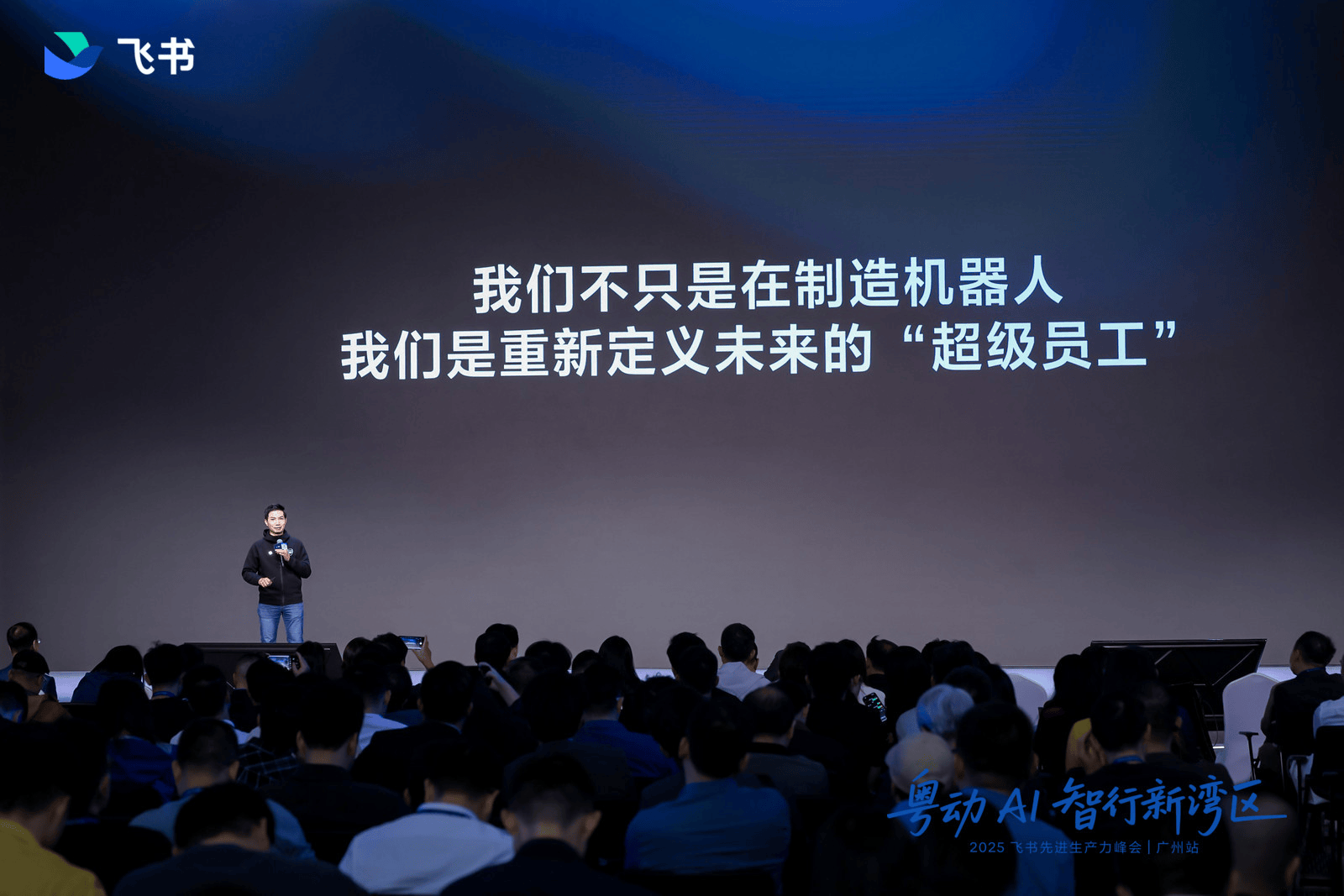
小鹏人形机器人里藏着一个“数字员工” 飞书发布“粤企一齐飞”加速计划
Sou Hu Cai Jing· 2025-12-19 08:47
Group 1 - The 2025 Feishu Advanced Productivity Summit in Guangzhou focused on the organizational upgrade of the "Physical AI" industry in the Greater Bay Area, attracting hundreds of executives, government representatives, and industry experts from sectors like new energy vehicles and intelligent driving [1][3] - Physical AI, proposed by Swiss scholars in 2020, is a core development direction of AI, enabling intelligent systems to understand physical laws and interact with the real world, widely applied in robotics and autonomous driving [3] - Feishu aims to help enterprises achieve "software-defined organizations," with AI deeply integrated into core manufacturing processes, evidenced by significant efficiency improvements in companies like Geely and Bull [3] Group 2 - Companies like Xiaopeng Motors and Ximalaya shared their experiences at the summit, addressing the complexities of hardware-software collaboration and knowledge management in the Physical AI field [4] - Xiaopeng's IRON digital employee integrates knowledge and data from various sources, resulting in cost savings of 1 million yuan annually and a 30% reduction in service desk processing time [6] - Ximalaya's use of Feishu has enhanced global collaboration and significantly compressed the development process of their seventh-generation Robotaxi, while also activating a vast knowledge base for new employees [7] Group 3 - The summit introduced the "Yueqi Yiqi Fei" efficiency acceleration plan, promoting the widespread penetration of AI technology in the manufacturing industry through benchmarking and AI inclusivity [7]


从“车间老师傅”到“门店销冠”:飞书AI正在重塑吉利汽车研究院、亚朵酒店的一线战场
Jiang Nan Shi Bao· 2025-12-02 07:32
Core Insights - The article highlights the role of frontline business personnel as the true drivers of the AI technological transformation, showcased through the first "Feishu AI Efficiency Pioneer National Competition" in East China, where six notable companies advanced to the finals with innovative AI applications [1] Group 1: Service Industry Empowerment - AI is significantly enhancing efficiency in service industries by standardizing operations and improving employee training, as demonstrated by Luolai Super Soft Bedding's AI "Magic Mirror" system, which automates appearance checks and has led to increased sales and operational efficiency [1] - The "Yadu 1900+ Store AI Food Safety Guardian Plan" by Yadu Hotel integrates multiple technologies to create an intelligent management loop, reducing manual workload and providing valuable insights for management [2] Group 2: Manufacturing Innovation - In the manufacturing sector, AI is breaking traditional models, as seen with Geely Automobile Research Institute's intelligent size detection system, which has halved measurement time and significantly improved efficiency while saving labor costs [3] - Yongzhuo Holdings has utilized AI to address challenges in steel production, creating a smart management system that provides real-time alerts and actionable insights, transforming experience-based decision-making into data-driven strategies [3] Group 3: Cross-Industry Integration - AI is proving to be a universal capability that transcends specific industries, as evidenced by Jitu Express's use of AI for video production, enhancing exposure while reducing costs, and New City Holdings' development of an intelligent operational platform that integrates previously isolated data systems [4] - The practices of these six East China companies illustrate that AI is no longer a distant concept but a practical tool embedded in various business scenarios, setting the stage for a nationwide impact as they approach the finals [4]
