首赛尔纤维

Search documents
化工新材料龙头,总经理辞职!
DT新材料· 2026-03-20 16:05
Core Viewpoint - The article discusses the recent leadership change at Xinxiang Chemical Fiber and highlights the company's strong performance and innovative developments in sustainable fiber materials, positioning it as a leader in the biomass cellulose fiber industry in China [3][5][12]. Company Overview - Xinxiang Chemical Fiber, established in 1960 and listed in 1999, is a leading enterprise in textile raw materials production in China, with a wide range of products including the "Egrets" brand of regenerated cellulose filament and spandex [4]. Financial Performance - In Q3 2025, Xinxiang Chemical Fiber reported revenue of 2.002 billion yuan and a net profit of 70.475 million yuan, marking a year-on-year growth of 47.44%. As of March 20, the company's market capitalization stood at 11.5 billion yuan [5]. Innovative Developments - The company has successfully launched several innovative products in 2025, including: - Shucel Fiber, developed in collaboration with the Chinese Academy of Sciences, which features zero emissions during production [7]. - Ruisel Fiber, which utilizes a proprietary DT composite solvent technology to recycle over 20 million tons of waste textiles generated annually in China [8]. - Jungrass Fiber, made from Jungrass, addresses sustainability issues in the regenerated cellulose industry and has applications in underwear, bedding, and medical dressings [9]. Investment and Expansion Plans - On March 2, 2026, the company announced a capital increase of 300 million yuan to its two wholly-owned subsidiaries in Xinjiang for the construction of a 30,000-ton biomass cellulose fiber project [10]. - During the National People's Congress in 2026, the chairman revealed plans for a 100,000-ton Jungrass Fiber project to commence in Tumu Shuke City, Xinjiang [11]. Policy and Industry Support - The national government supports sustainable fiber development, as indicated by the "14th Five-Year Plan" which outlines the direction for the biomass materials industry [12]. - Significant research initiatives are underway, focusing on high-performance fibers, bio-based and recycled fibers, and smart fibers [12]. Market Trends and Challenges - The article notes that the biomass materials industry is transitioning from concept to large-scale application, with several companies making strides in bio-based nylon, PLA, and PTT materials [13]. - Despite a solid foundation for development, challenges remain, including immature production technologies, high product prices, and an incomplete product standard system [13].


10万吨项目动工!生物基纤维龙头又有大动作
DT新材料· 2026-03-06 16:04
Core Insights - The article focuses on the sustainable carbon industry in China, particularly in the field of bio-based and recycled materials, as well as CO₂ conversion [2] Group 1: Company Developments - Xinxiang Chemical Fiber, a leader in the bio-based fiber industry, announced a significant project involving 100,000 tons of mushroom grass fiber to be launched in Tumu Shuke City, Xinjiang [5] - The company has increased its investment by 300 million yuan in two wholly-owned subsidiaries in Xinjiang, supporting the construction of a 30,000-ton bio-based cellulose fiber project [7][9] - Xinxiang Chemical Fiber's revenue for the first three quarters of 2025 reached 310 million yuan, with a net profit of 51.53 million yuan, indicating a strong growth momentum [9] Group 2: Sustainable Fiber Initiatives - The company is focusing on three major green fibers: mushroom grass fiber, which offers sustainable raw material solutions and has applications in various sectors including medical [8] - The planned expansion of mushroom grass cultivation in Xinjiang aims to increase the planting area from 10,000 acres to 60,000 acres by 2026, potentially supporting nearly 200,000 tons of fiber production during the 14th Five-Year Plan [9] Group 3: Industry Trends and Government Support - The shift from "technology validation" to "scale realization" in the bio-based fiber sector is highlighted by Xinxiang Chemical Fiber's 47.44% year-on-year revenue growth, reaching 2 billion yuan in Q3 2025 [10] - The national strategy recognizes the importance of high-efficiency bio-synthesis theories for new fiber materials, indicating strong governmental support for the industry [10] - Various companies are advancing in the bio-based materials sector, with significant investments and projects underway, including the establishment of integrated industrial bases for bio-based nylon and PLA fibers [13]

全球首个!中国科研团队实现离子液体法再生纤维素纤维规模化生产
Zhong Guo Xin Wen Wang· 2025-07-03 10:59
Core Viewpoint - The successful industrialization of ionic liquid-based regenerated cellulose fiber technology marks a significant breakthrough in green fiber production, with the first demonstration project achieving an annual output of 1,000 tons in Henan [1][3]. Group 1: Technology and Innovation - The project is the world's first to achieve large-scale production of regenerated cellulose fibers using ionic liquid technology, overcoming traditional spinning process and environmental challenges, resulting in zero emissions of wastewater, waste gas, and solid waste [3][5]. - The ionic liquid team, led by academician Zhang Suojiang, has spent over a decade addressing various scientific challenges, including ionic liquid design, cellulose dissolution mechanisms, and spinning processes, culminating in a new technology for dissolving cellulose and green spinning [3][5]. Group 2: Environmental Impact - The newly developed technology is expected to reduce carbon dioxide emissions by 5,000 tons annually compared to traditional fossil fibers, with a solvent recovery rate exceeding 99% [5]. - The project sets a benchmark for the industrialization of new green technologies, providing sustainable options for the textile industry and contributing to China's carbon peak and carbon neutrality goals [5]. Group 3: Market Potential - Regenerated cellulose fibers, derived from natural plant cellulose, possess excellent moisture absorption, breathability, and a silk-like luster, indicating strong market potential in the textile sector [3]. - Common products in the market include viscose, modal, and lyocell, which are expected to benefit from the advancements in ionic liquid technology [3].
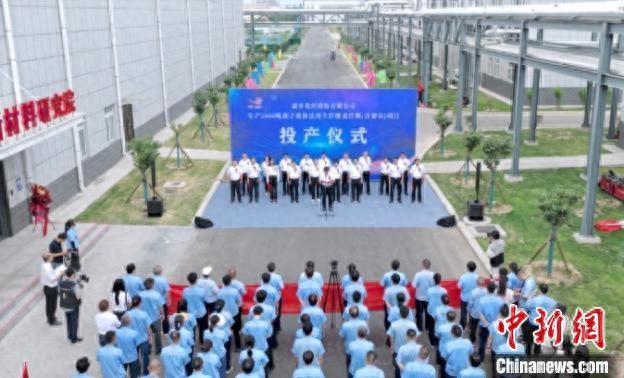
全球首个千吨级离子液体纺丝项目投产
Zhong Guo Hua Gong Bao· 2025-06-24 04:17
Core Viewpoint - The successful launch of the world's first thousand-ton ion liquid method regenerated cellulose fiber project marks a significant breakthrough in green fiber technology, achieving zero emissions of waste and a solvent recovery rate exceeding 99% [1][2]. Group 1: Project Overview - The project, located in the Baijun Biobased New Materials Industrial Park of Xinxiang Chemical Fiber Co., Ltd., has an annual production capacity of 1,000 tons of regenerated cellulose fiber using the ion liquid method [1]. - The project utilizes a full-process technology developed by Academician Zhang Suojiang's team, which addresses various technological challenges over a decade, including ion liquid design, cellulose dissolution mechanisms, and spinning processes [1][2]. Group 2: Environmental Impact - The ion liquid method completely eliminates reliance on strong acids and bases, as well as the environmental issues associated with waste gas and wastewater emissions, setting a new benchmark for sustainable development in the regenerated cellulose fiber industry [2]. - The project is seen as a significant contribution to achieving the "dual carbon" goals of the country, enhancing the global green competitiveness of China's textile industry [2]. Group 3: Future Prospects - Plans are underway for a ten-thousand-ton production line, indicating the project's potential for further scaling and market application [2]. - The project is expected to lead to increased market preference for the new fiber due to its superior performance and environmental benefits, driving a trend towards green consumption [2].
两会|锚定新质生产力 代表委员“把脉开方”促发展
证券时报· 2025-03-03 00:34
Core Viewpoints - The upcoming National Two Sessions in 2025 are expected to focus on themes such as new productive forces, artificial intelligence, and the silver economy, as indicated by proposals from industry representatives [1][2]. Group 1: Industry Insights - Industry representatives are actively conducting research and discussions to address industry pain points and enhance the practicality of their proposals for industrial transformation and high-quality development [2][4]. - The textile industry is facing challenges such as homogenized competition, but there are opportunities arising from the popularity of national style clothing and increasing prices of regenerated cellulose fiber, which is expected to boost industry prosperity [7]. - The focus on the silver economy is highlighted by representatives like the chairman of Jiangsu Variety Group, who emphasizes the importance of addressing aging society challenges and developing the silver economy [8]. Group 2: Proposals and Recommendations - Proposals include prioritizing the development of intelligent elderly care robots as a key direction for new productive forces, aiming to leverage the vast silver market in China [8]. - Recommendations for the textile industry include enhancing the export of domestic high-performance fibers, promoting the recycling of used textiles, and accelerating the development of the mushroom grass fiber industry [7]. - The need for national standards in the equipment machinery industry is emphasized to ensure quality and reliability in intelligent equipment, with a call for the establishment of relevant standards [10][11].