麻辣王子辣条

Search documents
2026年湖南食品行业发展趋势暨《2025年湖南食品线上品牌TOP30榜单》发布
Zhong Guo Shi Pin Wang· 2026-02-02 07:01
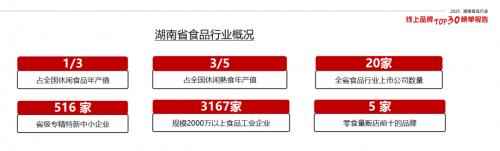
Core Insights - Hunan's food industry is transforming from an "industrial province" to a "brand powerhouse," significantly impacting China's snack food competition landscape [1] - Hunan contributes one-third of the national snack food annual output value and three-fifths of the prepared food output value, with 20 listed food companies and over 3,167 food industrial enterprises [1] - The "Hunan power" is evident as four of the top ten snack brands in the country are registered in Hunan, with one founded by a Hunan native [1] Industry Performance - The Hunan food industry has shown remarkable growth, with a focus on brand innovation and resilience among local brands [2] - A collaborative effort has led to the creation of the "2025 Hunan Food Industry Online Brand TOP30 List," which categorizes brands into growth-oriented and emerging brands [2][4] - The list includes 27 established brands and 3 new rising stars, reflecting both long-term strength and innovative potential in the Hunan food sector [2] Brand Analysis - The 30 selected brands span various categories, including snacks, condiments, grains, dairy, ready-to-eat meals, and beverages, showcasing a diverse competitive landscape [5] - Growth-oriented brands serve as the backbone of Hunan's food industry, characterized by mature product systems, stable supply chains, and strong user bases [6] - Emerging brands, established within the last two years, leverage precise market positioning and innovative product strategies to disrupt the market [8] Industry Trends - Health and functionality upgrades are becoming standard as consumer awareness of health increases, with brands reducing additives and enhancing nutritional content [12] - Standardization of flavors and category innovation are key trends, with brands like Jin Zai Food ensuring consistent taste through modern production techniques [13][15] - The rise of live e-commerce is transforming brand engagement, shifting from influencer-driven sales to direct brand interactions and multi-channel strategies [16] - Precision marketing targeting specific consumer segments and scenarios is essential for brand survival in a competitive market [17] Strategic Recommendations - Companies should focus on creating a strong flavor IP, deepening user engagement, and collaborating within the industry to enhance brand recognition [18] - Product development should prioritize health, functionality, and innovative flavor profiles to meet evolving consumer demands [19] - A dual-channel strategy combining live e-commerce with targeted marketing across various platforms will optimize brand reach and consumer retention [19] Conclusion - The release of the "2025 Hunan Food Industry Online Brand TOP30 List" marks a significant milestone in Hunan's transition from scale advantages to brand advantages [21] - Hunan food brands are poised to write a "Hunan flavor legend" in the national market, driven by health, standardization, and precision marketing trends [21]

湖南父子卖辣条,年入15亿
创业家· 2025-12-04 10:15
Core Viewpoint - The article highlights the transformation of the "spicy strip" industry, focusing on the journey of the brand "Mala Prince" and its founder Zhang Yudong, who turned a low-cost snack into a billion-dollar business through innovation and strategic decisions [4][10][23]. Group 1: Company Transformation - Zhang Yudong transitioned from a struggling tea factory to producing spicy strips in 2002, achieving annual sales exceeding 1.5 billion yuan by 2024 [4][13]. - In 2013, despite generating over 300 million yuan from the main product "Ruyi Stick," Zhang decided to shut down production to focus on healthier, authentic spicy strips, investing 30 million yuan in a GMP-compliant clean workshop [10][11]. - The company faced financial difficulties from 2013 to 2019, with cash flow issues leading Zhang to mortgage properties and sell cars to pay salaries [12][13]. - A regulatory change in 2019 allowed Mala Prince to capitalize on its early investments in technology, leading to a revenue surge from 1.9 billion yuan in 2019 to over 10 billion yuan in 2023 [13][14]. Group 2: Succession and Innovation - Zhang Yudong's son, Zhang Zilong, initially unaware of the family's wealth, has taken on a leadership role, emphasizing a "creative second generation" approach [15][16]. - Under Zhang Zilong's leadership, the brand has implemented youth-oriented marketing strategies, including large-scale events like "spicy strip weddings" and collaborations with influencers, increasing online sales from 9% to 20% [18][19]. - The company plans to launch a "super spicy strip factory" with a 2.35 billion yuan investment, aiming for an annual production capacity of 250,000 tons [22][23]. Group 3: Industry Overview - The spicy strip market, which originated in 1998, has grown significantly, with projections estimating a market size of 61.51 billion yuan in 2024, increasing to 73.38 billion yuan by 2029 [22]. - Mala Prince holds a dominant market share of 57.9% in the spicy strip segment, reflecting its successful branding and product innovation [22].

600次求职失败,00后回家接手200亿「辣条帝国」
创业家· 2025-10-02 09:55
Core Viewpoint - The article discusses the story of Zhang Zilong, who unexpectedly discovered his family's wealth and the transformation of the "spicy strip" industry, highlighting the generational shift in leadership and innovation within family businesses in China [5][6][30]. Group 1: Zhang Zilong's Discovery and Business Growth - In 2023, Zhang Zilong learned he was the heir to a billion-dollar spicy strip empire, which had annual revenues exceeding 1 billion yuan [6][7]. - The "Spicy Prince" brand, under Zhang's leadership, achieved a revenue of 1.5 billion yuan in 2024, with a goal of 300 million yuan in e-commerce sales by 2025 [7][20]. - Zhang Zilong's parents implemented a rigorous ten-year training plan for him to prepare for his role as the company's general manager [8]. Group 2: The Evolution of the Spicy Strip Industry - The spicy strip industry has grown into a market worth over 60 billion yuan, with a trend towards healthier and more standardized products [22][23]. - The competition between northern brands like Weilong and southern brands like "Spicy Prince" illustrates the differentiation in consumer preferences and marketing strategies [23]. - "Spicy Prince" has positioned itself as a premium brand by focusing on authentic spicy flavors and quality, avoiding direct price competition with larger brands [23]. Group 3: The New Generation of Entrepreneurs - The rise of the "post-00s" generation in family businesses reflects a broader trend of young entrepreneurs stepping into leadership roles, often leveraging digital tools and social media for brand promotion [25][26]. - These new leaders, like Zhang Zilong, are not just inheritors but are actively innovating and expanding their family businesses into new markets and platforms [27]. - The article emphasizes the importance of responsibility and adaptability among the new generation, as they navigate the expectations set by their predecessors [27][28].