
3.2T NPO模块

Search documents
全球首款 3.2T NPO 模块,阿里云成功点亮
半导体行业观察· 2026-03-01 03:13
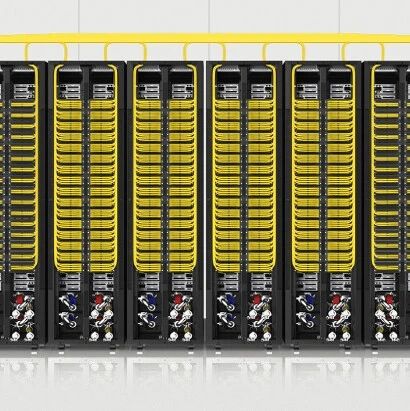
Core Viewpoint - The transition from copper to optical interconnects is essential for scaling up AI infrastructure, addressing limitations in bandwidth, latency, and operational complexity associated with copper interconnects [3][4]. Group 1: Current Challenges and Solutions - The current mainstream scale-up solutions rely on copper cabling, which, while cost-effective and low-latency, faces limitations in transmission distance, leading to increased complexity in manufacturing, wiring, power supply, and heat dissipation as systems scale [3]. - As clusters expand to hundreds or thousands of nodes, the physical coverage capability of copper interconnects approaches its limits, necessitating a shift to optical solutions for greater scalability and maintainability [3]. Group 2: UPN512 Architecture - Alibaba Cloud officially launched the UPN512 (Ultra-Performance Network for 512 xPU) architecture in October 2025, designed to create a large-scale, high-performance, reliable, low-cost, and easily expandable xPU interconnect system [4]. - UPN512 utilizes optical interconnects to directly connect xPUs with switches, employing a single-layer CLOS topology to achieve full interconnectivity for 512 xPUs, with future scalability to over 1,000 nodes [4]. Group 3: Key Technology - NPO - NPO (Near-Packaged Optics) is the core enabling technology of the UPN512 architecture, deploying optical engines close to the main chip and utilizing Linear Direct Drive technology to enhance bandwidth density and reduce reliance on advanced DSP chips [6]. - Compared to LPO (Linear-drive Pluggable Optics), NPO offers higher bandwidth density and lower requirements for the main chip's SerDes performance, promoting ecosystem development [6]. - NPO maintains an open decoupled characteristic with standard LGA connectors, making it more user-friendly for end-users compared to CPO (Co-Packaged Optics) [6]. Group 4: Performance Metrics - The 3.2T NPO module, developed by Alibaba Cloud, achieves a transmission bandwidth of 3.2Tb/s within a compact size of 22.5mm × 35.1mm, supporting both silicon photonics and VCSEL technology routes for various applications [9]. - The NPO module reduces power consumption by over 50% and costs by 30%, while maintaining end-to-end latency comparable to copper interconnects [10]. Group 5: Implementation and Future Plans - Alibaba Cloud has successfully implemented the 3.2T NPO technology in a new generation of domestic four-chip switches, achieving a total switching capacity of 102.4T, with potential upgrades to 409.6T [19]. - The switch operates with fine-grained port modes and maximizes single-chip Radix utilization, enhancing network scalability and flexibility while remaining compatible with existing MPO fiber optic cabling systems [20]. - Future plans include focusing on the stability and failure rate of NPO technology in long-term operations, which is crucial for the large-scale deployment of optical interconnects [27].

中信证券:阿里与腾讯押注NPO,关注Scale up网络发展机遇
Xin Lang Cai Jing· 2026-02-27 01:07
Core Viewpoint - The current AI computing network is undergoing a critical transition towards all-optical interconnection, with NPO technology emerging as an ideal compromise to overcome bandwidth physical limitations. Major tech giants like Alibaba and Tencent are accelerating the implementation and standardization of NPO architecture, indicating that this technology has entered the stage of large-scale commercialization [1][7]. Group 1: NPO Technology and Its Advantages - NPO technology demonstrates a strong balance in signal integrity, power consumption, and maintainability, making it a suitable solution for the extreme challenges posed by the evolution of large model architectures in AI [2][8]. - Compared to traditional high-power pluggable optical modules and CPO (Co-Packaged Optics) solutions, NPO (Near-Package Optics) offers significant advantages by relocating the optical engine closer to the switching chip, thus reducing signal transmission distance and power consumption while maintaining the independent replaceability of the optical engine [2][8]. Group 2: Major Players and Developments - Leading CSP manufacturers are rapidly advancing the application of NPO-related solutions. Alibaba has released the "UPN512 Technical Architecture White Paper," aiming to construct a fully interconnected system with 512 xPUs, which is expected to reduce optical interconnection costs by over 30% [3][9]. - Alibaba has successfully activated a 3.2T NPO module that supports silicon photonics and VCSEL technology, with a typical TDECQ of only 1.9dB and a power consumption of just 20W. This module has already been applied in the new generation of domestic four-chip switches [3][9]. - Tencent is also actively exploring the evolution of NPO based on silicon photonics technology and has initiated a standardization project with Alibaba, with prototype systems expected to be operational by Q3 2026 [3][9]. Group 3: Industry Transformation and Opportunities - The acceleration of NPO technology by internet giants signifies its entry into large-scale commercial use, which will profoundly reshape the business models and supply chain structures within the optical communication industry [4][10]. - NPO technology requires optical module manufacturers to possess strong silicon photonics integration capabilities, high-precision packaging processes, and deep collaboration with chip manufacturers, pushing them from merely providing modules to becoming "optical interconnection solution providers" [4][10]. - Domestic leading companies are seizing this historic opportunity, with firms like Zhongji Xuchuang showcasing OpenSocket NPO solutions expected to be deployed on a large scale by 2027, and Huagong Technology's 3.2T NPO optical engine anticipated for large-scale commercialization by 2026 [4][10].


国产大模型春节档密集推新,NPO和柜内光3月重点关注
Shanxi Securities· 2026-02-26 06:39
Investment Rating - The report maintains an "Outperform" rating for the industry, indicating an expected growth rate exceeding the benchmark index by more than 10% [1][37]. Core Insights - The domestic large model AI market is experiencing rapid updates, with significant demand for computing power, particularly for domestic GPUs, as competition intensifies for consumer traffic during the Spring Festival [3][15]. - Major AI applications are facing severe queuing issues, leading to a supply-demand imbalance in computing power, which is expected to drive the adoption of domestic inference chips [4][16]. - The report highlights the importance of Scaleup optical engines as a significant growth market following optical modules, emphasizing the need for advanced silicon photonic chip design and packaging capabilities [5][17]. Summary by Sections Industry Overview - The report discusses the recent surge in domestic large model AI applications, with notable releases from companies like ByteDance and Alibaba, showcasing advancements in multi-modal interaction and programming capabilities [3][15]. - The upcoming events in the optical communication sector, such as NVIDIA's and Broadcom's earnings releases, are anticipated to provide positive momentum against negative narratives surrounding AI [5][17]. Market Performance - The overall market saw an increase during the week of February 9-13, 2026, with the Sci-Tech 50 Index rising by 3.37% and the Shenwan Communication Index increasing by 2.81% [10][19]. - The top-performing sectors included optical cables and connectors, with significant weekly gains [10][19]. Investment Recommendations - The report suggests focusing on key companies in various segments, including: - Ascend Chain: Fenghuo Communication, Huafeng Technology, Huagong Technology, Shennan Circuit, Feirongda - Domestic GPUs: Cambrian, Haiguang Information, Muxi Co., Moer Thread, Tianshu Zhixin - Optical Engines: Tianfu Communication, Zhongji Xuchuang, Xinyi Sheng, Huanxu Electronics, Hongteng Precision - Cabinet Passive Optical: Tianfu Communication, Zhizhang Technology, Changxin Bochuang, Taicheng Light, Guangku Technology, Hengdong Light [19].
未知机构:兴证通信春节假期全球AI产业链大事件梳理春节期间海外AI产业-20260224
未知机构· 2026-02-24 02:40
Summary of Key Points from Conference Call Records Industry Overview - The records focus on the global AI industry, highlighting significant trends and developments during the Chinese New Year period from February 16 to February 22, 2023. Major tech companies are accelerating their investments in AI computing power infrastructure [1][2]. Key Companies and Developments - **NVIDIA and Meta Partnership**: On February 18, NVIDIA and Meta announced a multi-year strategic partnership, signing a multi-billion dollar agreement. Meta has become NVIDIA's second-largest buyer of chips, with plans to deploy millions of NVIDIA chips, including Blackwell architecture GPUs and next-generation Rubin architecture GPUs [2]. - **NVIDIA's Upcoming Chip Launch**: NVIDIA's CEO Jensen Huang revealed plans to unveil a "world-first" new chip at the GTC conference on March 15, 2023, with multiple groundbreaking products expected [2]. - **OpenAI's Capital Expenditure Plans**: OpenAI updated investors on its long-term capital expenditure plans, aiming for approximately $600 billion in total computing power spending by 2030, alongside a potential financing round exceeding $100 billion, with NVIDIA negotiating a possible $30 billion investment [2]. Market Performance - Notable stock performance in the optical communication sector during the specified week included significant gains: Lumentum (+18.66%), Coherent (+14.25%), AXT (+22.44%), and AAOI (+16.24%) [1]. Technological Advancements - **AI Model Releases**: Several AI models were released during the period, including Google's Gemini 3.1 Pro and Anthropic's Claude Sonnet 4.6, which is noted for its performance at a fraction of the cost of flagship models [2]. - **ByteDance Innovations**: ByteDance introduced several AI models, including Seedance 2.0 for video generation and Doubao 2.0, which features upgrades in language understanding and logic reasoning [2]. Government and Industry Initiatives - The Indian government announced plans to invest $200 billion in building data centers over the coming years to promote AI industry development, with investments from major companies like Google, Microsoft, and Amazon included in this initiative [2]. Additional Insights - The fourth Global AI Impact Summit took place in New Delhi, attended by prominent figures such as French President Macron and CEOs from Google, OpenAI, and Anthropic. Google’s management compared the current AI wave to a "10x faster industrial revolution," with a significant increase in cloud business backlog orders [2]. - ByteDance reported that its AI interaction numbers reached 1.9 billion on New Year's Eve, showcasing the growing engagement with AI-driven content creation [3]. This summary encapsulates the critical developments and trends in the AI industry as discussed in the conference call records, providing insights into company strategies, market performance, and technological advancements.