
豆包AI

Search documents
热点思考 | “看多消费”的第二弹(申万宏观·赵伟团队)
赵伟宏观探索· 2026-03-04 16:03
Group 1 - The article discusses the unusual trends in consumption during the Spring Festival, highlighting a surge in travel demand, particularly among older adults, and a shift towards personalized consumption experiences [2][4][6] - Travel during the Spring Festival saw a significant increase, with a 6.5 percentage point rise in inter-regional movement compared to the previous week, and domestic travel numbers reaching new highs, up 2.9 percentage points from the previous year's holiday [12][24] - The demand for travel among seniors (60 years and older) increased dramatically, with a 35% rise in flight bookings and a 40% increase in ticket purchases for attractions, indicating a broader age demographic engaging in travel [24][30] Group 2 - The article identifies three major shifts in consumption logic: the restructuring of travel methods, the upgrade of information dissemination, and the increase in quality supply [4][42] - Warmer weather and the rapid penetration of electric vehicles contributed to a 22% share of electric vehicle usage during the holiday, significantly higher than the 12% ownership rate, indicating a strong willingness to travel [48][51] - The rise of new consumption trends, such as personalized experiences, is attributed to the evolution of information dissemination methods, with platforms like Xiaohongshu seeing a 36% increase in travel-related posts during the holiday [59][66] Group 3 - The article notes that the increase in quality service supply during the Spring Festival, coupled with promotional policies, created a "supply creates demand" effect, with over 15,000 cultural performances held, attracting over 73 million visitors and generating 5.88 billion yuan in consumption [71][72] - Various regions implemented extensive promotional activities, such as issuing consumption vouchers and organizing numerous cultural events, to stimulate consumer spending during the holiday [72][106] - The trend of smaller family units is leading to a shift in consumption logic from family reunions to a balance of reunion and personal experiences, with a notable increase in travelers visiting multiple destinations [76][92]


热点思考 | “看多消费”的第二弹(申万宏观·赵伟团队)
申万宏源宏观· 2026-03-03 16:04
Group 1 - The article discusses the unusual trends in consumption during the Spring Festival, highlighting a surge in travel demand, particularly among older adults, and a shift towards personalized consumption experiences [2][4][6] - Travel during the Spring Festival saw a significant increase, with a 6.5 percentage point rise in cross-regional movement compared to the previous week, and domestic travel numbers reaching new highs, up 2.9 percentage points from the previous year's National Day holiday [12][24] - The demand for travel among the elderly (60 years and above) increased dramatically, with a 35% rise in flight bookings and a 40% increase in ticket purchases for scenic spots, indicating a broader demographic engagement in travel [24][30] Group 2 - The article identifies three major transformations in consumption patterns: a reconstruction of travel methods, an upgrade in information dissemination, and an increase in quality service supply [4][42] - Warmer weather and the rapid penetration of electric vehicles contributed to a 22% share of electric vehicle usage during the Spring Festival, significantly higher than the 12% ownership rate, indicating a shift in travel preferences [48][51] - The rise of new consumption trends, such as personalized experiences, is attributed to the evolution of information dissemination methods, with platforms like Xiaohongshu seeing a 36% increase in travel-related posts during the holiday [59][66] Group 3 - The article notes that the economic outlook for 2026 may show a divergence, with domestic demand expected to surpass external demand, and consumption growth outpacing production growth [6][80] - Historical data suggests that after real estate adjustments, consumer tendencies often rise, indicating that China may be at the beginning of a "U-shaped" recovery phase [80][92] - The article emphasizes that as household sizes shrink, there is a growing demand for service-oriented consumption, particularly in leisure and travel sectors, which aligns with global trends observed when GDP per capita exceeds $10,000 [92][96]

传媒行业周报:传媒回调行情仍在,智能新纪元撬动注意力经济
Huaxin Securities· 2026-03-01 07:45
Investment Rating - The report maintains a "Buy" rating for the media industry, highlighting potential growth opportunities driven by AI and content generation technologies [1][8]. Core Insights - The media sector is currently experiencing a slight pullback after a strong start to 2026, but the outlook remains positive with expectations for AI-driven narratives to enhance the attention economy [3][15]. - The report emphasizes the importance of AIGC (AI Generated Content) in driving content supply and enhancing the value of quality content, which is expected to stimulate the attention economy [3][15]. - Upcoming events such as MWC 2026 in Barcelona are anticipated to boost the practical application of AI products and services [3][15]. Summary by Sections Industry Review - The media industry has shown varied performance, with the AI wearable device index seeing significant gains while the influencer economy index has declined [13][19]. - Notable stock movements include significant gains for companies like CITIC Publishing and Jinling Sports, while Bona Film and Light Media faced substantial declines [13]. Key Recommendations - The report suggests focusing on companies like Shunwang Technology, Yaoji Technology, and Perfect World, which are expected to benefit from new product launches and AI integration [4][8]. - Other recommended stocks include Mango Super Media, Wanda Film, and Huace Film, all of which are positioned to leverage AI advancements in their operations [4][8]. Market Dynamics - The report notes that the gaming sector is witnessing a surge in female-oriented games, with titles like "My Garden World" achieving top rankings during the Spring Festival period [22]. - The approval of new game licenses is expected to provide a stable supply of content, with a total of 152 games receiving approval in February 2026 [23]. AI Integration - The report highlights the competitive landscape of AI applications, particularly between ByteDance's Doubao and Alibaba's Qianwen, with both companies enhancing user engagement through innovative features [14][15]. - AI's role in content production is evolving, with the introduction of new models like Google's Nano Banana2.0, which is expected to further enhance content creation capabilities [15]. E-commerce Trends - Alibaba's "38 Opening Red & 38 Renewal Week" promotional event is set to drive consumer engagement, while JD.com is investing heavily in its "Billion Supermarket" channel to boost sales [24][25]. - Meituan's AI assistant "Xiaotuan" has significantly improved user experience during the Spring Festival, indicating a growing trend in AI-driven customer service [26]. Film and Television - The report notes a surge in interest in AI-driven content creation, particularly in the realm of animated dramas, with major companies like Tencent and ByteDance entering the market [27]. - The approval of virtual reality films and the establishment of industry standards are expected to enhance the production quality and marketability of new content [28][29].






细思极恐,让AI编造一个陌生人,结果对方的微信头像“亮”了……
猿大侠· 2026-03-01 04:11
Core Viewpoint - Recent incidents have raised concerns about user privacy as AI models generate random WeChat IDs that correspond to real users, leading to unintended friend requests and privacy violations [1]. Group 1: Incident Overview - Users have reported cases where AI models, such as Doubao AI, generated WeChat IDs that matched real users, causing privacy concerns [1]. - Multiple platforms, including Doubao, Yuanbao, Qianwen, DeepSeek, and ChatGPT, have shown similar issues where generated IDs can be linked to actual users [1]. Group 2: Technical Analysis - The phenomenon is attributed to three main reasons: AI models train on vast amounts of publicly available data, which may include real WeChat IDs; the probability of generating a matching ID increases due to the large user base; and AI may inadvertently memorize and output personal information [6][7]. - An expert from Tsinghua University noted that the generation of real IDs by AI could indicate the use of improper methods [7]. Group 3: Risks and Implications - The generated IDs may facilitate social engineering attacks, as attackers can use AI to create plausible accounts that match real users, increasing the risk of identity theft and fraud [8][9]. - Users face challenges in proving that their information was leaked by AI platforms, as these platforms often claim that generated IDs are mere coincidences [10]. Group 4: User Precautions - Users are advised to adjust their WeChat privacy settings to minimize the risk of being found by AI-generated IDs [11]. - Recommendations include setting complex WeChat IDs, limiting search permissions, and verifying the identity of unknown friend requests to prevent scams [12][13][16].

豪掷80亿后发现,AI大战的胜负不靠红包
3 6 Ke· 2026-02-26 12:50
Core Insights - The AI red envelope battle during the Spring Festival saw over 8 billion yuan invested, making AI and large models accessible beyond first-tier cities, reaching elderly users and lower-tier markets [1][11] - Major tech giants like ByteDance, Alibaba, Tencent, and Baidu engaged in a strategic competition, each with distinct approaches to integrate AI into everyday life [2][4][11] Group 1: Industry Dynamics - The AI applications experienced a surge in user engagement during the Spring Festival, with ByteDance's Doubao achieving 1.9 billion interactions on New Year's Eve, while Alibaba's Qianwen attracted over 130 million first-time AI shoppers [4][11] - Despite the initial success, post-festival user retention rates dropped significantly, with average 30-day retention at only 12.8%, indicating challenges in maintaining user engagement after promotional activities ended [6][10] Group 2: Company Strategies - Doubao replicated WeChat's successful model by partnering with CCTV for the Spring Festival, integrating AI features like avatar generation and greeting videos into user interactions [3][4] - Alibaba's strategy focused on leveraging its ecosystem, converting 3 billion yuan in subsidies into practical AI experiences across various consumer scenarios, enhancing user engagement through familiar platforms [4][13] - Tencent utilized social engagement tactics, offering cash rewards through its Yuanbao app to encourage users to interact with AI features, aiming to create habitual usage patterns [4][12] Group 3: User Experience and Retention - The initial excitement from the red envelope promotions led to a significant influx of users, but many were driven by short-term incentives, resulting in a high churn rate post-festival [6][10][12] - Users expressed dissatisfaction with the complexity of tasks and low perceived value of rewards, leading to a rapid decline in app usage after the promotional period [6][10] - The effectiveness of AI applications in retaining users is closely tied to their integration into daily activities, as seen with Alibaba and ByteDance's strategies of embedding AI into existing services [13][14]



红包大战退潮!2026年春节AI“排位赛”大洗牌
Mei Ri Jing Ji Xin Wen· 2026-02-25 00:26
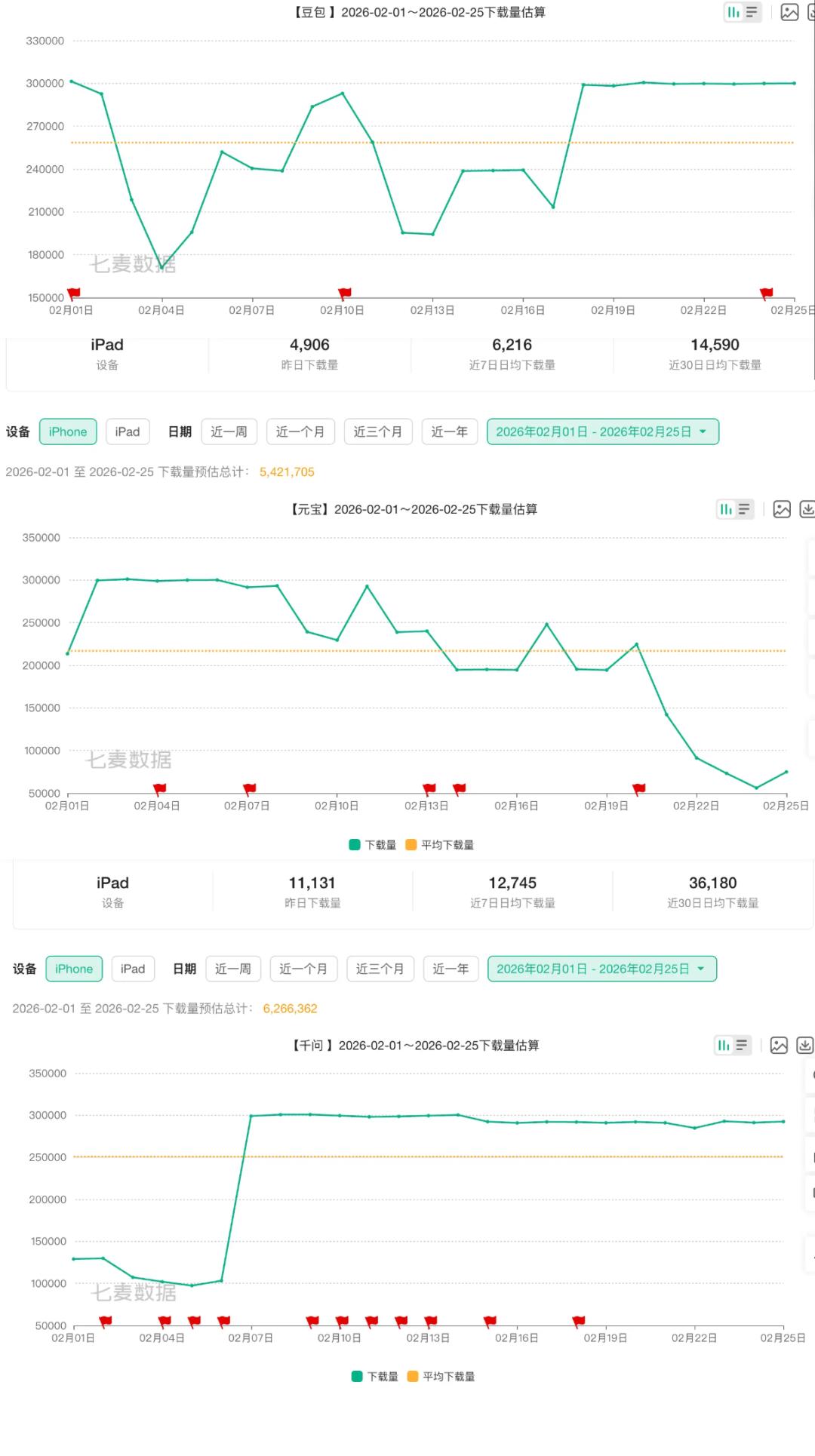
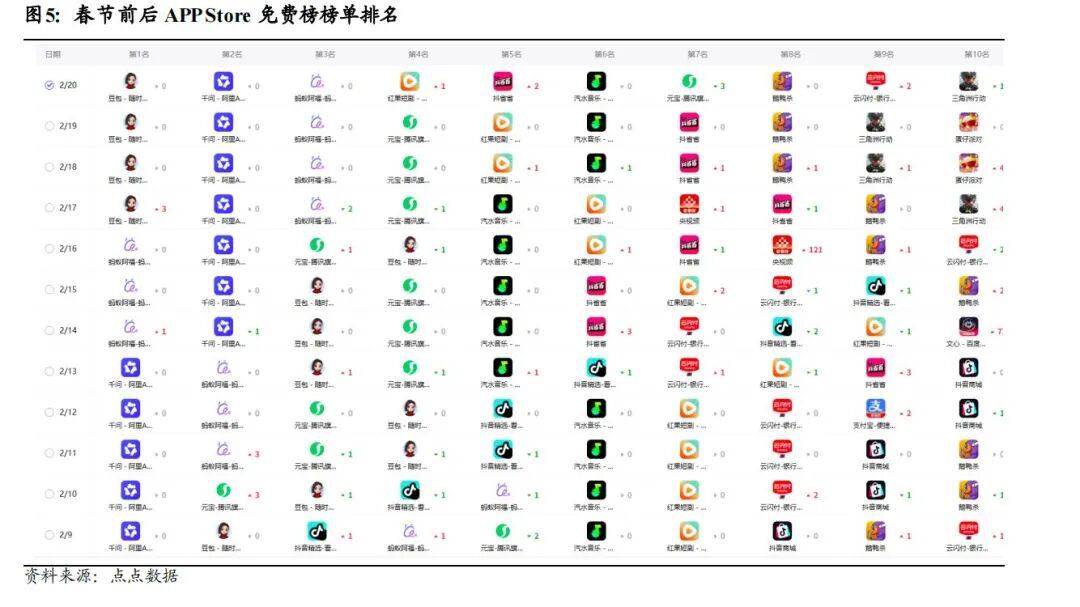
Core Insights - The core focus of the article is on the competitive landscape of AI applications during the Chinese New Year, highlighting the significant user acquisition efforts by major internet companies and the challenges they face in user retention and monetization [1][7][12]. User Acquisition and Engagement - Major internet companies have heavily invested in user acquisition during the Chinese New Year, with 千问 App reporting nearly 200 million "one-click orders" during the holiday, indicating that 1 in 10 people used the app [1]. - Tencent's 元宝 achieved over 50 million daily active users (DAU) and 114 million monthly active users (MAU) by February 18, while 豆包 reported 1.9 billion interactions on New Year's Eve, generating over 50 million themed avatars and 100 million New Year greetings [2][6]. - The competition saw 千问 App's DAU grow by 727.7% to 58.48 million on the first day of the New Year, significantly narrowing the gap with 豆包 [3]. Market Dynamics and Rankings - The rankings of AI applications fluctuated significantly during the holiday, with 千问 App, 豆包, and 蚂蚁阿福 frequently changing positions in the App Store [3][6]. - As of February 24, 豆包 remained at the top of the App Store free list, with 千问 in second place and 蚂蚁阿福 in fourth, while 元宝 dropped out of the top twenty [6]. Challenges and Future Outlook - Despite the apparent success in user acquisition, industry experts highlight challenges such as user retention post-subsidy, capability limitations in complex scenarios, and unproven monetization models [2][12]. - The article suggests that the current marketing strategies reflect a battle for the next traffic entry point, with long-term success dependent on user retention and the underlying AI capabilities [7][12]. - The competition is expected to continue evolving, with companies needing to focus on product innovation, user needs, and daily penetration rates to ensure sustained growth [14]. Differentiated Strategies - Companies are adopting distinct strategies: 阿里巴巴 integrates its AI model with a substantial cash reward plan, aiming to create a new business entry point; 字节跳动 employs a multi-modal approach to cover all user needs; and 腾讯 leverages its social ecosystem to enhance user engagement through 元宝 [11][12]. - The article emphasizes that the AI industry is transitioning from a "hundred models" era to an "oligopoly" phase, where the focus will shift from user acquisition to value creation and monetization [14].
AI大显神通会成为常态
Bei Jing Shang Bao· 2026-02-24 16:56
Group 1 - The core viewpoint of the articles highlights the unprecedented integration of AI into everyday life during the Spring Festival, with significant user engagement and application across various platforms [1][2]. - Major companies are competing aggressively for user acquisition, leading to record-breaking interactions, such as 1.9 billion interactions on Doubao AI and nearly 200 million users placing orders through Alibaba's Qianwen on New Year's Eve [1]. - The rapid updates and technological advancements in domestic AI products during the festival indicate a fast-paced development cycle, with no signs of slowing down despite the holiday [2]. Group 2 - The competition in the AI sector is shifting from user acquisition to product-centric competition, emphasizing the importance of user experience, commercialization, and ecosystem collaboration [3]. - The massive influx of users provides diverse usage scenarios and continuous feedback, which will enhance AI capabilities and user interaction [3]. - The evolving public perception of AI has shifted from fear of replacement to a focus on how to effectively utilize AI, indicating a deeper and more sustained competition among companies [3].
红包大战退潮!2026年春节AI“排位赛”大洗牌:元宝一度掉出前二十 豆包与千问的“拉锯战”才刚刚开始
Mei Ri Jing Ji Xin Wen· 2026-02-24 15:49
Core Insights - The core focus of the article is on the competitive landscape of AI applications during the Chinese New Year, highlighting the significant user acquisition efforts by major internet companies and the challenges of user retention post-subsidy [2][6][12]. User Acquisition and Engagement - Major internet companies engaged in a "red envelope war" to attract users, with significant investments leading to impressive user engagement metrics [2][3]. - As of February 23, Tencent's "Yuanbao" achieved over 50 million daily active users (DAU), while Doubao reported 1.14 million monthly active users (MAU) [3]. - The "Qianwen" app recorded nearly 200 million orders during the holiday, indicating a high level of user interaction [2]. Competitive Dynamics - The competition primarily unfolded between ByteDance's Doubao and Alibaba's Qianwen, with both apps experiencing substantial DAU growth during the holiday period [4][6]. - Qianwen's DAU surged by 727.7% on the first day of the red envelope activities, reaching 58.48 million, while Yuanbao's DAU increased by 2.1 times to 23.99 million [4]. Market Positioning and Strategy - The article notes a shift in the AI application landscape, with major players adopting distinct commercialization strategies based on their core strengths [8][9][10]. - Alibaba's strategy integrates its ecosystem with Qianwen, aiming to create a new business entry point through AI [9]. - ByteDance's approach focuses on a multi-modal strategy to cover various user needs, leveraging its traffic advantages [9]. - Tencent relies on its social ecosystem to enhance Yuanbao's capabilities, integrating AI into social interactions [10]. Challenges and Future Outlook - Despite the initial success in user acquisition, the industry faces significant challenges in user retention, with concerns about the sustainability of user engagement without subsidies [6][12]. - The article emphasizes the need for companies to improve AI usability and address operational costs to ensure long-term profitability [12]. - The competition for AI talent is intensifying, with a reported 14-fold increase in AI-related job postings since the beginning of 2026 [12]. Conclusion - The article concludes that while the red envelope war has ended, the competition for value creation and user retention is just beginning, signaling the onset of an "AI oligopoly" era [13].
没有“全民爆款”的春节档 还能撑得起资本期待吗?
Mei Ri Jing Ji Xin Wen· 2026-02-24 14:22
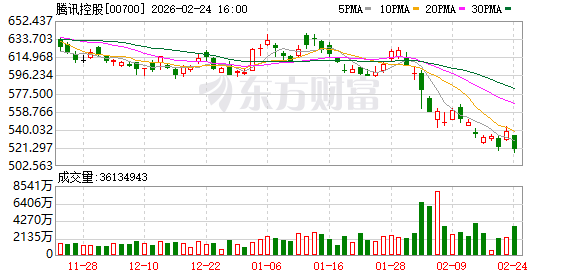
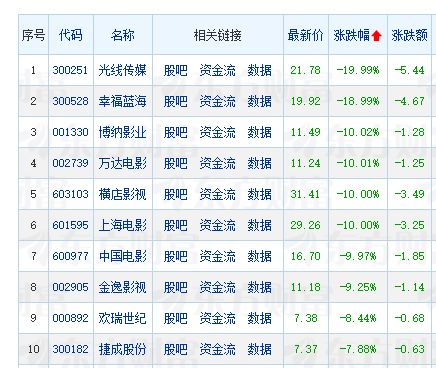
Core Viewpoint - The A-share film sector experienced a collective decline, with several companies hitting the daily limit down, reflecting investor concerns about the performance of the Spring Festival box office and the lack of blockbuster films in 2026 [1][2][3] Box Office Performance - The Spring Festival box office saw over 4.35 million screenings, a historical high, but the first-day box office was 1.278 billion yuan, a 30% year-on-year decline, returning to 2018 levels [2][3] - The average ticket price on the first day was 49.7 yuan, down from 51.3 yuan the previous year [2] - The 2026 Spring Festival box office was characterized by an increase in screenings but a lack of significant hits, with only "Flying Life 3" achieving over 2.9 billion yuan in box office, making it the only standout film [3][4] Industry Trends and Challenges - The film industry is facing a dual challenge of increased quantity but decreased quality and audience engagement, with a need for reassessment of the film ecosystem and content supply [4][5] - Analysts suggest that the industry should optimize content supply, explore diverse genres, and tap into consumer potential to adapt to changing market dynamics [4][5] Impact of AI on the Industry - The 2026 Spring Festival Gala was noted for its high integration of AI, with significant audience interaction and content generation, indicating a shift in content production methods [5] - The rise of AI is expected to provide new valuation logic for media stocks, as it transitions from merely distributing traffic to generating content [5] Non-Ticket Revenue Strategies - Cinema operators are actively expanding non-ticket revenue streams to mitigate box office fluctuations, with significant participation in online and offline activities during the Spring Festival [7] - The trend of combining viewing experiences with social interaction and IP consumption is emerging, indicating a shift towards diversified entertainment models [7]


【西街观察】AI大显神通会成为常态
Bei Jing Shang Bao· 2026-02-24 13:45
Core Insights - The integration of AI into daily life reached unprecedented levels during the Spring Festival, with significant user engagement and application across various sectors [1][2] - Major tech companies aggressively competed for user acquisition through subsidies and promotions, resulting in record user interactions and engagement metrics [1][2] - The rapid advancements in AI technology and funding during this period indicate a fast-paced development cycle, with no signs of slowing down despite the holiday [2] Group 1: User Engagement and Metrics - On New Year's Eve, the total interactions with Doubao AI reached 1.9 billion, while Alibaba reported nearly 200 million users placing orders through Qianwen [1] - Tencent disclosed that its daily active users surpassed 50 million, with monthly active users reaching 114 million [1] - The massive user engagement reflects a significant shift in consumer behavior and the growing presence of AI in everyday activities [1][2] Group 2: Competitive Landscape - The Spring Festival served as a concentrated battleground for AI companies, highlighting the importance of product-centric competition beyond initial user acquisition [3] - The competition among companies is expected to intensify, focusing on user experience, commercialization, ecosystem collaboration, and computational power [3] - Historical examples of AI competition, such as ChatGPT and DeepSeek, illustrate the unpredictable nature of the market and the ongoing struggle for dominance [3] Group 3: Technological Advancements - Domestic AI has undergone a comprehensive update across various dimensions, including reasoning, video, embodied, and conversational products [2] - The rapid pace of technological iteration and high funding amounts signal an urgent need for companies to innovate and adapt [2] - The evolving public perception of AI has shifted from fear of replacement to a desire for effective utilization, indicating a maturation of the market [3]