
3D打印粉末

Search documents
未知机构:ZX航空航天持续强Call全3D打印产业链轻舟已过万重山-20260228
未知机构· 2026-02-28 02:55
Summary of the Conference Call on 3D Printing Industry Industry Overview - The core logic of 3D printing is the continuous cost reduction and efficiency improvement, which drives the marginal expansion of applications in various fields [1] - The cost-effectiveness of industrial-grade additive manufacturing has significantly improved, with applications rapidly penetrating areas beyond aerospace, such as shoe molds, 3C products, and automotive parts [1] Key Points Powder Segment - The powder production process has shifted from traditional atomization methods to hydrogen dehydrogenation combined with spheroidization, leading to significant improvements in yield and cost [1] - The average price of TC4 titanium powder has decreased from 2000 RMB/kg in 2020 to currently 200-300 RMB/kg, with a target of reaching 100 RMB/kg in the medium term, approaching the prices of stainless steel and aluminum alloy powders [1] - Powder materials account for 50% of the cost in the 3D printing blank segment, making cost reduction in this area crucial for overall economic viability [1] Core Components - The combination of laser and galvanometer technology has gradually reduced dependence on overseas suppliers like IPG and Scanlab, with domestic technology maturing [2] - The cost of a single set of 500-1000W fiber laser and supporting galvanometer has decreased from over 100,000 RMB to below 50,000 RMB, resulting in a 20% reduction in equipment manufacturing costs [2] Equipment Development - A single 500W laser has an average printing efficiency of 25 cm³/h, with the development of multi-laser large-size equipment leading to exponential growth in printing efficiency [2] - Customized equipment for the 3C sector features a wide low-height forming chamber design that reduces spot size and improves precision, enhancing the quality of blank parts closer to final products [2] Investment Opportunities - The entire industry chain is experiencing cost reduction and efficiency improvements, making 3D printing a universal process across the manufacturing sector [2] - Recommended investment opportunities include: 1. **Huasu High-Tech**: A leading manufacturer of industrial-grade metal/non-metal 3D printing, expected to ship 1,500 units in 2026, a year-on-year increase of over 400% [2] 2. **Harsen Co., Ltd.**: A pioneer in titanium powder technology, aiming to reduce TC4 powder costs to below 100 RMB/kg, facilitating further penetration of titanium alloy 3D printing [3] 3. **Jiangshun Technology**: Engaged in differentiated rocket engine DED printing, benefiting from the increasing penetration of 3D printing in the rocket engine sector [3] Other Notable Companies - Other notable companies in the industry include Dazhu Laser, Plit, Feiwo Technology, Yinbang Co., Nanfeng Co., and Deen Precision [4]

太空算力成新风口!商业航天股集体冲高,东方通信涨停,全产业链迎机遇!
Jin Rong Jie· 2025-12-12 11:05
Group 1 - The A-share commercial aerospace sector has experienced a significant surge, with key stocks like Dongfang Communication leading the charge, resulting in a strong market sentiment and multiple stocks hitting the daily limit up [1] - The overall trading volume in the sector doubled compared to the previous trading day, with commercial aerospace-themed funds seeing an average net value increase of 4.2% in a single day [1] - Northbound capital showed a clear interest in the sector, with a net purchase of 980 million yuan in core stocks, indicating strong market recognition of the policy dividends and growth potential in the commercial aerospace industry [1] Group 2 - The establishment of the Commercial Aerospace Administration by the National Space Administration marks a significant milestone, transitioning the industry from a "policy cultivation period" to a "regulated development period," which will optimize processes and reduce institutional transaction costs for companies [1] - The global aerospace industry is projected to exceed $600 billion, with China's market leading the growth at a 15% annual increase, capturing 22% of the global market share [2] - The rocket industry chain is expected to benefit directly from increased launch demand and technological breakthroughs, with a complete ecosystem already established in China's commercial aerospace sector [3] - The satellite manufacturing and application sector is experiencing a shift towards mass production due to the dense networking of low-orbit constellations, with a projected revenue of 71 billion yuan in 2025, reflecting a 28% increase from the previous year [3] - The demand for high-strength materials and 3D printing in aerospace is growing, with the market for aerospace 3D printing materials expected to grow by 42% in 2025, and related companies seeing revenue growth exceeding 30% [3]


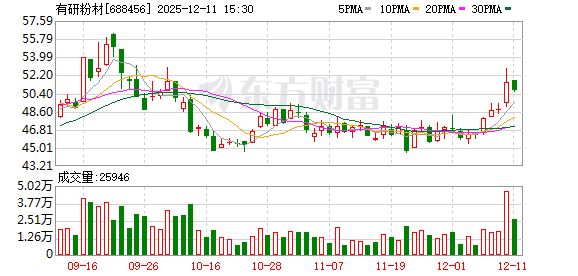
有研粉材:商业航天产业未来将保持高速发展
Zheng Quan Ri Bao· 2025-12-11 10:36
Core Viewpoint - The company has reported an increase in orders driven by demand for 3D printing powders across various sectors, including aerospace, commercial space, and other industrial fields [2] Group 1: Company Insights - The company indicated that the commercial space industry is expected to maintain rapid growth and will increasingly adopt metal 3D printing technology, leading to sustained demand for powder materials [2]


中洲特材(300963) - 20250513投资者关系活动记录表
2025-05-13 11:14
Group 1: Company Overview and Performance - The company introduced its operational performance for 2024 and future development plans, highlighting a sales volume of 5,233.85 tons and a production volume of 5,209.13 tons, resulting in a sales-to-production ratio of 100.47% [3][4] - The planned production capacities for the second and third phases of Jiangsu Xinzhongzhou are 3,000 tons and 4,500 tons respectively [3][4] Group 2: Market and Product Focus - The company's product sales primarily cover sectors such as oil, chemicals, new energy, nuclear power, marine engineering, and automotive components [3][4] - The company’s 3D printing powder, which includes cobalt-based, nickel-based, and iron-based high-temperature alloy powders, currently contributes a small proportion to overall revenue [3][4] Group 3: Competitive Landscape - The company differentiates itself from competitors like Tunan Co. and Steel Research High-Tech by focusing on civilian high-temperature corrosion-resistant alloys, primarily serving the oil, chemical, nuclear, and new energy sectors [3][4] - The company plans to maintain market share through specialized and differentiated strategies, enhancing product technology and competitiveness [11] Group 4: Research and Development - The company collaborates with Shanghai Jiao Tong University to establish a joint research center for high-end metal special materials, emphasizing the importance of R&D and new product development [6][9] - Future R&D will focus on core components for nuclear power, marine engineering, new energy, high-end manufacturing equipment, and 3D printing ultra-fine powders [9][10] Group 5: International Expansion and Market Strategy - The company aims to expand its international market presence while optimizing product structure and increasing its share among high-end overseas clients [8] - The company has already exported its 3D printing powders to Europe and the United States and plans to increase application scenarios based on market demand [11] Group 6: Financial Management and Risk Mitigation - The company employs cost-plus pricing, timely bulk purchasing, and lean production to mitigate the impact of commodity price fluctuations on profit margins [11] - The company is positioned to leverage the growth potential in the high-temperature alloy industry, which is still in its early stages in China [11]