AI储能

Search documents
【电新环保】本轮春季躁动,AIDC电源储能、锂电、氢氨醇为布局重点——行业周报251228(殷中枢/郝骞/陈无忌/何霖/邓怡亮)
光大证券研究· 2025-12-28 23:04
Overall Viewpoint - The AIDC power/storage sector is experiencing a positive outlook, with North American AI chain focusing on light modules, liquid cooling, AIDC power, and AI storage. Recent developments in liquid cooling have opened up new opportunities for AIDC power overseas orders, and the 26H2 HVDC technology solution is expected to see increased volume. Collaboration related to SST is also anticipated to yield results. The overseas energy storage market remains robust, with the logic of electricity shortages in the U.S. unchanged, and a temporary easing of U.S.-China relations. The market is currently less sensitive to BBB and 301-related legislation, warranting continued attention to AIDC power and overseas storage sectors [4]. Group 1: AIDC Power/Storage - The North American AI chain is prioritizing light modules, liquid cooling, AIDC power, and AI storage, with liquid cooling trends enhancing the potential for AIDC power overseas orders [4]. - The 26H2 HVDC technology solution is expected to facilitate increased production, while SST-related collaborations are projected to gradually materialize [4]. - The overseas energy storage market remains favorable, with the U.S. electricity shortage logic still intact, and a temporary thaw in U.S.-China relations [4]. Group 2: Lithium Battery - Recent environmental assessments for the Jiangxia lithium mine and Tianqi Lithium's decision to not use SMM pricing have influenced the market, with several lithium iron phosphate companies announcing production cuts to strengthen pricing negotiations [4]. - Changes in the supply side of lithium carbonate and the "anti-involution" logic are enhancing price support expectations, leading to a recovery in the lithium battery sector during the spring market [4]. - The investment hierarchy for lithium battery materials is as follows: lithium carbonate > lithium hexafluorophosphate > aluminum foil > separator > copper foil > anode [4]. Group 3: Hydrogen Ammonia and Wind Power - During the 14th Five-Year Plan, hydrogen ammonia is viewed as a significant direction for new energy consumption and non-electric applications, supported by future industry prospects and the EU carbon tariff in 2026 [5]. - The National Development and Reform Commission emphasizes the potential for coordinated, large-scale, and advanced construction of hydrogen ammonia projects [5]. - Although Goldwind Technology's stock has surged due to commercial aerospace trends, market expectations for hydrogen ammonia remain relatively low, indicating a need for continued focus [5].

公募基金明年看好AI产业链
Shen Zhen Shang Bao· 2025-12-24 17:45
Group 1 - The core viewpoint is that many public funds are optimistic about the A-share market in 2024, expecting a recovery in corporate profit growth [2] - Fund managers believe the market will gradually shift to a dual-driven model of external and internal demand, with structural opportunities in the AI industry chain, particularly in AI applications [2] - Long-term expectations for 2026 suggest a transition from valuation-driven growth to a combination of profit and valuation driving market performance [2] Group 2 - Current market conditions are seen as a turning point, with increasing momentum in the revenue recovery of listed companies and expectations for profit growth in 2026 [3] - The technology sector is expected to maintain a balanced and sustainable trend, with improvements in both domestic and overseas computing power, and a near-term explosion in AI applications [3] - A favorable liquidity environment and economic recovery are anticipated to enhance corporate profit growth, expanding opportunities in technology stocks across various fields [3] Group 3 - Recommendations include focusing on China's advantageous industries combined with AI, particularly in computing power, energy storage, and semiconductor equipment [4] - The AI sector is viewed as a significant investment direction, with expectations for continued capital expenditure from North American CSP manufacturers until 2030 [4] - Key areas of interest in AI applications include entertainment, operational optimization for businesses, and advancements in humanoid robots and smart driving technologies [4]

第七届金麒麟新能源设备最佳分析师第一名长江证券邬博华最新行研观点:新能源作为产业发展新增长现状与未来
Xin Lang Zheng Quan· 2025-12-01 05:56
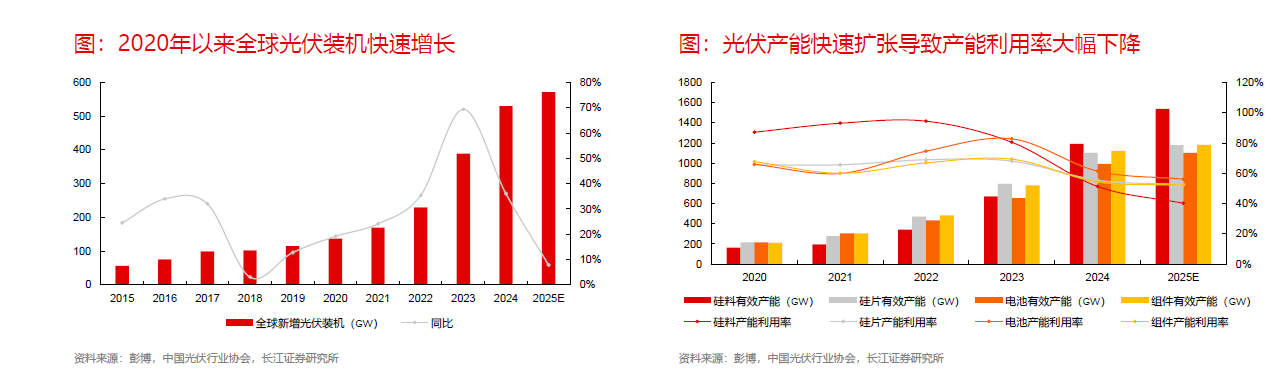
Core Insights - The article discusses the current state and future prospects of the renewable energy industry, highlighting the rapid growth in demand and supply, as well as the challenges faced by the industry in terms of profitability and competition. Group 1: Current Industry Status - Since 2020, the global "carbon neutrality" initiative has led to significant growth in the renewable energy sector, with an expected addition of nearly 600GW of solar capacity by 2025, reflecting a compound annual growth rate of 33% over the past five years [6] - The rapid expansion of supply in the solar sector has resulted in a significant drop in capacity utilization rates, with some segments, such as silicon materials, falling below 50% [7] - The electric vehicle (EV) sector has driven explosive growth in the lithium battery supply chain, with global lithium battery penetration increasing from 2% in 2018 to over 20% by mid-2025 [7] Group 2: Competitive Advantages of China's Renewable Energy Industry - China's renewable energy industry exhibits strong global competitiveness, characterized by leading technology, with a self-controlled solar and lithium battery supply chain that outperforms global standards [8] - The production capacity of solar and lithium battery segments in China accounts for 70%-90% of the global total [9] - Domestic products benefit from a cost advantage due to favorable production factors, creating a low-cost moat [10] Group 3: Profitability Challenges - The renewable energy sector is currently facing profitability pressures due to overcapacity, with solar manufacturing companies experiencing significant net profit losses despite some recovery in Q3 2025 [11] - The lithium battery industry has seen a decline in profitability since its peak in 2022, but improvements in both volume and price are expected to continue into Q3 2025 [11] Group 4: Future Development and New Growth Points - The industry is transitioning from high-speed growth to high-quality development, with a focus on energy storage solutions to address consumption issues [12] - The penetration rate of renewable energy generation has reached approximately 20%, leading to rigid demand for energy storage due to mismatches in supply and demand [15] - The introduction of a continuous settlement mechanism in the spot market by the end of 2025 is expected to expand arbitrage opportunities for energy storage [16] Group 5: International Expansion and Market Opportunities - The overseas wind power market is projected to grow rapidly, with significant increases in installed capacity expected in regions such as Asia, Africa, and Latin America [23] - The demand for energy storage and transformers in the U.S. is anticipated to surge, with estimated total storage capacity demand reaching 1199GWh from 2025 to 2030, reflecting a compound annual growth rate of 56% [25] - Companies are increasingly seeking international markets, with expectations of rising overseas revenue proportions, particularly for companies like Dajin Heavy Industry [24] Group 6: Innovations and New Technologies - Solid-state batteries are emerging as a new growth point, offering advantages such as higher energy density and safety [28] - The development of BC (Bifacial Cell) technology is expected to become mainstream, with significant production capacity anticipated by the end of 2025 [30] - AI-driven energy storage solutions are projected to see increased demand in North America, with potential annual storage needs reaching 200GWh from 2025 to 2030 [34]


远景田庆军:源网荷储是能源转型的必由之路,AI储能将重塑电力系统格局
中关村储能产业技术联盟· 2025-10-18 09:20
Core Insights - The article emphasizes the importance of the synergy between source, grid, load, and storage (源网荷储) as the future of energy transition, highlighting the need for AI storage to drive industry transformation [2][5]. Group 1: Industry Trends - The evolution of the power system will follow two key paths: the implementation of numerous source-grid-load-storage projects, some operating in off-grid modes, and the deepening of electricity market reforms, which will introduce uncertainties for renewable energy asset revenues [3]. - As of August, the cumulative installed capacity of wind and solar power reached 1.7 billion kilowatts, with a target of 3.6 billion kilowatts by 2035, indicating a significant growth opportunity of 1.9 billion kilowatts [2]. Group 2: AI Storage Solutions - AI storage is defined by two main components: the "trading agent," which functions like an electricity trader with capabilities in power forecasting, trading control, and real-time market perception, and the "networking agent," which acts as a power dispatcher ensuring stable grid operation [5]. - The transition from traditional power dynamics of "source following load" to "source-load interaction" is crucial, promoting intelligent interaction and optimization among power sources, grids, loads, and storage [5]. Group 3: Challenges and Barriers - Despite strong national policies supporting the development of source-grid-load-storage systems, challenges such as inconsistent technical standards, difficulties in grid access, and an underdeveloped market mechanism remain significant barriers to project implementation [6]. - Four major market issues were identified: forced high ratios of abandoned electricity due to surplus power, lagging market mechanisms limiting project flexibility, lack of transparency in electricity pricing, and high technical and management difficulties affecting operational efficiency [6]. Group 4: Future Outlook - The key to addressing the core challenges of source-grid-load-storage lies in possessing "full-chain system integration capabilities," which includes understanding both the energy system and intelligent manufacturing [7]. - AI storage is projected to be a critical technological pathway for solving the synergy challenges, with a focus on integrating trading and networking agents to establish sustainable profit models and enhance system value [7][8].