AI智算集群设备

Search documents
年终盘点丨算力国产化托底,资本市场GPU新股狂飙突进
Di Yi Cai Jing Zi Xun· 2025-12-26 04:09
Core Insights - The rise of domestic AI chip manufacturers in China's stock market has garnered significant attention, with companies like Cambricon (寒武纪) and Moore Threads (摩尔线程) achieving remarkable stock price increases upon their listings [2][3] - The market is witnessing a surge in domestic GPU manufacturers, with several companies preparing for IPOs, indicating a growing interest in AI chip production [3][4] - Despite high expectations for domestic AI chips, challenges remain, including competition from established players like NVIDIA and the need for these companies to prove their value in a crowded market [10][11] Group 1: Market Dynamics - Cambricon surpassed Kweichow Moutai to become the highest-priced stock in A-shares, reflecting investor enthusiasm for AI chip stocks [2] - Moore Threads and Muxi Technology saw their stock prices soar on their debut, with Muxi achieving a record profit for new listings in nearly a decade [2][3] - The entry of NVIDIA's H200 chip into the Chinese market adds complexity to the competitive landscape for domestic GPU manufacturers [3][16] Group 2: Financial Performance - Revenue growth for Moore Threads, Muxi, Bilan Technology, and Tensu Zhixin from 2022 to 2024 shows significant increases, but all companies reported substantial losses during the same period [7][8] - The revenue from the top five customers for these GPU manufacturers is highly concentrated, with some companies relying on a small number of clients for the majority of their income [9][10] Group 3: Market Share and Competition - The market share of domestic GPU manufacturers remains low, with Muxi holding approximately 1% of the AI accelerator market in 2024, and other companies reporting similar figures [9][10] - The competition among these manufacturers is intensifying, with no clear leader emerging in terms of market share or product performance [10][11] Group 4: Customer Dynamics - The customer base for these GPU manufacturers is highly concentrated, with significant fluctuations in client relationships, indicating potential revenue instability [9][10] - Major clients are increasingly shifting, with only a few companies remaining consistent among the top customers year over year [9] Group 5: Future Outlook - The domestic GPU market is expected to see a gradual increase in localization, with projections indicating that the domestic GPU market's localization rate will rise from 2% in 2022 to over 50% by 2029 [12][13] - Companies are focusing on enhancing product performance and building a robust ecosystem to compete effectively against international players like NVIDIA [18][20]



年终盘点|算力国产化托底,资本市场GPU新股狂飙突进
Di Yi Cai Jing· 2025-12-26 03:30
Core Viewpoint - The market for domestic AI chip manufacturers is still in its early stages, with several companies recently going public and facing significant challenges ahead, including competition from established players like NVIDIA [2][9]. Group 1: Market Dynamics - Several GPU manufacturers have low market shares, indicating that the competition is just beginning [2][9]. - The market for domestic AI chips is characterized by high customer concentration, with the top five clients accounting for over 70% of revenue for many companies [7][8]. - The entry of NVIDIA's H200 chip into the Chinese market adds complexity to the competitive landscape for domestic manufacturers [15][16]. Group 2: Financial Performance - From 2022 to 2024, revenues for key GPU manufacturers are projected to grow significantly, but they are also facing substantial losses, with total losses exceeding 50 billion yuan for some [5][6]. - The revenue growth for these companies is primarily driven by AI data center-related products, yet they remain unprofitable [5][6]. Group 3: Product and Technology - The performance of domestic GPU products has not shown significant differentiation, with many products having similar capabilities [9][17]. - Companies are working on improving their product offerings, with new architectures and chips being developed to enhance performance [18][19]. Group 4: Industry Trends - The domestic GPU market is expected to see an increase in localization, with projections indicating that the market share of domestic chips will rise significantly by 2029 [11]. - There is a growing interest in domestic computing power among cloud and data center companies, driven by the need for cost-effective solutions [13][14].

摩尔线程张建中和他的伙伴们
YOUNG财经 漾财经· 2025-12-23 11:19
Core Viewpoint - Moore Threads is a comprehensive GPU chip developer and AI computing solution provider that aims to become the domestic alternative to NVIDIA, achieving a strong market presence with a significant valuation and rapid growth in revenue [4][18]. Group 1: Company Overview - Moore Threads was listed on the Shanghai Stock Exchange's Sci-Tech Innovation Board on December 5, achieving a remarkable closing increase of 425.46%, with a total market capitalization of 282.25 billion [4]. - The company aims to capitalize on the booming AI sector, with a projected compound annual growth rate (CAGR) of 208.44% in revenue from 2022 to 2024 [4]. - As of 2025, Moore Threads is ranked 212th on the Hurun Global Unicorn List with a valuation of 31 billion yuan [4]. Group 2: Leadership and Founders - Zhang Jianzhong, the founder and chairman, holds 11.06% of the company's shares and controls 36.36% through various holding platforms, with his stake valued at over 4.3 billion USD (approximately 304 billion yuan) [6][7]. - Zhang has a strong background in the GPU industry, having previously served as NVIDIA's Vice President and General Manager for Greater China, where he significantly increased NVIDIA's market share in China from under 50% to nearly 80% [7][10]. - The founding team includes several key figures from NVIDIA and other tech companies, contributing to the rapid growth and success of Moore Threads [13][14]. Group 3: Product and Market Strategy - Moore Threads aims to develop a "fully functional GPU" that supports graphics rendering, scientific computing (including AI), and multimedia encoding, distinguishing itself from other domestic chip companies [17][18]. - The company has successfully produced five GPU chips and has maintained a rhythm of releasing one new GPU architecture annually from 2021 to 2024, with significant milestones in product development [19]. - The Chinese GPU market is projected to exceed 120 billion yuan by 2025, indicating a substantial growth opportunity for Moore Threads [18]. Group 4: Financial Performance and Challenges - In 2024, Moore Threads reported a revenue of 438 million yuan, a year-on-year increase of approximately 253%, despite a high R&D expense ratio of 310% [20]. - The company is currently in discussions for orders exceeding 2 billion yuan, covering various sectors including AI computing and professional graphics acceleration [20]. - Moore Threads is positioned to achieve significant performance growth by 2027, with a potential for profitability in the same year [20].
摩尔线程上市临近“中国版英伟达”之争硝烟渐浓
Jing Ji Guan Cha Bao· 2025-11-22 05:13
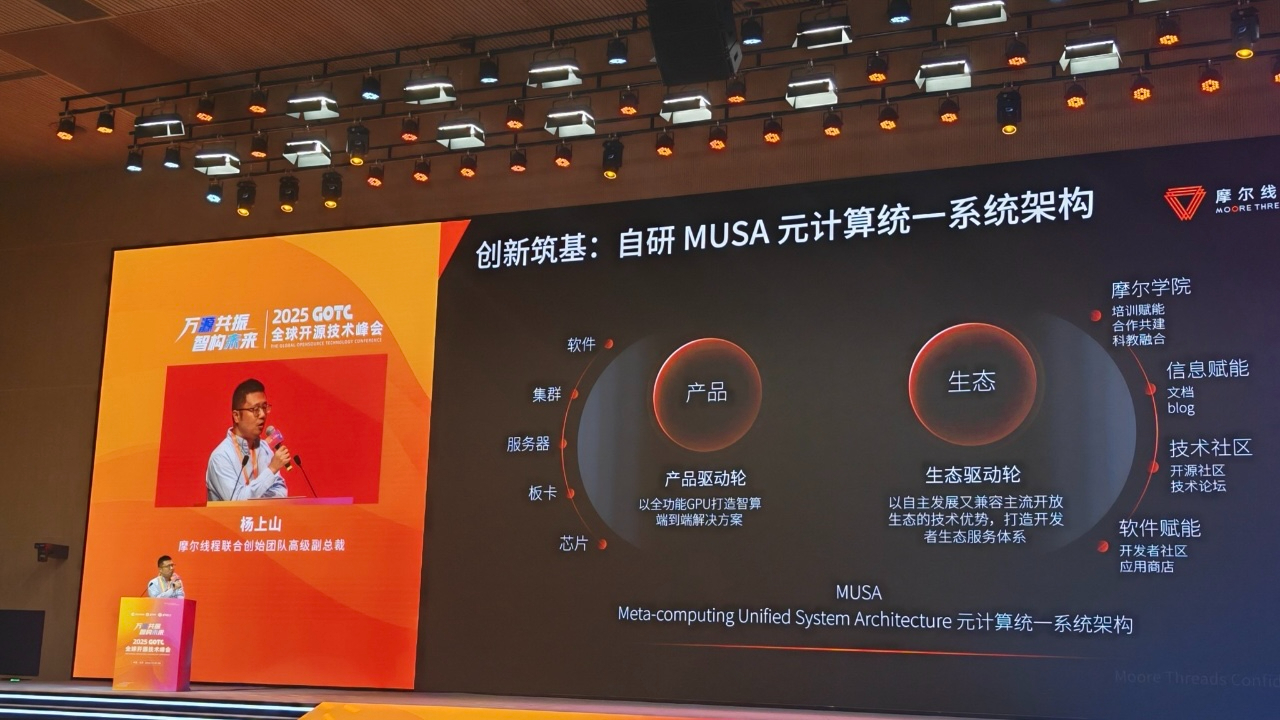
Core Viewpoint - Moore Threads has successfully launched its IPO on the Sci-Tech Innovation Board, with an issue price of 114.28 yuan per share, resulting in a post-issue market capitalization of approximately 53.7 billion yuan, marking it as the largest IPO project on the Sci-Tech Innovation Board since 2025 [2][3][4]. Group 1: Financial Performance - The company achieved significant revenue growth, with 7.02 billion yuan in revenue for the first half of 2025, up from 4.38 billion yuan in 2024 and just over 40 million yuan in 2022 [6][12]. - Despite the rapid revenue increase, the company has incurred substantial losses, totaling 5.486 billion yuan over the past three and a half years, necessitating the 8 billion yuan raised from the IPO to support ongoing high-intensity technology iterations and to address liquidity needs [3][8]. - The company reported a net cash flow from operating activities of -1.164 billion yuan for the first half of 2025, leading to increased short-term borrowings from 0 at the end of 2022 to 1.217 billion yuan by mid-2025 [8][9]. Group 2: Customer Structure and Market Position - Moore Threads has a highly concentrated customer base, with the top five customers accounting for 98.29% of revenue in the first half of 2025, primarily from large B-end clients such as telecom operators and intelligent computing centers [11][12]. - The company’s revenue structure indicates that it earns not only from selling graphics cards but also from integrated computing devices, with significant contributions from major clients [7][12]. Group 3: Research and Development - The company has invested heavily in R&D, with cumulative expenditures reaching 3.81 billion yuan from 2022 to 2024, which exceeds its revenue during the same period [8]. - The company aims to achieve profitability by 2027, projecting revenues of 5.983 billion yuan and a gross margin of 61%, although this includes approximately 307 million yuan in government subsidies [14][15][16]. Group 4: Technology and Market Outlook - The founder emphasized the competitive advantages of the MUSA architecture, which integrates GPU hardware and software, offering superior versatility and market adaptability compared to other technologies like ASIC and GPGPU [18][20]. - The GPU market is expected to grow significantly, with forecasts predicting the Chinese GPU market to reach 1.363 trillion yuan by 2029, driven by increasing demand across various applications [28][30]. - The company plans to focus on six key areas for future development in computing services, including deep integration of hardware and software, expansion into international markets, and sustainable development initiatives [30][31]. Group 5: Market Valuation - At the IPO price of 114.28 yuan, Moore Threads has a market valuation exceeding 53.7 billion yuan, corresponding to a static price-to-sales ratio of 122.51 for 2024, raising questions about whether this valuation is sustainable [32]. - The funds raised from the IPO will primarily be allocated to three R&D projects: next-generation AI training and inference chips, new graphics chips, and AI SoC chips [32].