
AI电商服务

Search documents
未来电商会怎么发展?来了美国亚马逊,我得到了一些答案
Sou Hu Cai Jing· 2026-01-17 05:37
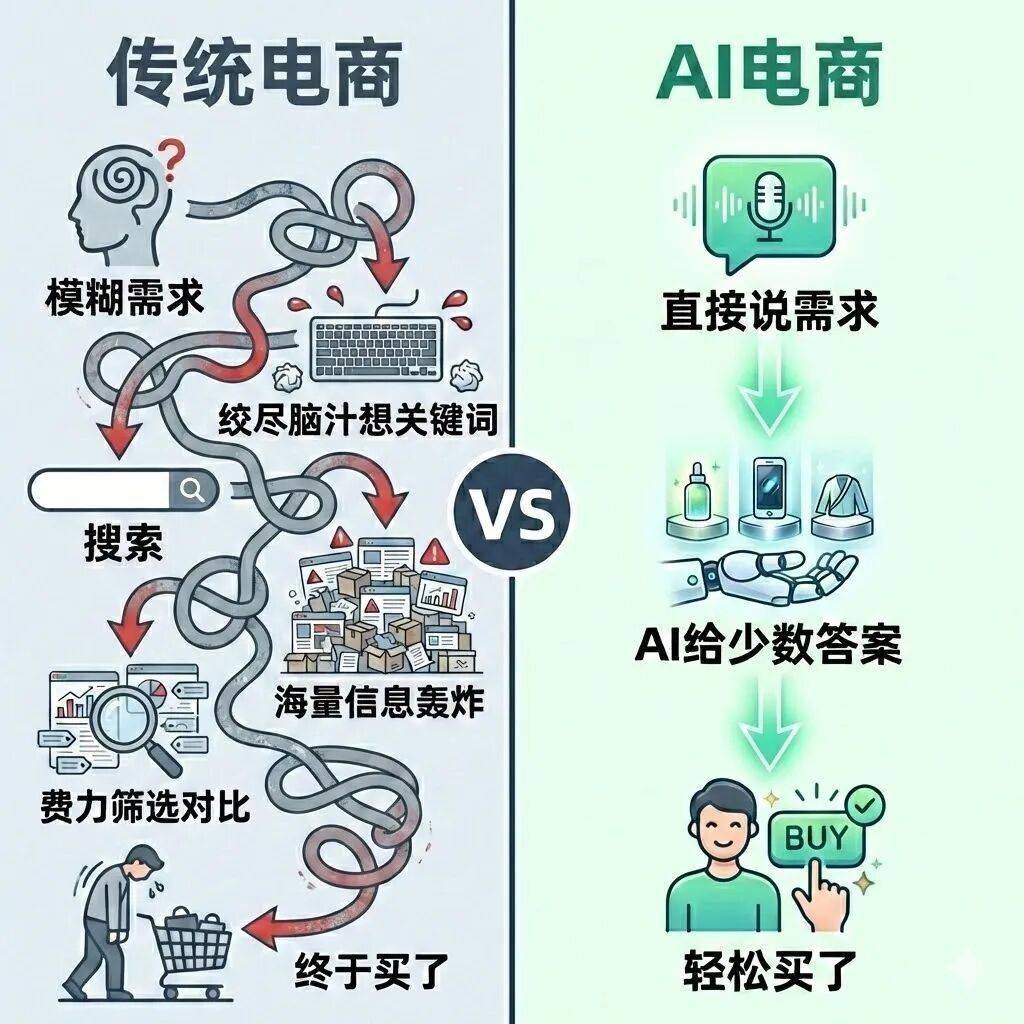
Core Insights - The article discusses the transformative impact of AI on e-commerce, suggesting that the industry is entering an "Answer Era" where AI can provide direct answers to consumer needs rather than just search results [3][5]. Group 1: AI in E-commerce - The shift from traditional e-commerce to AI-driven platforms will change the consumer experience from searching for products to having conversations that yield direct answers [5][17]. - AI can streamline the shopping process by eliminating the need for consumers to translate their needs into keywords and sift through extensive product lists [4][6]. Group 2: User Experience Enhancements - AI will enable users to express their needs in natural language, resulting in a more intuitive shopping experience where they receive a few optimal product recommendations instead of hundreds of options [6][18]. - The AI-driven approach aims to reduce the "transaction cost" of shopping by minimizing the tedious aspects of product comparison while preserving the enjoyment of browsing [19]. Group 3: Implications for Businesses - Businesses will need to adapt their marketing strategies from SEO (Search Engine Optimization) to GEO (Generative Engine Optimization) to align with AI recommendations [21]. - The competitive landscape will shift, as products that do not make it into the top recommendations may face significant visibility challenges, potentially leading to a decline in sales for those items [20][21]. Group 4: Engineering Capabilities - The article emphasizes that companies do not necessarily need to develop large AI models; instead, they should focus on integrating existing AI capabilities effectively into their business processes [24][25]. - Successful implementation of AI features, even simple ones, can lead to substantial revenue increases, as demonstrated by Amazon's experience [26].


A股超4500股飘红,AI电商大涨,多股涨停,贵金属再创新高,沪银拉升8%
21世纪经济报道· 2026-01-14 02:45
Core Viewpoint - The article discusses the recent surge in the A-share market, particularly focusing on the "New Easy Zhongtian" concept stocks driven by the emergence of Generative Engine Optimization (GEO) technology, which is reshaping how businesses engage with users through AI-driven search and recommendations [7][9]. Market Performance - On January 14, the A-share market saw all three major indices rise, with the Shanghai Composite Index at 4177.86 (+39.10, +0.94%) and the Shenzhen Component Index at 14430.20 (+260.80, +1.84%) [2]. - The total trading volume in the market exceeded 1 trillion yuan within the first 27 minutes, with a predicted total of 3.39 trillion yuan for the day, reflecting a decrease of over 309.8 billion yuan compared to the previous day [2]. AI and E-commerce Stocks - AI e-commerce stocks experienced significant gains, with companies like Guangyun Technology and Zhidema reaching the daily limit of 20% increase, while others like Tianlong Group and Yidian Tianxia saw increases of over 15% [5][6]. - The "New Easy Zhongtian" trio, including Yidian Tianxia, Zhongwen Online, and Tianlong Group, has seen stock prices rise over 47% since the beginning of the year [5][8]. Generative Engine Optimization (GEO) - GEO is identified as a key driver of the current market rally, as it represents a shift from traditional search engines to AI-generated search, positioning itself as a crucial tool for businesses to capture user traffic [7]. - Despite the hype, there are concerns regarding the actual business value of GEO, with many companies not yet demonstrating a clear link between their revenues and GEO-related activities [7][9]. Company Performance Analysis - Yidian Tianxia reported a revenue of 2.717 billion yuan for the first three quarters of 2025, a year-on-year increase of 54.94%, while Tianlong Group's revenue decreased by 5.84% to 5.459 billion yuan, although its net profit increased significantly [8]. - Zhongwen Online continues to report losses, with a revenue of 1.011 billion yuan and a net loss of 520 million yuan, indicating a widening loss primarily due to overseas operations [8]. Valuation Concerns - The valuation of stocks related to the "New Easy Zhongtian" concept has significantly increased, with some companies showing a disconnect between their market valuations and actual performance [8]. - For instance, BlueFocus has a TTM price-to-earnings ratio of -343.15, indicating severe losses, while the "New Easy Zhongtian" stocks have seen short-term price increases exceeding 47% [8]. Market Sentiment and Risks - Recent announcements from several companies highlight the disconnect between market speculation and actual business performance, with firms like Yidian Tianxia and BlueFocus acknowledging that their AI-driven revenues are still minimal [9]. - The article suggests that while the GEO concept may be subject to speculation, the underlying trend of AI applications in business is expected to be a significant driver in the industry moving forward [9].







三年行动计划打造六个新标杆 浙江加快平台经济高质量发展强省建设
Zhong Guo Chan Ye Jing Ji Xin Xi Wang· 2025-08-01 22:59
Core Insights - Zhejiang Province is accelerating the high-quality development of its platform economy, aiming to exceed 1,000 platform enterprises by 2027, with over 50 of them reaching a scale of 10 billion yuan, and achieving a total revenue of 2.2 trillion yuan from platform enterprises [1][2] Group 1: Development Goals - The goal is to have 10 million active online business entities and maintain an annual growth rate of 5% in online retail sales [1] - The province emphasizes a shift from scale-driven to innovation-driven growth in the platform economy [1] Group 2: Key Initiatives - Establishing a new benchmark for technology leadership by encouraging leading platforms to transition into high-tech enterprises and increasing R&D investment [2] - Implementing a "platform + industry" dual empowerment action to create over 25 billion-level consumer goods industry clusters [2] - Promoting international competition and cooperation by enhancing the quality of online trading platforms and supporting enterprises in expanding into global markets [2] Group 3: Consumer Engagement and Labor Relations - Launching the "Zhejiang Boutique" cultivation plan to improve product service quality and create innovative consumption scenarios [2] - Developing a new model for managing delivery services to provide better support for gig economy workers [2][3] Group 4: Governance and Market Integrity - Adopting a modern governance approach that integrates regulation with service, focusing on fair competition and addressing issues like counterfeit goods and fraudulent practices [3] - Currently, Zhejiang has over 850 platform enterprises, with a significant contribution to the national market in terms of transaction volume [3]
