
AI Car

Search documents
从交通工具到具身智能体 “AI+汽车”绘就行业新蓝图
Zhong Guo Qi Che Bao Wang· 2025-11-10 05:56
Core Insights - The forum focused on how AI is transforming automobiles from mere transportation tools to autonomous decision-making entities, outlining a technological blueprint for the automotive intelligence revolution [2] Group 1: AI Car Development - The white paper titled "Preliminary Imagination and Exploration Practice of AI Car" was released, outlining the future of automotive intelligence from an industry perspective [3] - AI Car is identified as the core carrier of the next-generation intelligent space and an ecological node for smart mobility, characterized by autonomy, interactivity, and adaptability [3] - The white paper presents ten key judgments regarding AI Car, including the transformation of autonomous driving system design logic, the importance of world models for understanding and predicting the future, and the role of computational optimization and data loops in efficient self-iteration [3][4] Group 2: New Survival Triangle for Enterprises - The white paper introduces a new survival triangle for enterprises in the AI era, emphasizing a shift from manufacturing value to operational value and from fixed hard asset-driven strategies to data soft asset-driven strategies [4] - It highlights that data should be viewed as a core strategic asset influencing competitive advantage rather than a cost center [4] - The focus shifts from single-dimensional competition to ecosystem competition, providing a methodological guide for industry breakthroughs [4] Group 3: Technological Breakthroughs and Practices - Experts discussed the optimization of complex systems in the automotive sector, addressing challenges such as problem description difficulties, multi-objective conflicts, and high computational costs [5] - The evolution of automobiles into "smart mobility entities" requires a reconstruction across driving, cabin, and powertrain dimensions, emphasizing safety and user value [5] - Various companies, including Dongfeng, Changan, Huawei, Tencent, Baidu, and Horizon, shared their engineering practices and advancements in AI integration within vehicles [6] Group 4: Collaborative Platform and Future Directions - The forum established a collaborative platform for academia, industry, and research, clarifying the technological direction and industrial logic for AI Car development [7] - The deep integration of AI technology with the automotive industry is expected to accelerate the evolution of cars as embodied intelligent entities, contributing "Chinese wisdom" and "Chinese solutions" to global automotive intelligence development [7]


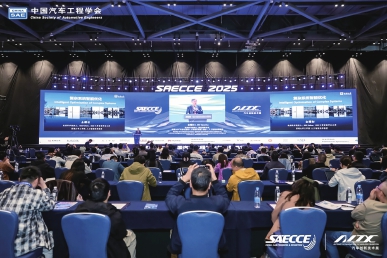
从交通工具到具身智能体,“AI+汽车”绘就行业新蓝图
Zhong Guo Qi Che Bao Wang· 2025-10-28 09:53
Core Insights - The forum focused on how AI is transforming automobiles from mere transportation tools to autonomous decision-making entities, outlining a technological blueprint for the automotive intelligence revolution [1][9] Group 1: AI Car Development Direction - The white paper titled "Preliminary Imagination and Exploration Practice of AI Car" was released, outlining the future of automotive intelligence from an industry perspective [2] - AI Car is identified as the core carrier of the next-generation intelligent space and an ecological node for smart mobility, characterized by autonomy, interactivity, and adaptability [4] - The white paper presents ten key judgments, including the transformation of autonomous driving system design logic, the emergence of world models for future predictions, and the importance of computational optimization and data loops for efficient self-iteration [4] Group 2: Technological Breakthroughs and Practices - Experts discussed the optimization of complex systems and the integration of AI with the automotive industry, emphasizing the need for breakthroughs in problem description, multi-objective conflicts, and computational complexity [5][7] - Companies like Geely, Dongfeng, and Huawei shared their engineering practices and advancements, highlighting initiatives such as Geely's "Beidou Tian Shu" plan and Huawei's dual-driven approach of market demand and technology development [8] - The forum established a collaborative platform for academia and industry, clarifying the technological direction and industrial logic of AI Car development while showcasing China's leading practices in automotive intelligence [9]

预见未来,《Al Car的初步畅想与探索实践》白皮书发布
Zhong Guo Qi Che Bao Wang· 2025-10-23 08:15
Core Insights - The article discusses the release of the first white paper themed "AI Car" in the automotive industry, which outlines the product definition and key technological foresight for the transition to the AI Car era [3][4]. Group 1: AI Car Definition and Key Technologies - The white paper defines AI Car as a super intelligent entity composed of multiple sub-intelligent agents, including driving, cabin, chassis, and power agents [3][4]. - It emphasizes that AI technology will fundamentally reshape the development paradigm and user experience of smart terminals [3]. - The paper identifies ten key judgments regarding the future of AI Cars, including the transformation of autonomous driving system design logic and capabilities through VLA [3][4]. Group 2: Future Directions and Strategic Implications - AI will enable the formation of a larger end-to-end system combining intelligent driving and chassis, thereby redefining the driving experience [8][9]. - The transition of power batteries towards intelligent battery systems capable of real-time perception and autonomous decision-making is highlighted [9]. - The white paper suggests that the product transformation driven by AI will alter the survival and development logic of enterprises, shifting their strategic goals from "making good cars" to "operating intelligent entities" [10][11]. Group 3: Recommendations for Enterprises - Companies are advised to define the unique personality and value proposition of their intelligent entities to rejuvenate brand identity [10]. - It is recommended that enterprises enhance their data value across the entire process and establish a cross-functional AI development team to ensure systematic research and development of AI Cars [11]. - The white paper proposes that automakers should accelerate the construction of comprehensive ecological resource integration capabilities to strengthen user engagement and create competitive barriers in the AI era [11].
